Why Do I Procrastinate Even When I Know Better?
DustEcho Editorial
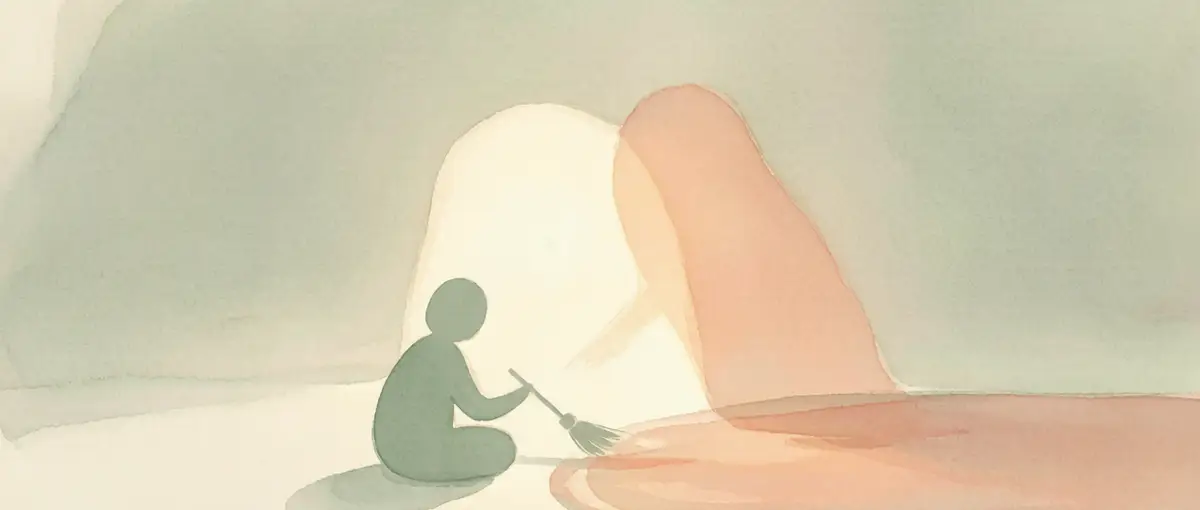
Procrastination is not laziness, and it is not a time-management problem. At its core, it is an act of emotional regulation: you use "not doing" to avoid the discomfort that a task stirs up inside you. The clearer you are about what you should be doing, the more likely it is that you are not forgetting—you are avoiding. The task is stuck not on your calendar but somewhere in your chest.
Picture the scene you know too well. It is a Tuesday afternoon, the report is due, and you have known since Monday that it needs to be written. Instead you are at the third video in a row, thumb moving on autopilot, while a low hum of guilt sits just behind your ribs. You glance at the clock and feel the knot tighten. You are not resting; you are hiding in plain sight, and both parts of you know it.
Why do I procrastinate even when I know better?
Knowing what to do does not remove the discomfort attached to doing it. Procrastination often protects you from fear, shame, uncertainty, or the risk of being evaluated; the task is delayed because it feels emotionally unsafe, not because you forgot the plan.
How can I start when I already know the advice?
Name the feeling the task brings up, then make the first action small enough to approach without a performance test. Explore the pattern gently if more productivity advice keeps adding pressure instead of helping you move.
Am I Lazy, or Is Something Else Hitting the Brakes?
We have a habit of calling procrastination "laziness" or "weak willpower," but a truly lazy person feels relief after putting something off. More often, the person who stalls feels anything but light: scrolling with one hand, carrying a vague guilt with the other, watching the minutes pile up and feeling more panic, not less.
That doubled state—both hiding and panicking—looks less like laziness and more like a protection system that misfired. Your brain quietly tagged the task in front of you as some kind of threat, so it hit the brakes for you and said, "step back from this for now." It is the same family of reaction as pulling your hand off a hot stove: it fires far faster than your reasoned thought of "should I be avoiding this?"
So the part of you that "knows what to do" is the brain that explains and reasons. The part that "keeps putting it off" is the older, safety-focused brain. These are not the same system. When you use reason to overpower instinct, you usually lose, because instinct does not listen to arguments—it only listens to one question: "am I safe right now?"
Why Does Knowing Better Make Procrastination Hurt More?
Because the sentence "I know perfectly well" is itself an extra burden. Knowing and not doing invites a layer of self-doubt: I understand all these principles, so why am I still like this? Is something wrong with me as a person?
That doubt adds a new kind of threat to the task. A loop forms: the more you feel you "should" have done it, the more you fear facing the version of yourself that "failed again," the more you want to flee, the more you delay, and the more you blame yourself afterward—which makes starting next time even harder. You are not crushed by the task itself; you are crushed layer by layer by the shame of "knowing but not doing."
This explains a common illusion: many people believe that if they just learn one more method or read a few more practical posts, they will finally start. But if the root of procrastination is emotional, then knowing more only adds another line to an already-overflowing "things I should do" list. The piece on why I know a lot but cannot live well points at the same mismatch—between knowing and being able to act sits a whole landscape of emotion.
How Does a Task Turn Into a Threat in My Head?
The task itself is rarely dangerous. Dangerous is the meaning we quietly pile onto it. For example:
- Messing it up = I am not good enough;
- Not doing it well this time = one more piece of proof that I am worthless;
- Someone seeing my progress = they will see through me to the fact that I am not actually enough.
Once a task carries the weight of "proving myself," it stops being a task and becomes a small trial. To protect you from the trial, the brain chooses not to enter the room. You will notice this most at work—when you feel you have to prove yourself at the office, the very thing you most need to move forward is the thing most likely to freeze, because the stakes are so high that the urge to avoid is strongest.
There is a subtler version too. We stall because we are afraid that starting will reveal we are not as capable as we hoped. Standing at "not yet begun," you can at least keep the imagined "maybe I could" alive; once you actually do it, the imagination gets tested by results. Avoidance, sometimes, is how we protect a pleasing possibility.
Why Do the Most Important Things Get Put Off the Longest?
Because the more important something is, the heavier the threat feels, and the bigger the protection response. Replying to a quick message never gets delayed. But writing the annual report, ending a relationship, starting to exercise, or finally beginning the book you have always wanted to write—these touch a person's core self, so the brain tenses up naturally.
It is also because important things are harder to break down. They are too big, too distant, too vague; you cannot see the end, so instinct judges "this is not safe, do not move." At that point people instinctively want to wait for the right moment to begin, as if the resistance will vanish once the mood is right, the energy is up, and the surroundings are calm. But the resistance is usually not outside—it lives in how you feel about the task.
Learning to go with the flow (shun-shi) helps here, because it loosens the grip of "I must be in the perfect state first." You start where the current actually is, not where you wish it were.
I Am Not Resting—I Am Hiding
This distinction matters, because it decides what you do next. Real rest leaves you replenished. Avoidant "delay" leaves you emptier—you think you are relaxing, but a string stays wound tight the whole time.
The test is simple: after rest you feel lighter; after avoidance you feel heavier. If you have stalled all day and lie down at night more tired than you woke, it is probably not laziness—it is an unspoken feeling that has been quietly burning. It will not fade because you "force yourself to sit a while longer." It cools only once you first see it.
Self-Blame Locks Procrastination Tighter
The saddest part is this: the weapon most people use against procrastination is exactly what makes it worse—self-blame. You call yourself "wasted another day," shame rises, the task feels more threatening, the urge to avoid grows, and so tomorrow you delay again.
A little gentleness works better. Not permissiveness, but first removing the verdict of "I am terrible," and admitting: I am stalling now because this thing makes me uncomfortable, and my brain is hiding for me. Seeing this layer shifts you from "fighting myself" to "walking with myself to make the thing smaller." The Eastern idea of letting go (fang-xia) is exactly this skill of loosening the tension first, and it does not conflict with starting with less effort.
Practicing non-doing (wu-wei) is not about collapsing into inaction; it is about not forcing the river. When you stop shoving against yourself, the smaller first step becomes visible. And simplicity (jian-yi) reminds you that a task shrinks the moment you strip away the extra meaning you glued onto it.
How Can I Make Peace With This Avoidant Hand?
Not by destroying it, but by keeping it from blocking the door. A few things you can try right now:
- Shrink the task until it is not worth fearing. Instead of "finish the report," aim for "open the document and write three lines." Small enough that instinct cannot be bothered to launch its defense—and you are already in the room.
- Allow the beginning to be ugly. Tell yourself in advance that this time it will be jerky, messy, and full of urges to flee, and that is fine. Swap "must be good to start" for "start, then get good," and the threat drops a notch.
- Name the feeling. When you stall, do not only ask "why am I stalling again"—ask "what feeling am I avoiding right now?" Speaking the discomfort aloud takes some of its power away.
- Do not use self-blame as fuel. Blame feels potent in the short run but only tightens the lock long term. Swap "why am I like this" for "where am I stuck right now," and the path opens the moment your tone changes.
The table below sets common misunderstandings against what is closer to the truth:
| What we assume | What is more likely |
|---|---|
| I am lazy, weak-willed | I am avoiding uncomfortable emotion |
| Learning more methods will let me start | The root is feeling, not a knowledge gap |
| I will move once the mood is right | The mood follows the moving |
| Scolding myself will push me | Blame locks avoidance tighter |
Loosening the Knot Around Starting
If you treat procrastination as an enemy, it grows more enemy-like. If you see it as "a self that fears pain and is asking for help," the road gets easier. You are not broken; you have simply gone too long without being met—by anyone, including yourself—with gentleness at the moment you "did not want to move."
If today you can do only one thing, do the smallest one: take that task you keep avoiding and break it down until it is almost laughable—say, "just open the laptop and click the file open." Do not ask yourself to finish; ask yourself only to walk through the door. Once you are through it, the heaviest threshold is already crossed. The rest can come as you go.
Written and reviewed by DustEcho Editorial for self-reflection and cultural inquiry—not counseling, medical advice, or a clinical diagnosis.
Not sure where to begin?