Jianyi: Even the Messiest Tangle Has One Thread to Pull
DustEcho Editorial
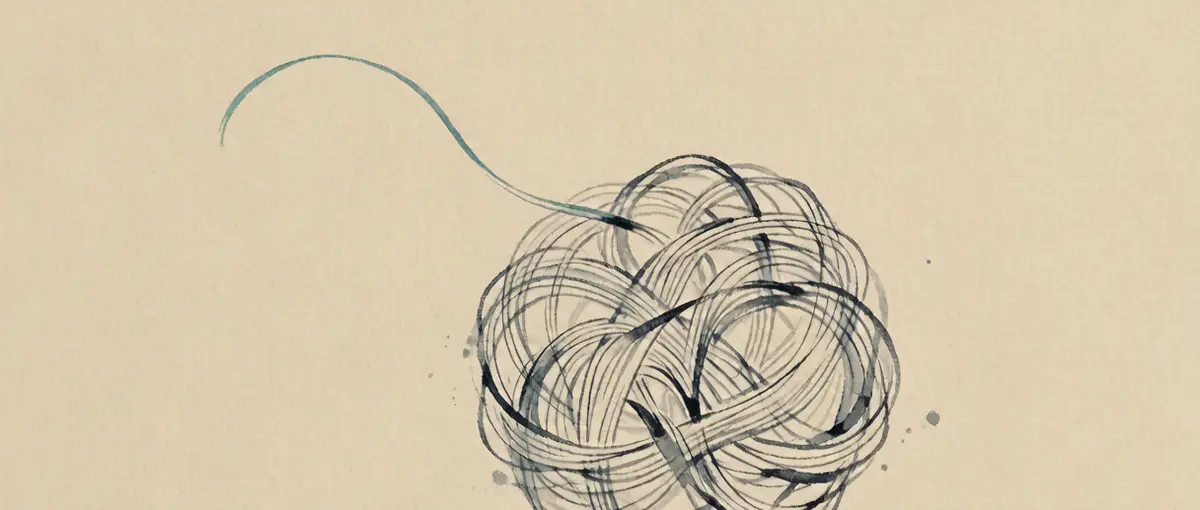
In the I Ching, the single character 易 (yi, "change") has long been said to carry three meanings. The tradition names them 变易 (the ever-present changing), 简易 (the simple and plain), and 不易 (what does not move beneath it). The second of these, jianyi, is the one this piece stays with. The ancients taught that "易簡而天下之理得" — through the simple and the plain, the principle of all under heaven is grasped. The idea is that even the vastest, most tangled shifts of the world rest on a thread of reason that can be reduced to something a person can hold in one hand. Most of what feels complicated, the tradition suggests, is not heaven's design but something we wind around ourselves. And the plain, the simple, is the thing the I Ching means for us to feel out — not so that we shrink the world or take it lightly, but so that inside the mess we can recognize the central axis, after which the branches and leaves are no longer things that can tie us down.
I have a friend whose desk is always buried under unanswered messages, unread documents, and small errands that never made it onto any schedule; in one corner of her screen a dozen red notification dots drift like buoys. She is not lazy. Every single item feels "important" to her, so she stacks them all in front of herself, and the more she stacks the more panicked she becomes, until the one thing that mattered most is buried underneath, and she sits in the pile unable to move a single finger for half an hour. Later she started asking herself just one question: if I don't touch this today, what happens? Most of the time the answer was "nothing." That is the cut jianyi describes — a single move from "everything is important" to "what is important right now," and the thread in the tangle shows itself, and her hand is free to pull it.
Wanting to hold everything, you end up gripping nothing
A person slips easily into a kind of illusion: that multiplying tasks and thickening complication is the same as taking life seriously. So the list grows longer, the plan grows denser, even rest gets a "high-efficiency method" and even daydreaming gets a timer. But a hand is only so big. To clutch ten things and to clutch three — the tightness you can manage is utterly different, and among ten things the ones you truly hold may be none at all. The opposite of jianyi is not carelessness; it is greed — unwilling to let anything go, so every matter gets only the edge of your attention, like pressing down several jumping frogs at once, and in the end keeping not one. Laozi said "少則得,多則惑" — have less and you gain, have more and you are confused. The same layer of truth: take a little less, and you can actually hold it; the hand left empty is the one that can catch what truly matters. The confusion of "more" is not a sign that life is hard; it is a sign that the hand has spread itself so thin that nothing has weight anymore.
When things are a mess, find the point that barely moves
What jianyi points to does not delete the problem. The thing that hardly moves is found first, inside the mess. A ball of tangled thread only knots tighter if you yank; but find where the end is and pull along it, and the whole ball loosens. The "thread-end" in life is often the plainest question: what is this thing actually asking me to do? For whom? What is the one thing I most fear right now? The answer is usually clear in a sentence. The rest of the complication grew from it like branches and should not be allowed to take the host's seat, still less to cover the trunk. Many people panic not because the matter is truly so large, but because they mistook the branches for the trunk, hugging a pile of fragments and spinning in place, forgetting the direction they first meant to go. The still point was there the whole time; the noise simply made it hard to see.
Translate the complex into steps you can actually walk
Many are frightened by a "big goal" not out of laziness but because it is too large to grab — one glance and it stands like a solid wall, and a person naturally retreats. The wisdom jianyi names is to translate the distant mountain into the step under your foot. Want to change careers? You need not first wonder "what if I fail"; first wonder whether you can have one conversation with someone this week. Want to write something good? You need not first aim at "a masterpiece"; first sit down and write five hundred words today. Want to take care of your body? You need not first imagine "a complete overhaul"; first go to sleep half an hour earlier tonight. Run a complex matter through this kind of breaking-down and it stops being a wall and becomes a flight of low steps; the steps are low, so a person is willing to take them, and taking them, the wall gets climbed over. Simplicity, here, is leaving an entrance for action — a door small enough that you stop being afraid to open it.
Simple is not "skimp" — it is telling the main from the side
Jianyi is often mistaken for "save wherever you can," and then even the things that deserve care get done carelessly. In truth it is not skimping but telling which matter is worth the effort and which can be let pass. The seriousness jianyi calls for goes deeper exactly where it is needed — gather the strength scattered across ten tasks back onto one, and that one is done thoroughly, done properly. What gets saved is the branchwork; what stays is the trunk, and the work on the trunk cannot be saved at all. It is like painting: the blank space is simplicity, but the one stroke that must be there carries a thousand catties and cannot be saved along with the rest. The difficulty of jianyi lies exactly here: knowing what to keep and what to give up, giving up cleanly and keeping solidly. Confusing "simple" with "careless" is the easiest mistake to make, and the one that makes people distrust the whole idea.
Simplicity is a strength you have to practice
It sounds contradictory — jianyi looks light, yet doing it takes strength. "Adding" follows a person's greed and anxiety; you add without thinking, a group, a task, a thought, effortless. "Subtracting" asks you to put down by your own hand something that looked useful, and that motion is often harder than picking up, like emptying a full embrace, each thing taken out a small ache. So what jianyi describes is not a gift but a strength to practice — a daily willingness, inside the clutter, to recognize which thing you could in fact not do, which sentence you could in fact not answer, which road you could in fact walk around, which gathering you could in fact decline. Practice it long and a person grows clear, not because the world turned simple but because you stopped adding chaos for it, and the eye learns to skip the noise that does not matter. The clarity is not handed over; it is trained, the way a muscle is.
Simplify one step and the world shrinks a ring smaller
Many wait until "everything is sorted" before they will move, yet sorting is the result of having simplified, not its premise. Simplify one step first — put down one unnecessary thing, answer one unnecessary message, close one group that only shouts — and the world shrinks a ring smaller, and the ball that pressed the breath out of you shows an opening. Jianyi is an action, not a state; you do that subtraction first and the fog agrees to lift, not the other way around. How many people are stuck at "when I'm ready," when the feeling of being ready comes by subtracting, not by waiting. A person keeps imagining a quiet node where, arrived, there is no more untangling; but life holds no such node, and mess is the normal state. Jianyi is not straightening the world once and for all, but being willing each day to do those few subtractions, like sweeping the floor daily — not expecting the floor never to gather dust, only asking that under the feet there is always a clean patch to stand on. The one who knows how to simplify does not live more lightly but knows to spend strength where it is worth spending, and lets the rest go, not taking every single matter onto their own shoulders.
In the end, the sight jianyi names is a pair of eyes that can pass through the fog. Thick as the fog is, the mountain's shape remains; tangled as the matters are, the central axis remains. You need not straighten every thread — only hold the one, and the rest becomes background. The ancients pulled this layer of meaning out of 易 precisely for fear that a person would be dizzyed by their own cleverness. The great way is simplest; simplest to the point that, if you are willing to trust it, it is enough — enough to turn a tangle of mess into one clear thread in your hand.
What does Jianyi mean in the I Ching?
Jianyi means simplicity: finding the central thread in a complicated situation and making it walkable. It is not careless reduction; it is knowing what matters now and what can wait.
How can I simplify an overwhelming decision?
Write down the outcome that matters most, the next reversible step, and one thing you can deliberately leave out. A smaller decision is easier to test, revise, and actually complete.
Want to understand why everything feels equally urgent?
If every branch keeps demanding attention, gentle self-exploration can help you return to the trunk without dismissing what is genuinely important.
Keep reading: Letting Go: The Relief of an Open Hand · Qijia: The Slow Practice of Turning 'Me' Into 'We' · Shang Shan Ruo Shui: It Flows Downhill, and Carries Everything
Written and reviewed by DustEcho Editorial for self-reflection and cultural inquiry—not counseling, medical advice, or a clinical diagnosis.
Not sure where to begin?