Bianyi: What You Thought Was Nailed Down Has Been Moving All Along
DustEcho Editorial
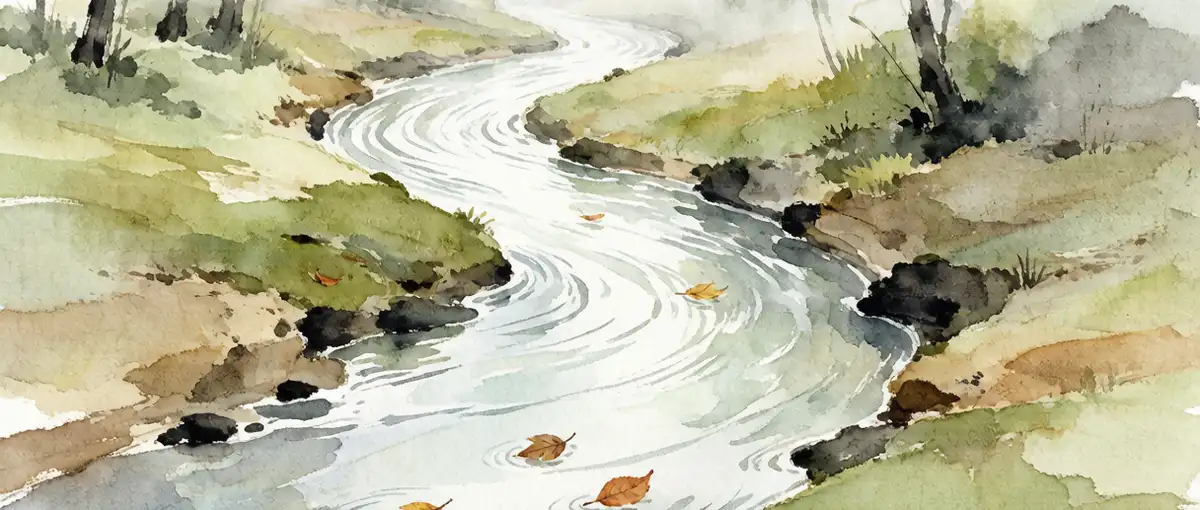
In the I Ching, the single character yi (易) has long been said to carry three layers of meaning, and the first of them is bianyi (变易) — change, or mutability. Its claim is simple and stubborn at once: between heaven and earth, nothing stops. All things, without cease, are flowing, arising, perishing, and taking on new shapes. This is not the private opinion of one school or another; it is the very ground the whole book stands on. From beginning to end, what it speaks of is change itself. Later readers repeat the line "shengsheng zhi wei yi" — that which keeps generating is called yi — and the "generating" there is bound precisely to this never-resting movement, the honest pressure of old forms stepping back so new ones can step forward.
I grew up on a lane lined with old brick walls, and at their foot there was always a spread of moss that on rainy days shone slick and bright. Years later I went back. The walls were still standing, but the courtyard behind them had changed hands several times over; the moss had withered and greened again; even the crooked tree at the lane's mouth had been dug up, and in its place stood a neat row of shrubs. We are quick to mistake "still here" for "unchanged." That is exactly what bianyi points to: the things you thought were nailed down have been moving all along, only slower than you care to admit — slow as the shadow on a wall, which can drift a foot before you look up, and when you do, the scene is no longer the scene.
To name this is not to read anyone's fortune. Bianyi offers no chart of what will befall you, no fixed verdict on a coming year. It is closer to a pair of spectacles: put them on, and the quiet motion that was always there comes into focus. The point is not to predict but to notice, so that the living fact of change stops surprising you into fear and starts reading, instead, as the ordinary weather of being alive.
The road you thought would never change
Most of us carry, somewhere inside, a road we believe will not change. A job held for five years: new at first, then familiar, then so known that you could trace every crease of it with your eyes closed. You call it stable, a ballast stone that holds the weight of your days, until even payday becomes a date you no longer bother to think about. Yet the company restructures, the industry turns, and your own appetite shifts in secret — the overtime you once tolerated now makes your stomach clench at the thought; the dullness you once wore as a badge has become, in other eyes, slowness; what you once said "this is what I want" about turned, one unmarked day, into "I'll make do for now." Bianyi gives no warning. It simply, while you are not looking, swaps the ground beneath your feet for a different soil, and by the time you notice, you are standing on another earth entirely.
Relationships too — only slower than you notice
Change in relationships moves even slower, slow as the pendulum on a wall that looks stopped if you don't watch it. Two people who have been together a long time drift from late-night talks to each scrolling a phone — not because one day they suddenly went cold, but because hundreds of ordinary evenings slid by; a single "forget it" takes the place of ten grievances left unsaid — not the outcome of one fight, but the stack of countless swallowed words; the New Year once longed for becomes a polite sitting-down. Here bianyi is no betrayal. It is a kind of honesty: each person's circumstances are in motion, and to expect the other to freeze at some year's version of themselves was never quite fair. See this clearly, and the complaint of "how did you change" thins out, replaced by a quieter pity — "so we have both come this far" — and when the grievance loosens, the two can draw near again.
Even "I" is not set in stone
The hardest part is admitting that you yourself are changing. The steadiness you disliked at twenty, you begin to crave at thirty; what once had to be a certain way, you wake one morning to find you no longer care; the homely bustle you once found vulgar becomes, late at night, the very thing you want closest; the bondage you most feared then becomes, later, the solitude you most fear. We are used to saying "this is just how I am," yet that "how I am" is itself altering, altering without announcement, so quietly that even you may not own up to it. Bianyi brings the self down from its pedestal: you are not a fixed piece of jade but a river — the you of this moment and the you of ten years on are not the same handful of water, and yet both are, without question, you. Admit this, and you need not panic at "why am I not as I was." The relief is practical, not poetic: when the self is allowed to be a river, a shift in taste or a new fear is no longer a betrayal of who you were, only the next stretch of the same water.
Fight change, and it only carries you
Facing change, the first reflex is usually to clutch. Afraid of losing the job, you cling to one post; afraid of the bond breaking, you grip it tight; afraid of the strange, you shrink back into the familiar, unwilling even to change the playlist. But the tighter you clutch, the more you feel the sand leaking through your fingers; the more it leaks, the more you panic; the more you panic, the tighter you clutch — a knot winding tighter and tighter. The motion of bianyi runs contrary to grasping: treat it as an enemy and it becomes a wave that shoves you, choking you until you cannot stand; loosen a little, and it becomes a force you can borrow, like rowing with the current instead of against it, far easier. Much anxiety does not come from change itself but from the strain of "it must not change" — the force spent in the wrong place traps you, and you mistake it for the world being unkind.
Make change ordinary, and you needn't be startled each time
We have a habit of treating change as a surprise. A raise is owed; a transfer is "how could this happen." A warming relation is only right; a cooling one is "why me." But bianyi says the changing is the norm and the unchanging is what should surprise us. Get this through your head and you lose a good deal of the "never saw it coming" shock — not by growing cold, but by leaving a seat for change in advance, so that when it arrives it does not overturn everything. Like knowing winter will come and laying in clothes by autumn: not that you fear no cold, but that you fluster less. To make change ordinary is not resignation; it frees your energy to catch the changes that truly matter and deserve your care, instead of being frightened by every ripple and wasting your footing. Many people are tired not from changing but from being struck on the head each time; invite "change" into the everyday early, and the blow grows light, and you grow loose.
Let it flow, and you stand firmer
To "accept change" is easily heard as a discouraged word, as if all you could do was resign and drift. The reverse is truer: precisely because you know everything will leave, you need not press your whole weight onto any one spot; you dare to set things down when needed, and you are willing to be present while you have them. Water never tries to nail itself in place, and so it always moves ahead; let what is in your hands flow, and your shoulders lighten. What bianyi gives is not the panic of impermanence but a loose, settled steadiness — meet what comes, hold it; when it leaves, do not hard-keep it; be serious in the gathering, dignified in the parting; treat no scene as permanent, and no ending will break you. That old line, "that which keeps generating is called yi," was speaking of this refusal to stop, this need not to stop — it is change that keeps everything still possible, and keeps the "you now" always able to grow into something else. Many want to seize "forever," yet yi says the opposite — only because there is no forever is there unceasing life. Let the old go, and the new can arrive; own your changing, and you are not trapped in the self of any one year. This loosening is not giving up; it is leaving the road open for the self that walks on, is loosening your clenched fingers one by one, so as to catch the next wind that comes.
What does Bianyi mean in the I Ching?
Bianyi means change or mutability: conditions, relationships, and identities keep moving even when we mistake them for fixed. It is a way to notice change, not a method for predicting your future.
How can I accept change without feeling powerless?
Separate what is moving from what you can choose today. Keep one value or boundary, release the demand that every detail stay the same, and make the next adjustment while you still have room to choose.
Want to understand why change feels like a threat to who you are?
If you keep trying to nail one version of life in place, gentle self-exploration can help you move with change without losing your center.
Keep reading: Compassion: The Warmth You Hand a Struggling Friend, and Withhold From the Person in the Mirror · Letting Go: The Relief of an Open Hand · Qijia: The Slow Practice of Turning 'Me' Into 'We'
Written and reviewed by DustEcho Editorial for self-reflection and cultural inquiry—not counseling, medical advice, or a clinical diagnosis.
Not sure where to begin?