Why do I keep one foot out the door in relationships?
DustEcho Editorial
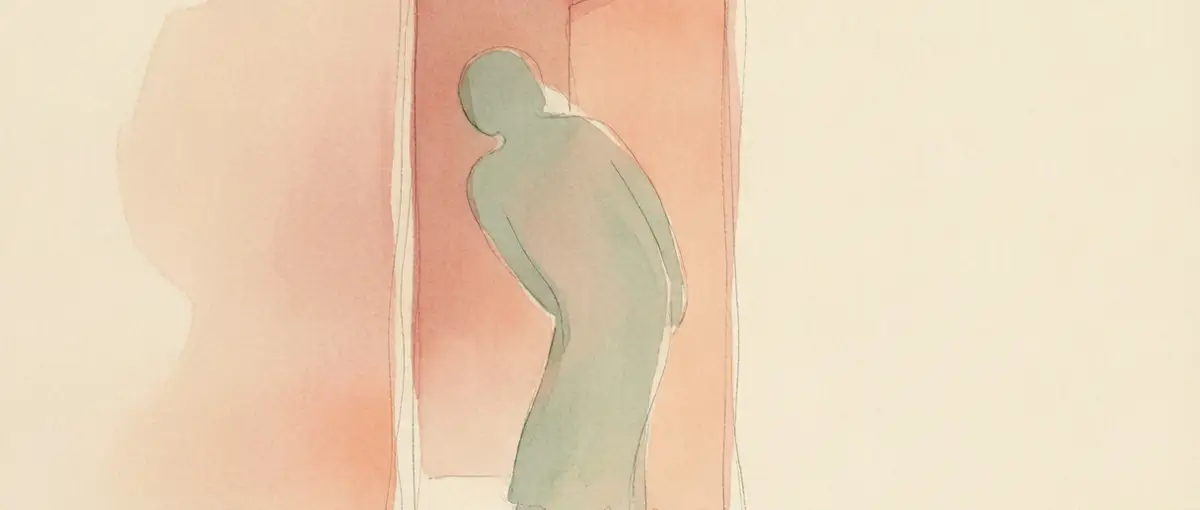
You're in a relationship that's actually pretty good, the other person is kind to you, yet in a corner of your mind you keep an exit plan. Not that you want to break up — you just can't help scheming: if it ever falls apart, where would I live, how do we split the money, how would the days go. As if you can't feel at ease unless the exit is figured out first.
It's a bit like someone who's stepped into the room but keeps a hand on the doorknob. Body's inside; feet ready to step out any second.
This often isn't because things are bad now, but because you fear that "settling in completely" would make you vulnerable. You've seen relationships vanish without warning; you've been left; or since childhood you could never take "he'll always be here" as real. So you learned one thing: don't trust it all, don't give it all, leave the door a crack — so that when you do have to leave, you won't crash too hard.
But that crack has a cost. You're present, yet your heart hangs loose, and the other person feels it. They take a step closer, you step back half. They want to settle, you start hunting for flaws. Not that you don't want it good — you're afraid to let the relationship actually land. Landing means admitting you care, and anyone who's cared knows caring itself is the risk.
So you want intimacy and push it away a little, at the same time. The most twisted part is that you blame the relationship for being unstable, yet half that instability is the wind blowing in through the crack you left yourself.
Try letting go of the knob. Not forcing yourself to hand over everything at once, but allowing yourself this one small step: take your hand off the knob. This moment, I won't scheme the exit; I'll just stay here well. When you truly need the exit, you can think about it then; it won't be too late. Only when you stop bracing to leave do you find that staying at ease is, surprisingly, not that dangerous.
If the other person really cares, they can hold the sight of you slowly lowering the knob. And you, too, will little by little believe that some doors can be closed.
Someone will say, isn't keeping a wary eye the smarter move? Being clear-eyed and being perpetually ready to flee are two different things. Clarity is seeing the other person and yourself, ready to take it on. Perpetual flight is seeing everyone as someone who'll leave, so you extract yourself first. One brings you closer; the other keeps you alone.
Try an experiment: next time you're having a decent time with them, don't rush to list the risks in your head. For that one slice of time, take your hand off the knob and see if the sky falls. Do it a few times and you'll notice the knob went cold long ago — it was you who kept gripping it.
When you actually close the door once, you'll find the room didn't collapse and the outside didn't vanish. You simply, at last, stood firm in one place. And that urge to flee that once lived in you will quiet down as you choose to stay, again and again. It wasn't beaten — you just stopped feeding it. The hardest part of a relationship isn't getting close; it's daring to stay close and still not move. What you're practicing isn't locking the door, but leaving it open and trusting you won't be blown away by a gust. Once that step is taken, the intimacy after it finally lands. You don't have to do it all at once. Let go for a second today, a minute tomorrow — enough. The knob's been cold so long; warming it takes time too. Give yourself that patience, and the relationship can keep up.
The door needn't stay open forever, nor always ajar. You have the right to decide when to open it and how wide. Just don't decide it's dangerous to be open before you've even tried. Try once; the answer is on you.
How can I stay present in a relationship without losing my boundaries?
Staying does not mean surrendering your judgment. Notice concrete behavior, keep your own routines and support, and choose one moment to remain present instead of rehearsing an exit. If there are real signs of coercion, disrespect, or harm, leaving may be the safer choice.
Want to understand why closeness makes you keep an escape route ready?
If commitment feels like a door that must stay open for emergencies, gentle self-exploration can help you distinguish caution from the fear of being settled.
Keep reading: Why do I get anxious when the relationship is stable? · Why do I get prickly when someone gets close · Why do I feel something's off when I'm treated well
Written and reviewed by DustEcho Editorial for self-reflection and cultural inquiry—not counseling, medical advice, or a clinical diagnosis.
Not sure where to begin?