Is it normal to feel anxious about money?
DustEcho Editorial
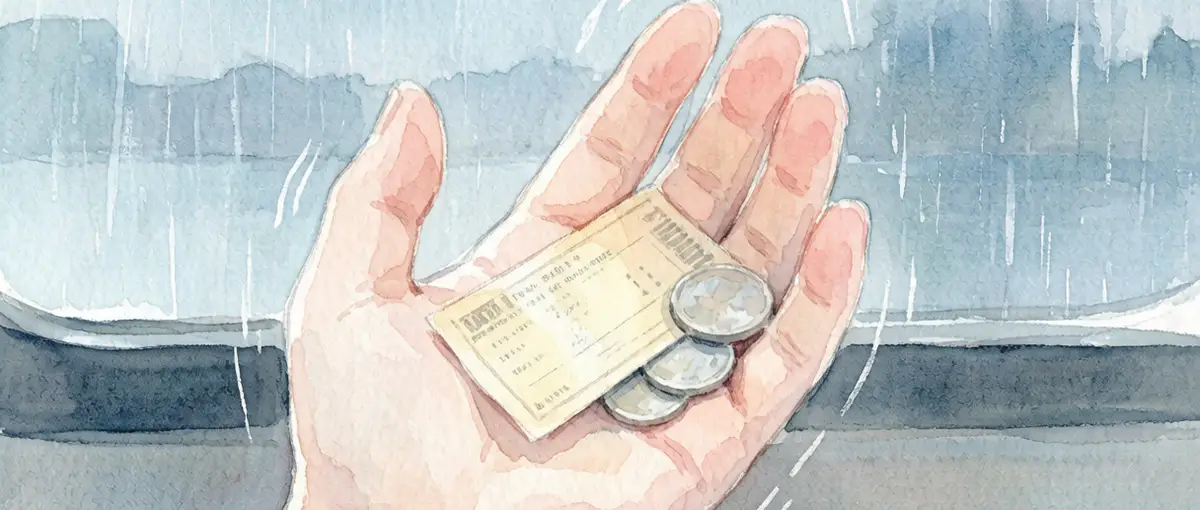
Straight to the answer: yes, feeling anxious about money is completely normal. You are not "overthinking it," and you are not carrying this tightness alone. No matter your income level, money touches a person's deepest sense of safety, and safety is exactly where anxiety tends to slip in. So when you suddenly start calculating next month's bills at 2 a.m., feel a flicker of panic after tapping a shopping link, or get a knot in your stomach at the word "layoff" — none of these reactions means you are weak. They are the human instinct for facing uncertainty.
Because it is so normal, we actually owe it to ourselves to spell it out: what normal money anxiety looks like, where it comes from, when it deserves a closer look, and whether we can live alongside this tension instead of forcing ourselves to "stop worrying about nothing" every single time.
Why does the body tense up before the mind even thinks about money?
Interestingly, money anxiety is often not "thought" into being but "felt" into being. Many people describe it like this: a tightness in the chest, shoulders creeping up toward the ears, a small flutter in the stomach — and only then does the thought arrive, "Do I not have enough?" That order tells us something. The body picks up the threat signal before reason does.
This makes sense from an evolutionary view. For a very long time, having no resources meant not surviving, so the brain welded "money" to "survival" tightly together. Even today, when you are fed and housed, that ancient alarm system is still running. It cannot tell the difference between "I went over budget by five hundred this month" and "there is no food stored for winter." Any number ticking downward sets off the bell.
This is also why simply "doing the math" sometimes makes people more panicked rather than less — the more you check the balance, the louder the alarm rings. Rational review helps, but only after the physical layer of tension has come down a little. Admitting "my body is anxious right now" is itself a way to slowly turn the alarm's volume down.
The good news is that the alarm is not a verdict. It is a worn-out guard who mistakes every small dip for an invasion. You can learn to thank it for caring, then gently tell it the numbers are not what they used to be.
If I earn enough, why can't I stop worrying?
This is the most common puzzle people bring: the bills are payable, there is savings, yet the moment things quiet down, the "what if something goes wrong" worry surfaces. If you recognize this, please don't scold yourself for being dramatic.
One common source is the memory of early scarcity. Some people grew up in households that struggled with money. What that period left behind was not just memory but a background tint of "good times don't last." Later, income rises, but the tint stays. It is not today's fact, yet it keeps secretly filtering today's events.
Another source is sensitivity to losing control. Money represents how much we can catch ourselves when we fall, and so much of life is genuinely outside our control — a parent's illness, an industry shift, one accident. Projecting anxiety onto "money" sometimes happens because money at least looks like a domain where "I can do something." In other words, worrying about money may really be worrying about the things that make us feel truly powerless.
There is also a group of people who quietly believe they "don't actually deserve this life," so they earn while waiting to have it taken back. This mindset resembles what we explore in why do I always feel like I don't have enough money — the root is not in the account balance but in the sense of self-worth. When you quietly convert "do I deserve to be treated well" into a savings number, no amount of money will ever fill that hole.
Does feeling guilty when I spend mean I'm just stingy?
No. Most of the time, "spending" is connected in the body to an old story. Some were told again and again as children "save your money," so consuming got tied to "making a mistake" or "being immature." Others once suffered for careless spending, and now every payment feels like replaying that lesson. The panic is not because the thing is unworthy, but because the act of paying triggers guilt.
If you find it hard to spend on yourself — even纠结 over a necessity and regretting it the instant you buy — you might read why don't I allow myself to spend on myself. That piece is about the deeper question of "do I deserve to be good to myself." Sitting next to it is often the script of "I must be useful first, care for others first" — once you put yourself last, spending feels like stealing a share that belongs to someone else.
The key distinction: stinginess is actively refusing to give; anxiety is passively fearing to take. The first says "why should I," the second says "I don't deserve." If you are in the second group, your tension is not accusing you of being cheap — it is guarding the door carefully for the self that hasn't been allowed to relax in a long time.
How do I tell "normal anxiety" from a red light?
For most people, money anxiety lands in the left column of the table below — it is background noise in life, not the thing running your life. You can use it for a quick self-check:
| Signal | Leans "normal anxiety" | Leans "worth a closer look" |
|---|---|---|
| Frequency | Occasional, mostly in stressful periods | Nearly daily, and it won't lift |
| Behavior | Worries, but still spends, saves, plans | Long-term avoidance of bills, afraid to open the banking app |
| Body | Brief tension, settles afterward | Ongoing insomnia, palpitations, low mood |
| Relationships | Occasionally unwilling to discuss money | Fully avoids talking about money, leading to fights or hiding |
| Thoughts | "I should watch my spending" | "I won't make it" / "something bad is bound to happen" |
The "worth a closer look" column is not there to scare you. It is a reminder: when anxiety starts making decisions for you, cuts you off from people, or drags your body down, it has stopped being ordinary unease and become a signal that deserves real attention. Reaching for professional support then is as normal as hiring a coach for your muscles — no need to shoulder it alone.
Since it's normal, can I live peacefully with it?
Yes, and that is often a more realistic goal than "never anxious again." Caring not at all about money would actually be a little unhealthy in an uncertain world — a bit of tension helps us save, do our homework, and keep a backup plan. The problem was never "having anxiety," but "anxiety grabbing the only microphone."
A few small practices to move anxiety back to the audience:
- Schedule the worry. Set aside ten minutes a day just for "math plus spiraling thoughts," then close the notebook. Box the boundless worry into a bounded slot.
- Separate fact from imagination in writing. On the left, write "what actually happened" (balance, bills, income). On the right, write "what I imagined" (it's over, I'll be abandoned). Side by side, the alarm often drops half a notch on its own.
- Use small certainties to counter big uncertainties. Even an automatic transfer of a tiny savings amount, or paying off one credit card, sends the body a "I've got this" signal — far more useful than blank worrying.
- Don't carry it alone. Money anxiety fears silence most; the less you talk, the more it grows into a monster. Once with someone you trust, or a professional, lay the accounts open, the fear usually shrinks.
One last thought: wanting to shake off this tightness fast is human instinct, which is why you'll understand why we always want to get rich quick — behind it is often not greed, but wanting to buy the anxiety off in one lump sum with a pile of money. Sadly, safety can rarely be bought in one payment; it is built day by day, stacked slowly by your repeated proofs of "I can still cope."
So, is it normal to feel anxious about money? Yes. It means you care whether you can keep living well, and that you are willing to catch the people who matter. Seeing this tension not as an enemy but as an overzealous guard, you'll trade a little self-attack for a little calm — and that, by itself, is enough to let the tightness loosen, slowly, a bit.
Is it normal to feel anxious about money?
Yes, money anxiety is common because money is closely tied to safety and uncertainty. It does not automatically mean you are financially irresponsible or that something terrible will happen. Separate current facts from imagined outcomes, take one manageable step, and seek qualified financial or mental-health support when the anxiety is persistent or overwhelming.
Want to understand what your money anxiety is protecting?
Use self-exploration to notice the difference between a useful planning signal and an alarm that has taken over the whole conversation. This is emotional reflection, not financial advice.
Written and reviewed by DustEcho Editorial for self-reflection and cultural inquiry—not counseling, medical advice, or a clinical diagnosis.
Not sure where to begin?