Why Do I Always Feel Like I Never Have Enough Money
DustEcho Editorial
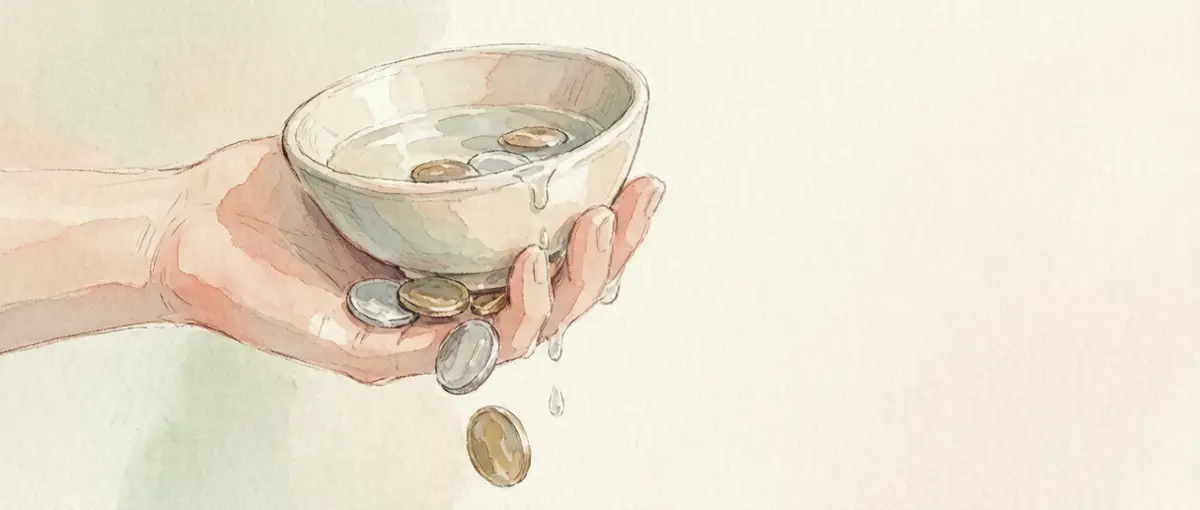
There's a balance in your account, and next month's salary is coming too, yet you stare at the numbers with a knot in your chest — "Is this enough? What if?" When a friend mentions a trip, your first reaction is to calculate the cost; when you see something you want, you first think "is this really necessary." You're not actually poor; it's a baseline hum of "never enough," like a radio that keeps playing in the background.
This not-enough feeling rarely matches your bank balance.
What does "never enough" look like?
It's more than just saving. You don't spend where you should, and pinch pennies ferociously where you shouldn't, yet you still panic after saving. The bill is barely paid and you immediately wonder "what about next month"; a bonus arrives and you stash it away, skipping even the celebration. Money in your hands is like holding water — it looks full, but you're sure it's leaking.
The most typical version is "number anxiety": you check the account every few days, feel reassured for two hours after one glance, then start worrying again. The money didn't shrink; the panic didn't stop.
Where does this feeling come from?
For many people, the standard for "enough" is a moving horizon. The family was tight when you were little, and adults said "we have no money"; that insecurity grew into your body, and even after you started earning, your body still remembers being poor. So "enough" isn't a number — it's a state of "not yet out of danger," one you can never reach.
Then there's consumerism fanning the flames: you keep seeing others live better, buy more expensively, relax more easily. Once comparison starts, "enough" gets pushed further away. You're not lacking; you feel you "should have more to be safe."
Some people also can't tell "want" from "need." Wants get compressed into needs, and needs get inflated into anxiety, until everything feels like a necessity and everything feels insufficient.
How does it affect us?
Quality of life gets quietly pressed down. It's not that you can't afford it — you don't dare enjoy it. A good meal, a trip, something you like, all crossed off because "what if I need it later." Life becomes mere accumulation, and you forget why you're accumulating.
Relationships suffer too. Couples fight about money, and often it's not a real shortage — one fears not having enough, the other thinks it's enough yet you're still tight. Two money philosophies collide, and the grievance is bigger than the gap.
The biggest pity: it makes you miss "now." You keep waiting for later, for "enough" to relax — but "enough" keeps retreating, and the present slips away.
What can you try?
Give "enough" a concrete anchor. For example, calculate your real monthly spending and multiply by three to six months — that's your safety cushion. Once you reach it, let yourself breathe, turning "enough" from a floating target into a number.
Also practice telling "need" from "want." Wanting isn't a crime; occasionally satisfying a want is part of living, not a betrayal of the future.
How do I stop feeling like I never have enough money?
Replace the moving feeling of "enough" with a number you can review: calculate your essential monthly costs, choose a realistic emergency cushion, and decide when it is sufficient for this season. Then give yourself permission to treat the remaining uncertainty as uncertainty, not as proof that you are unsafe.
Why do I feel poor even when I have money saved?
Savings can answer a practical question without calming an emotional one. If your safety line keeps moving, each new balance provides only brief relief before the fear asks for more. A written plan, a limit on checking, and a separate allowance for living now can help the number stop carrying your whole sense of security.
Want to understand your scarcity alarm?
If "not enough" follows you even when the facts are stable, gentle self-exploration can help you tell financial planning from fear that has learned to speak in numbers.
A small reminder
If you're checking the account again and starting to calculate "not enough" in your head, pause and ask: is this panic your real situation today, or is old insecurity replaying itself through today's scene? Often the answer is the latter. Separate "not enough" from "what I truly need right now," and you'll find you're standing on firmer ground than you imagined. Money is a tool, not an opponent; it shouldn't be sparring with you around the clock.
In the end
The point of money is to let you live more freely, not to make you guard it more tightly. That "never enough" panic is, more often than not, not reality — it's old insecurity speaking through today's account.
You can save steadily and spend at ease. Whether it's enough shouldn't be decided by anxiety, but by what you genuinely need to live.
Keep reading: Why Do I Feel Guilty When I Spend Money? · Why Do I Compare My Finances to Others? · Why Do I Keep Checking My Bank Balance?
Written and reviewed by DustEcho Editorial for self-reflection and cultural inquiry—not counseling, medical advice, or a clinical diagnosis.
Not sure where to begin?