Signs You're Using Money to Cope With Emotions?
DustEcho Editorial
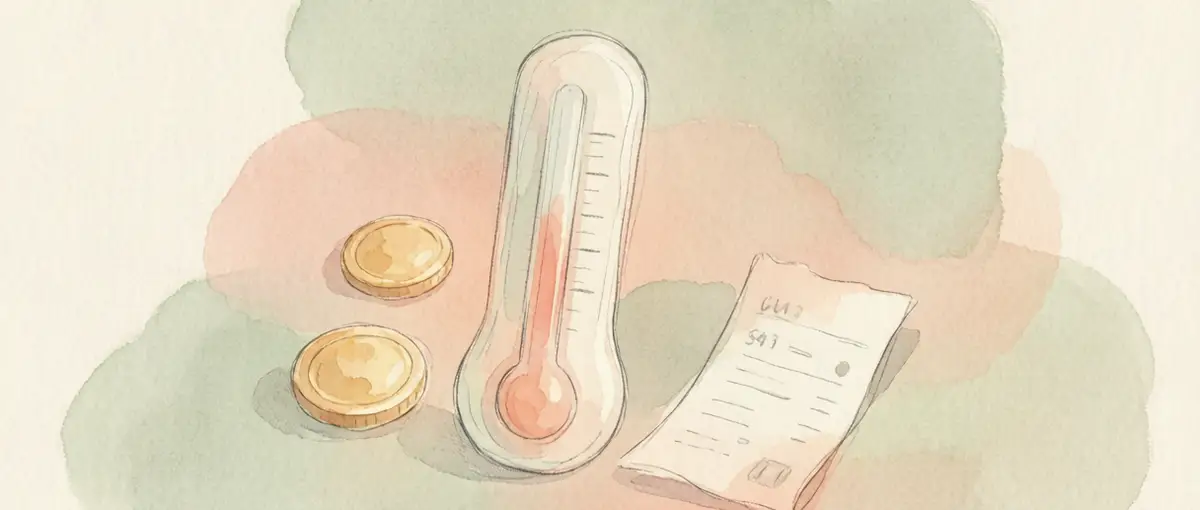
The quickest way to know whether you're using money to cope with emotions isn't to study your bank statement — it's to replay the moment you pressed "buy." You're spending to soothe feelings when the relief of paying matters more than the thing you bought, when the checkout feels like finally being able to breathe, and when that calm fades within days and pulls you back for another purchase. This doesn't mean you're bad with money or weak-willed; it means your spending has quietly taken over the job of holding emotions you haven't had room to feel.
Which of Your Purchases Are Actually Soothing Emotions?
Let's lay out the easiest signals to recognize. The table below isn't here to diagnose you; it's to help you name the moments that felt "off" without knowing why.
| What it looks like on the surface | The feeling likely running underneath | A cheaper way to meet it |
|---|---|---|
| You buy before deciding you need it, just to "feel better" | anxiety, emptiness | pause thirty seconds and name the feeling |
| Nothing is missing, yet you shop the moment you're happy or sad | emotions needing an outlet | let the feeling sit; don't cover it up |
| You regret it the second you pay, almost dislike yourself | self-blame, shame | don't return it and attack yourself; write it down |
| Late at night, alone, exhausted — that's when you buy most | loneliness, fatigue | a bath, a walk, one text to a friend |
| Someone else has it, suddenly you want it | comparison, not-enough | ask: is this my need or someone else's life? |
| The same category repeats — a fifth lipstick, a third black coat | compensation, hoarded safety | use what you already own first |
| You spend as a "reward" to cancel out a hard day | self-demand set too high | rest and doing nothing count as rewards too |
| You hide purchases from your partner or family | shame, avoidance | start with the smallest, most honest confession |
| The balance is tight but your hand won't stop | loss of control, numbness | freeze the payment channel so impulse loses its exit |
The point of this table isn't "how many did you match." Every row shares one pattern: what gets satisfied at checkout is rarely the object itself, but the feeling that wasn't caught in that moment. When you feel like you never have enough money, what fills the hole is rarely the next purchase — it's first admitting that what's empty right now is something other than your wallet.
Your Receipts Know You Better Than You Do
I've come to think of spending as an emotional thermometer. When you take your temperature, the number doesn't explain why you have a fever; it simply reports the heat honestly. Spending works the same way — the amount on the receipt, the hour you ordered, the categories that keep repeating are all reporting your inner temperature, and we almost never look down at them.
The same person who shops little and thinks clearly by day can become unable to stop at eleven at night. That isn't necessarily "weaker willpower"; far more likely, the loneliness and fatigue gathered through the day have finally found an exit. And someone who won't let themselves spend on themselves may, after long suppression, swing into a rebound of concentrated spending — the thermometer didn't break suddenly, it had been quietly heating up while you refused to hold it up.
A thermometer has one more gift: it doesn't judge you. Thirty-eight degrees is thirty-eight degrees; it doesn't mean you're "too sensitive" or that you "deserve it." It only reminds you that it's time to take care. We ignore it because, next to facing a feeling, paying is too easy, too fast, too silent — silent enough to feel like nothing happened. But the receipt remembers, and so does the bank notification.
How Do You Tell "Wanting" From "Needing Comfort"?
This is the row where most of us fool ourselves most easily. An object and a comfort look almost identical: both make you feel "a little better" right now. A few questions you can carry in your pocket help separate them before you pay:
- If this were given to me for free, would I still want it? — a lot of "wanting" only wants the sense of control in the act of paying.
- Did I decide after three days of planning, or did I fall more in love every minute for five minutes? — the urge to be comforted usually arrives in a rush.
- After buying, am I looking forward to using it, or to finally being able to exhale? — the second is usually an emotion knocking.
- If I can't buy it now, do I feel "I missed a good thing" or "my feeling has nowhere to go"? — the second means what's missing is soothing, not the item.
- Am I using this purchase to cancel out that voice saying "I should try harder"? — when you constantly tell yourself "I should", shopping easily becomes a temporary payoff to a self under constant pressure.
Treat these questions like the marks on a thermometer. You won't get the answer right every time, but the moment you start asking, you've switched from "paying on autopilot" to "seeing yourself." Telling the difference is the beginning of care; you don't have to conclude "I must quit."
Why Do These Signals Get Loudest at Night?
If you watch closely, most people who spend to handle emotions show their signals in a handful of fixed scenes: late at night, alone, right after a fight, at the end of overtime, after scrolling through someone's polished life. These moments share one thing — your defenses are lowest and your feelings are least caught.
Ordering at night is rarely because you were too busy by day; it's because the day had work, people, and rhythm holding you up. At night those held-up feelings all drop, and shopping becomes the hand easiest to reach for. Likewise, when you keep people at a distance even when you're lonely, a delivery box becomes proof that "someone is thinking of me." And there's the kind who constantly compare their finances to other people's lives — comparison by comparison, you start to feel "I deserve this too," and each purchase buys a brief peace that says "I'm not worse than them."
So the night signal isn't your weakness; it's a reminder. What you may need at that moment isn't a parcel but a moment that can actually hold you. See this clearly and you no longer have to order at three in the morning while quietly hating yourself.
Your Body and Your Account Speak First
Beyond the psychological signs, your body and your account often sound the alarm earlier — we just tend to miss it:
- Your heart races before paying and your fingers move faster than your mind — your body is opening the first gate for the emotion.
- The thrill of opening the parcel lasts minutes, then comes a flat emptiness — the feeling wasn't soothed, only paused.
- Mid-month you start avoiding your balance yet still place the order — the account is telling you this purchase now costs more than "wanting."
- The same category piles up while usage keeps dropping — what you're hoarding isn't objects but safety.
- Every big spree is followed by a low, not by satisfaction — the thermometer is saying the medicine missed the illness.
This bodily and numerical feedback is more honest than any lecture. It isn't here to accuse you; it's here to hand you the thermometer. The more willing you are to read it, the less you'll fool yourself.
What can I do before an emotional purchase?
Pause long enough to name the feeling and the practical need separately: “I feel lonely,” “I feel restless,” or “I need rest,” rather than assuming the next item must solve it. If spending is causing debt, secrecy, or significant distress, consider getting support from a qualified financial or mental-health professional.
Want to understand what your spending is trying to soothe?
If the receipt keeps carrying feelings that are hard to name, gentle self-exploration can help you find a pause between discomfort and checkout.
Pick Up the Thermometer Before You Reach for the Medicine
This piece isn't asking you to quit every "emotional purchase" tomorrow — that demand would itself be too harsh on you. The point of recognizing signals was never to correct them at once, but to lift that thermometer into view: oh, my thirty-eight degrees today is from loneliness, not from missing a lipstick; oh, my late-night order was reaching for the feeling of being held, not actually needing that thing.
The moment you can name "I'm using money to soothe an emotion right now," you've already separated the person from the behavior: you are someone who hurts and wants comfort, and spending is only the thermometer you borrowed for now. Next time a receipt prints, try not looking at the amount first — look at your own temperature today. Simply recognizing the signal is already taking care of yourself.
Written and reviewed by DustEcho Editorial for self-reflection and cultural inquiry—not counseling, medical advice, or a clinical diagnosis.
Not sure where to begin?