Bamboo: Joint by Joint, It Grows Itself Taller
DustEcho Editorial
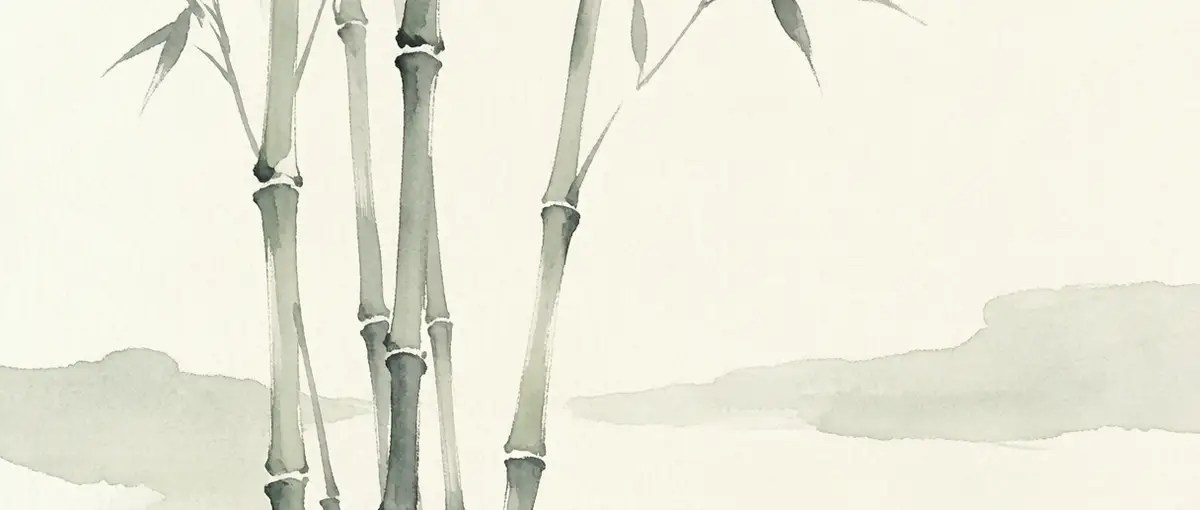
Bamboo holds a strange place in Chinese culture: it is both a rustic material — for baskets, sheds, chopsticks, none of it possible without bamboo — and the highest-spec item in a scholar's study. Su Shi said, "I can go without meat in my food, but I cannot live without bamboo," lifting bamboo from a daily tool to a spiritual necessity. Along with pine and plum it forms the "three friends of winter," and along with plum, orchid, and chrysanthemum the "four gentlemen." This piece will not tell you that "bamboo governs scholarship" or "planting bamboo invites the noble." We are only looking at where this stalk stands in the culture, and at the bit of care it still answers to in a person's growth today.
What does bamboo symbolize in Chinese culture?
Bamboo symbolizes steady growth, humility, resilience, and the ability to bend without breaking. Its joints suggest progress in stages, while its hollow center suggests leaving room to learn. This is a cultural image for reflection, not a promise of success or fortune.
How can I grow steadily without losing flexibility?
Choose one honest next “joint,” keep room for new information, and cut one side shoot that is draining your attention. Explore the idea gently if you are growing quickly but losing your center.
Before It Breaks Ground, the Joints Are Already There
While the bamboo shoot is still underground, the pattern of its joints is already laid out. It does not rise and then divide itself on the spot; before it ever sees light, the structure is set. This is a lot like a person's early coloring: how you were treated as a child, what sense of rhythm you built, is often written into the bones before you ever "stick your head up." What bamboo reminds us is not "destiny," but this — how tall you grow later depends, to a great extent, on what joints were buried in the times no one could see. Don't wait until you're on stage to practice the basics; that stretch in the root is already grown.
Hollow at Heart, So It Can Hold
Bamboo is hollow inside. The ancients deliberately made something of this: "bamboo understands an empty heart," meaning it can contain, and is not proud. Empty is not lacking; it leaves room for other things to enter. A person who fills themselves too full — so full there's no room for a question, no leeway — has in fact stopped growing. An empty heart is not weakness; it leaves an interface for yourself. Bamboo, with one hollow tube, tells us: the person who can take in opposing views and take in new things is the one who can catch the height that follows. Full, and it overflows; empty, and it receives. An old truth, and a true one.
It Grows Fast, but Not Recklessly
After rain, a shoot can shoot up dozens of centimeters a day, fast enough to startle. But it climbs joint by joint, upward, not wildly sideways. Fast does not equal out of control. Today many people fret about "falling behind," and the moment things speed up they panic, and the moment they panic they chase whatever is hot, scattering everything. Bamboo's speed has an axis: each joint locks, then it charges the next. Its lesson is — you may charge, but you need joints; you may be fast, but go segment by segment, don't yank the roots up to chase. Many people don't lose to slowness; they lose the axis in the moment of speed.
No Matter the Wind, It Bends but Does Not Break
The bamboo stalk is thin and tall; a gust bends the whole thing into a bow, and when the wind stops it springs straight again. It doesn't brace hard like pine, nor snaps at a touch like rotten wood; it "lets the force pass through softly." This way of living suits anyone pushed around by life again and again: all hard, and you crack easily; all soft, and you collapse. Bamboo offers a third option — bend down, but keep the sinew unbroken, and when the force passes, right yourself. In relationships, in the workplace, the person who can bend and spring back tends to go further than either the rigid or the spineless. It isn't teaching you not to resist; it's teaching you not to snap your hand of cards all at once.
Each Joint Is a Way Station
Every joint of the bamboo is a "gather, then rise again." It isn't one smooth stalk, but one cut into segments by the joints. This is a lot like doing things: a big goal, cut into joints, and with each joint passed you're steadier, more solid. Many people resent "step by step" as troublesome, wanting to shoot to the top in one gulp, only to come up empty and broken midway. Bamboo paints growth as a string of joints, reminding you — don't resent the slowness; each joint is a real height, and only by stepping it firm do you reach the next. Those who skip rarely avoid coming back to fill that joint.
Cut the Side Shoots, and the Main Stem Stands Straight
When bamboo grows to a certain point it needs "branch pruning" — the sideways shoots are removed so the nourishment concentrates on the main stem. People are the same: you don't have to grab every opportunity, crowd every excitement. Subtract appropriately, and the main stem stands straight and tall. Bamboo doesn't teach "want everything"; it teaches "know what to cut." Too many branches kept on look lush, but they actually steal your height. Our age is least short of side shoots — new platforms, new side hustles, new identities, each of them attractive, but each draws on the main stem's nourishment. Dare to cut, and you grow straight.
Bamboo Can Be a Carrying Pole, or a Flute
The same stalk, cut down, can be a pole for heavy loads, or hollowed into a flute for tunes. It can bear weight, and it can sound — both. People too: don't live yourself into only one use. When it's time to step up, step up; when it's time to speak, don't stay muffled. The most regrettable way to live bamboo is to be treated as a stick that's only hard; it could clearly sound a tune in softness too. One stalk of bamboo teaches: resilience and expression are not in conflict. You don't have to cut away your own voice just to look tough.
The Shoot's Sheaths Protect It Layer by Layer
Before breaking ground, the bamboo shoot is wrapped in several layers of sheath, one protecting the next, slowly pushing through. It doesn't pop out smooth and bare; it grows wrapped, protected. Today many parents — or young people themselves — would strip all "protection" away and throw the child into competition early. Bamboo reminds us: to wrap when wrapping is due is not weakness; it lets that joint inside grow solid over time. The sheath falls off on its own; there's no rushing it. What you strip away in a hurry is sometimes exactly why you later can't stand firm.
A Bamboo Flowers Only Once in Its Life
Bamboo is strange: most of its life it only grows leaves and doesn't flower, and when it finally does, often a whole grove flowers at once, then withers. Folk say "when bamboo flowers, great change must come" — that's reading too much in. But as an image, it resembles a certain kind of person — quietly accumulating day in, day out, saving it all up for one time when everything gathered is shown, then stepping back with composure. Not every flower needs to bloom often; some lives bloom truly only once or twice. Bamboo performs "spending it all" quietly and completely.
To Write Bamboo Is to Write a Measured Kind of Rising
We won't write "bamboo reports peace and fortune," nor "bamboo before the door surely raises a worthy person." What we write is this: is your way of growing jointed — do you have the modesty of an empty heart that holds others, the softness of bending without breaking, the steadiness of joint by joint, the clarity to dare cut the side shoots? This old image of bamboo stands by the fence, stands in the painting, watching everyone who wants to grow upward: you may be fast, you may be tall, but don't lose that jointed self. The bamboo that truly grows tall is not the fiercest stalk, but the one with the most joints.
Keep reading: Kan: Water is always there, so learn to stand in it · Kun: It never steals the spotlight, yet everything rests upon it · Li: It shines because it first found something to cling to
Written and reviewed by DustEcho Editorial for self-reflection and cultural inquiry—not counseling, medical advice, or a clinical diagnosis.
Not sure where to begin?