Pine: The Colder It Gets, the Less Willing It Is to Turn Yellow
DustEcho Editorial
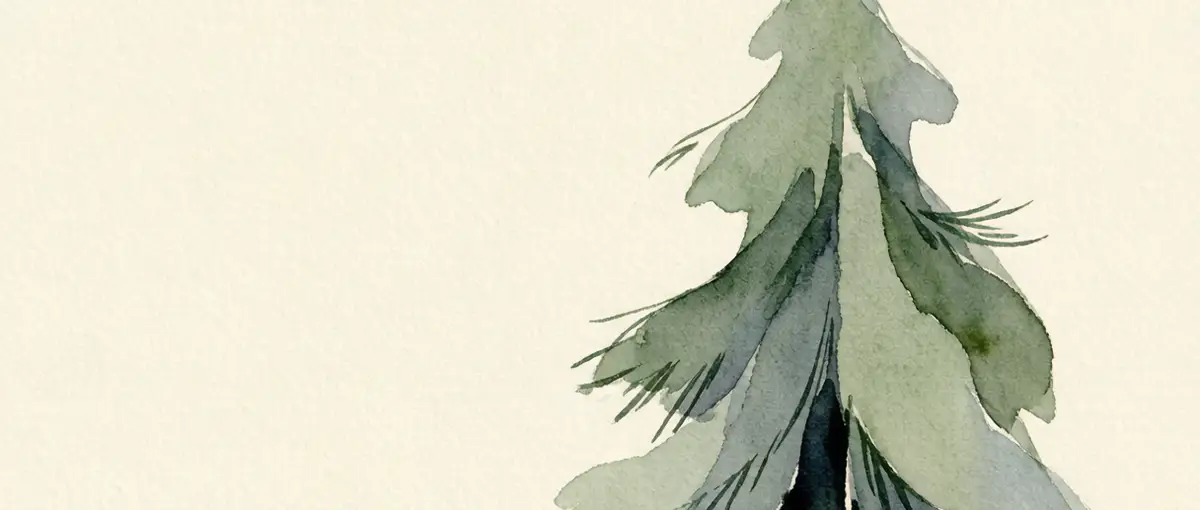
In a Chinese garden, pine was never just a backdrop. It was a regular guest — invited into paintings, planted along the approaches to tombs, carved into seals. Confucius said, "Only when the year grows cold do we know that the pine and cypress are the last to fade." With that one line he lifted a tree into a kind of mirror for people: everything else withers in winter, but pine simply will not. It is not the kind of pretty that steals attention in a Jiangnan spring; it is the one still standing when everything else has bowed its head. This piece will not tell you that "planting pine keeps misfortune away," nor that "pine guarantees a long life." We are only looking at where this tree stands in the culture, and at the bit of grit it still answers to in a person today.
It Is Not That It Feels No Cold — It Endures
A lot of people think pine "isn't afraid of the cold," but that's wrong. Pine is certainly cold; its needles freeze and its branches stiffen, it just doesn't run away by dropping its leaves like other trees do. It swaps broad leaves for fine needles, shrinking the surface area so water escapes slowly, and then it simply holds on through winter. This is a rather foolish and yet very steady way to live: no hiding, no dropping the load, drawing consumption down to the minimum and waiting for warmth to return. When a person is getting through a hard stretch, it's often not because they are "strong," but because, like pine, they trim the unnecessary spending, keep what should be kept, and endure day by day. What pine teaches is not passion — it is "don't retreat."
One Color All Year Long
The peach of spring, the lotus of summer, the maple of autumn — each has its moment of glory, then fades. Pine has no moment of glory; it stays a deep green the whole year. That's rather unexciting, and rather impressive. Our generation is chased by "milestones" and "moments in the spotlight," as if life is wasted without a flash of red. Pine stands there and reminds us: simply staying present is already an achievement. It doesn't prove itself through any single season; it relies on "turn around any time and I'm still here." In relationships, in work, the person who stays quietly online, never making a fuss — that's a bit of pine.
Its Roots Go Where Others Can't Stay
Pine loves growing in rock crevices, on hilltops, in the wind's path — places with thin soil, little water, and hard gusts. Its roots have to dig for a long time before they can catch any earth. It doesn't pick the fertile, watered riverbanks the way willows do; pine turns ground that "no one believed in" into its own. Today many people fret about "a low starting point" or "a bad environment," and pine's way of living is a silent rebuttal: you don't grow only because the environment is good; you grow because, in a poor environment, you drive your roots deeper than others, and so stand more firmly. Of course this is not a call to be grateful for hardship — only that an offbeat position doesn't mean game over.
When the Wind Comes, It Does Not Hurry to Bend
A pine's branches stretch out sideways. No matter how strong the wind, it sways but doesn't shudder all over like a poplar, nor gets knocked flat like a sapling. Its steadiness comes from a slow-accumulated hardness inside the trunk. People are the same: the closer the moment, the steadier you must be. Not that you feel no panic — pine sways too — but sway as it may, the roots hold. Looking back after many things have passed, keeping your footing then turned out to be more useful than being clever then. Pine doesn't teach "never move"; it teaches "even moving, stay standing."
The Needles Are Fine, the Strength Is Slow
A single pine needle looks thin and soft, as if it would snap at a pinch. Yet a whole tree of such needles piles up into a green that is solid through winter. Pine's strength was never a single burst of force, but millions of frail things refusing to retreat, year after year. This is a lot like the quiet confidence a person builds up slowly: the few pages read each day, the handwriting practiced a few times, the principles held a few times — unremarkable on their own, but together they become a you that others can't overturn. Pine puts "slow" and "hard" side by side, telling us that hardness need not come from coarseness.
Only When the Year Grows Cold Do We Know the Pine and Cypress Are the Last to Fade
Back to Confucius's line. He wasn't praising pine for its looks; he was saying that only when it turns cold do you learn who truly holds up. In ordinary days everyone is about the same, lively and noisy; once the cold comes, those who drop leaves first are the first to fall behind. Pine's worth is tested by the "cold." Brought to today, what we call reliable, what we call good to work with, tends to show itself only after things get hard and turn cold. This old image of pine is there to mark that scale: anyone can do it in good times; only what stays green through adversity counts.
It Ages Slowly, and Ages Steadily
A pine's life is often counted in centuries, and an old pine doesn't age by collapsing — it grows thicker, more gnarled, more itself. It is in no rush to grow up, nor afraid to; time falling on it is a credit, not depreciation. This runs exactly against today's anxiety that everyone feels about "being useless when old": pine says, slow is fine, the key is that when you're old you're still there, still standing, still green. The composure a person has left after weathering a few rounds of cold and heat is precisely the pine way of growing old — not that it doesn't age, but that it ages with backbone.
The Potted Pine Is Pruned Stubbornness
Many people keep a potted pine at home — crooked, the size of a palm, yet absurdly expensive. That is a person taking the wild pine and twisting it into a shape they like. But look closely, and inside those distorted branches is still that refusal to submit. This is a lot like a person who has been disciplined by life: you think you've tamed him by pressing him into a small pot, but he's only folded his stubbornness into the bends. Pine stays green even in the pot, only the green now holds a little more of a tidied-up quiet. Writing about pine this far, it isn't pity — it's respect. To keep stubbornness alive as a bonsai without dying is itself a kind of skill.
What does the pine tree symbolize in traditional imagery?
Pine can symbolize endurance, steadiness, longevity, and keeping a living core through a lean season. It is not a command to endure everything indefinitely; roots need soil, water, and room to recover.
How can I stay steady without forcing myself to be invulnerable?
Reduce the pace, deepen the routine that supports you, and ask what kind of help would make staying possible. Persistence that destroys your health is not the same as resilience.
Want to understand why leaving feels like failure even when you are depleted?
If you keep standing in the cold to prove your strength, gentle self-exploration can help you distinguish commitment from self-abandonment.
To Write Pine Is to Write a Kind of Refusing-to-Leave
We won't write "a home with pine is sure to prosper," nor "pine in the wrong spot brings conflict." What we write is this: when everything around is contracting and taking its final bow, do you carry an inertia of "hold on a little longer"? Pine is not a tree of heroics; it doesn't show off, doesn't charge, it simply won't yellow, won't drop, won't step off the field. Everyone carries a bit of this ability; it's just usually covered by the rhythm of "strike while hot" and "chase the high." This old image of pine stands there, chanting no slogans, only marking a tally with its un-yellowing green — for everyone still holding on hard.
Keep reading: Kan: Water is always there, so learn to stand in it · Kun: It never steals the spotlight, yet everything rests upon it · Li: It shines because it first found something to cling to
Written and reviewed by DustEcho Editorial for self-reflection and cultural inquiry—not counseling, medical advice, or a clinical diagnosis.
Not sure where to begin?