Dry-Heat and Damp Out of Balance: Swinging Between Parched Land and Waterlogged Mire
DustEcho Editorial
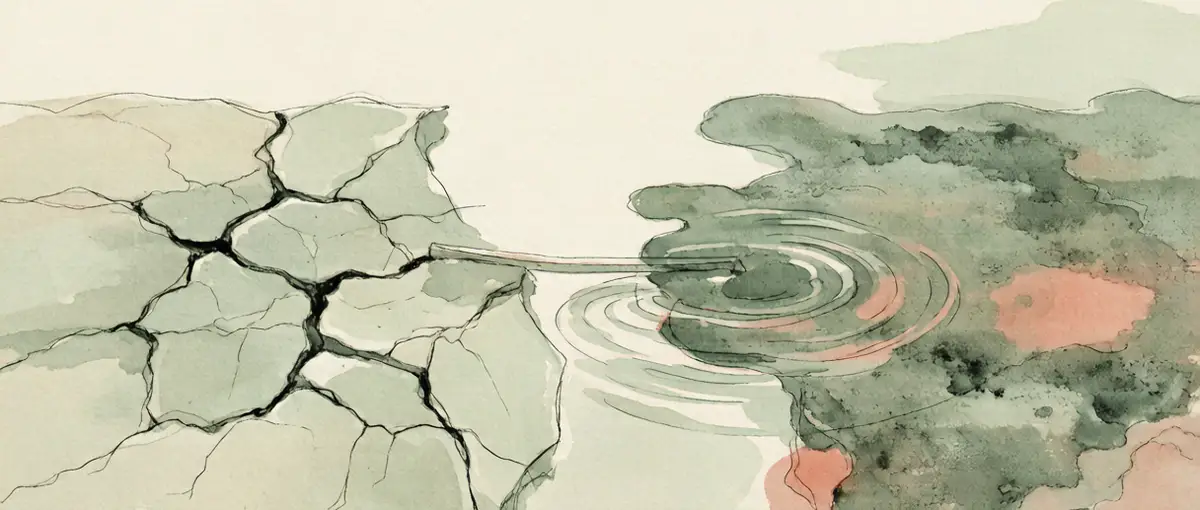
In the five-element system, dryness and dampness are forces that must balance each other. Dryness is fire carried on the wind — it governs aridity, urgency, a scorching it can't contain. Dampness is moisture held in the soil — it governs nourishment, sinking, a murkiness that won't clear. When a person's chart holds a scale that keeps tipping first one way then the other, becoming a "dry-damp imbalance," they are neither quite dry nor quite moist — they swing between two extremes. This piece is not about fortune or misfortune, and it won't read anyone's destiny. It only describes one kind of drain: the consumption of being pulled between too-dry and too-damp. You are not fickle — the small bit of moisture inside you simply never settles at exactly the right point.
It's not a bad temper — it's a scale that keeps tipping
People with a dry-damp imbalance often feel like the weather. One moment crisp and clean, then let one thing go wrong and they "drought" — words turn sharp, patience drops to zero, the smallest spark sets them off. By deep night that dry fire has spent itself and they "flood": the mind feels heavy, nothing holds energy, like a quilt soaked in water. They wonder: the same task, clean in the morning, tangles by evening. This isn't a split personality. It's a scale swinging between dry and damp that never found its still point. Others call them "moody." Only they know how much of that rise and fall is their body adjusting an uneven dampness.
When dryness takes over, like a cracked field
You can imagine dryness as a field long starved of rain. The ground has hardened; touch it and it splits. Water poured on is sucked away in an instant, leaving no moisture. When dryness runs heavy, a person is that field: words carry thorns, tasks rushed, any slowness irritates. A promise must be kept at once, or it scorches. It is not a lack of patience — their "earth" is too dry to hold even the composure of waiting. A friend said that when his dryness flares, what he fears most is "why are you in such a hurry" — because even he couldn't say. He only feels a fire roasting inside that burns back into him unless he pushes things forward. He isn't quick-tempered; this field has simply gone too long without rain thorough enough to soak in.
When dampness sinks in, like a muddy, murky pool
The damp end is another scene. When dampness runs heavy, a person is like a flood that won't recede for months: thoughts turn sticky, emotions heavy, everything soaks into something unclear. To decide, they go back and forth; to speak plainly, they circle back. They aren't confused — their "water" is simply too much, muddying everything that should stay clear. The worst isn't the damp but the emptiness after it: a busy day, and looking back nothing is settled, while the person feels like wood swollen with water — too heavy to move. They aren't lazy; this flood has drowned the part of them that could be crisp. When it retreats the ground stays soft, and before the next step they must probe for a while. Dry and damp take turns like two actors on a stage, and they're caught in the middle, neither in charge.
It's not that you lack constancy — the scale just can't settle at either end
A dry-damp imbalance is most easily called "inconsistent" or "one way then another." In truth they aren't lacking constancy; the swing itself has shattered it. In dryness they can stand firm; in damp they can sink deep. But rarely is there a moment both firmly standing and quietly moist. So their decisions feel like betting on the weather: bet right and they're crisp; bet wrong and they scorch or rot. It isn't that they can't hold or let go — the scale itself sways, so every stance looks unsteady. Others see them sway and call them unstable; no one sees the dizziness of their own inner sky. So before blaming them for flip-flopping, look under their feet: on one side scorched earth, on the other a mire — is there even a patch of level dry land to stand on?
Having lost the thing called "just right"
For the dry-damp imbalanced, the hardest part isn't the dry or the damp — it's "just right." They rarely taste that middle state: not scorched yet not sunk, not murky yet not clear, able to speak and to listen. Not that they dislike it — the state is simply too brief, like the dry freshness between two rains, gone in a moment. So in relationships they leave people guessing: warm one instant, cold the next. They aren't tormenting anyone — they themselves can't predict whether the next spell will be drought or flood. And the most exhausting part is this "can't-predict" — they want more than anyone to know what sky they'll be tomorrow, but the scale never tells them in advance.
It's not that you're hard to please — the damp just hasn't found an outlet
People often think the dry-damp imbalanced are "hard to please." But to them it doesn't sound difficult; it sounds like "I don't even know what I want right now." In dryness they need stop, quiet, a basin of cool water over the head. In damp they need clarity, brightness, a wind that blows the murk away. Yet these two needs often fight in the same afternoon. This isn't preciousness; the small bit of moisture in the body has been searching for a steady outlet to rest at, but keeps getting pulled both ways and can't settle. To demand they "be stable," it's better to first gently ease that scale onto an unbiased fulcrum — not forcing them to stop changing, but showing that even while they change, someone isn't making it hard.
Give the scale an immovable fulcrum
Back to the imbalance itself. It isn't fierce, and shouldn't be disliked. A dampness that keeps tipping only needs a fulcrum to steady it, and it can still moisten just right. For the dry-damp imbalanced, the most important thing isn't "forcing yourself to be constant," but first admitting: this scale really does need steadying. Start small — when dryness flares, let yourself pause five minutes before replying; when damp sinks in, let yourself finish one thing before the next. To steady isn't to stop changing; give that swing an immovable fulcrum, and dry can hold moisture, moisture can support dry. You don't need to never be drought or flood again. You only need, while swinging, to remember you could originally stop at a position that breathes just right. A breathing position needn't be large. Room to catch your breath is enough.
A more modern way of saying it
In the language of psychology, a dry-damp imbalance comes close to an "instability of arousal level" — an imbalance between the sympathetic nervous system (restless, urgent, dry) and the parasympathetic (sinking, sticky, damp), leaving a person swinging between "over-activation" and "over-inhibition," unable to rest in the calm-clear middle. It's often tied to long-term pressure and disordered sleep: when the body grows used to alternating stress and shutdown, a person loses the composure of being "just online." Steadying the fulcrum is the practice of rebuilding rhythm and self-regulation — giving over-arousal a buffer, over-inhibition a wake-up, letting that scale learn to stop. In the moment it stops, they discover for the first time that a sky without drought or flood truly exists, and that it is far more comfortable than they imagined.
Written and reviewed by DustEcho Editorial for self-reflection and cultural inquiry—not counseling, medical advice, or a clinical diagnosis.
Not sure where to begin?