Jin Han in BaZi: When Metal Feels Too Cold
DustEcho Editorial
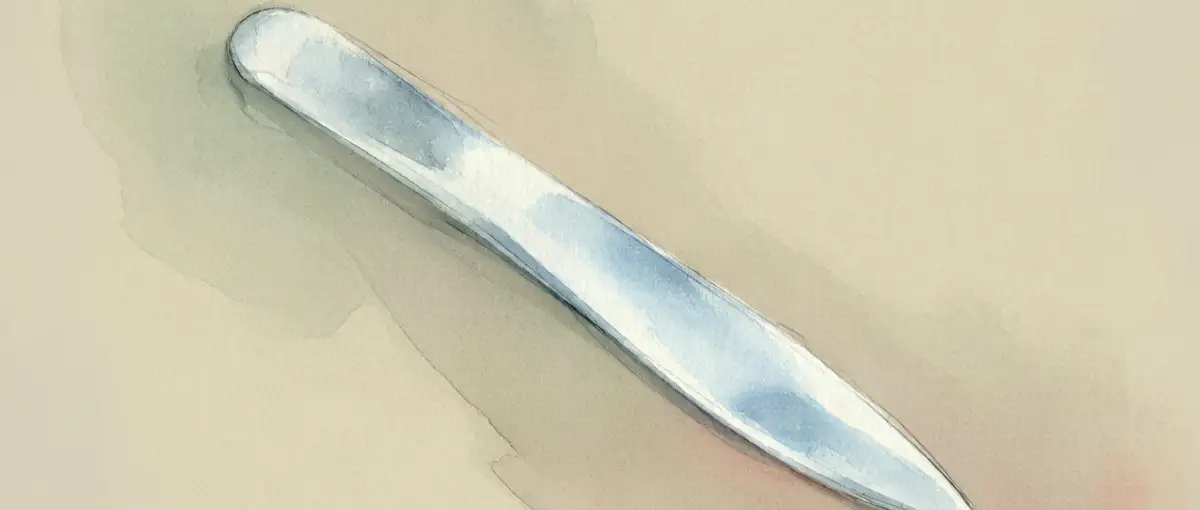
In BaZi, Jin Han describes Metal energy becoming overly cold and defended: clear boundaries, sharp thinking, and warmth held too tightly. It is not a verdict about your character or relationships. Read as a warm, non-predictive lens, Jin Han helps name the experience of being so protected that closeness starts to feel unsafe, even when you still want it.
It Is Not Coldness — It Is a "Temperature" Turned Down Too Low
People with jin-han are often called "aloof," "hard to approach." But cold was never their intent. Metal's duty is contraction — holding in excess feeling, cutting clean blurry boundaries, keeping the wrong things outside. This is protection, and clarity. The trouble is only that when this contracting energy is set too cold, a person slides from "someone who tells things apart" into "someone no one can get near." He does not refuse closeness; he meets each approach as a fire that might burn him, showing the blade and bolting the door first. Others feel his cold; only he fears the warmth that might melt the shape he built. So he would rather stay cold than risk the melting.
Like a Blade Soaked in Cool Water
You can picture jin-han as a fine blade. A blade is good: it cuts, it guards, it draws a clean line through a tangle. But a blade soaked in cool water gains a coldness no one dares to grasp. The jin-han person carries an overloaded boundary sense: concern read as probing, approach read as invasion. Not because he is sharp, but because his edge is too bright — even kindness landing on it reflects a cold light. A friend said he dreads being walked home after a gathering — that warm pleasantry takes a whole night to fade from his bones. He does not dislike people; he has simply not yet learned to speak after setting the blade down. Once someone clapped his shoulder, he stiffened before turning to smile — the blade showing first.
You Are Not Hard — The Metal Is Too Cold, and Trembles at the Slightest Warmth
Jin-han is most easily misread as "hard character," "no feelings." But hardness is "not wanting to soften"; jin-han is "afraid to soften." It is not a lack of softness — only that the moment it appears, he fears he cannot pull it back. Metal quenched too cold trembles at the least warmth: when someone is kind, his first response is doubt, not welcome; when a relationship draws near, he plans the exit first. He is not without love; his love is wrapped in frost, needing someone willing to peel it away layer by layer without minding the cold. So do not call him "heartless" yet; first see if what he hands you is a blade he fears might wound. He is not loveless; he has raised his love into a precision instrument that needs its own manual. Everyone finds the manual a bother — yet he cannot see why love needs one.
Telling Things Apart — and Pushing People Away
Metal's gift is "dividing": right from wrong, near from far, what should be from what should not. The jin-han person takes this to an extreme: what to mind, what not to mind, who is worth it, who is not — he carries a gauge more exact than any ruler. This makes him clear, and lonely. The hardest part is not dividing, but the times of "not dividing." Once Metal grows too cold, even "being a little vague" or "making do once" feels like blunting his own edge. So in relationships he seems too clean — ending cleanly, refusing fully, even comforting with a blade's chill. He is not unmoved; he simply does not know, besides stating things clearly, what temperature catches a person's sadness.
Wrapping Oneself in Rules
The jin-han person is often the "ruler" in a relationship. What to do and where the boundary lies — he knows best, and usually measures for others too. This is Metal's clarity, and Metal's loneliness. Yet few ask whether this ruler was ever measured gently by anyone. Most jin-han people cannot answer, for he has long locked his own needs into the coldest drawer, sealed with three locks — one named "should not depend," one named "no need," one named "I'm fine alone." He can measure everyone clearly, yet cannot measure the self that also wishes to be treated well. So the clearer he is, the more he stands in a snowfield — seeing far, but unable to warm himself.
Not Aloof — the Metal Has Simply Been Too Long Out of the Furnace
Jin-han is often called "aloof," "hard to get along with." But to him it is not aloofness; it is being used to not troubling others. Once Metal grows too cold, the first loss is the ability to re-warm: new warmth cannot enter, old heat will not stay, and even one show of weakness feels like betrayal of himself. This is not a character flaw; it is that the metal has been too long out of the furnace — no fire to temper it, no hand to hold it, the edge gone utterly cold. Demanding he be "warm" helps less than giving him space to warm slowly: do not force him to open up at once; first let him see that those who draw near mean to warm the frost, not dull his blade. He does not shut people out across a thousand miles; it is only that before the frost melts, no warmth can stick to cold metal.
Leave a Little Hearth-Fire for the Blade
Back to jin-han itself. It is not fierce, and should not be resented. A piece of metal quenched too cold, once returned to the fire, can be both keen and warm again. For the jin-han person, the key is not "forcing yourself hot," but first admitting: this blade, too, needs a little hearth-fire. Begin small — toward someone kind, doubt one time less; toward a relation that draws near, leave one step more; allow yourself, with someone you trust, now and then to set the blade down and show the softness you kept. Returning to the furnace is not melting; returning a little fire, the edge stays an edge — only it no longer bites cold into the hand that holds it. You need not become a blaze; you only need to stop quenching yourself into cold iron that trembles at a touch. Cold iron does not feel pain. But you do.
A More Modern Way to Say It
In the language of psychology, jin-han comes close to an "over-defended sense of boundary" — meeting the world with clarity, rules, and emotional contraction, until true needs and closeness sink beneath awareness into chill. It often links to early "rely on yourself" and "never show weakness" lessons: when dependence feels dangerous, a person tempers into a silent ruler. Returning to the furnace is, in truth, rebuilding secure attachment and expressive flexibility — allowing approach, weakness, being cared for. Metal could always cut and measure; only let it not grow too cold to know its own warmth. Not recognizing warmth does not mean there is no warmth; that little warmth has always been there, only covered by frost, waiting for someone willing, without minding the cold, to breathe it open.
What does Jin Han mean in BaZi?
Jin Han means that Metal energy is symbolically cold or over-contracted in a BaZi reading. In a modern interpretation, it can describe strong boundaries, emotional reserve, and difficulty letting warmth in. It is not a fixed personality label; the useful question is how to stay clear and protected without cutting yourself off from care.
Want to understand your boundaries and closeness pattern?
If being self-contained has started to feel lonely, start a personal BaZi reading to explore the pattern with context and self-reflection. The goal is practical clarity, not a fixed prediction.
Keep reading: Guan Sha Hun Za: Two Foremen Inside, Each Giving Different Orders · Han Nuan Shi Heng: The Broken Thermometer Inside the Body · Huo-Yan: When the Light Comes On Too Fast, It Also Burns
Written and reviewed by DustEcho Editorial for self-reflection and cultural inquiry—not counseling, medical advice, or a clinical diagnosis.
Not sure where to begin?