BaZi Chart Interpretation: Cai Wang and Ambition
DustEcho Editorial
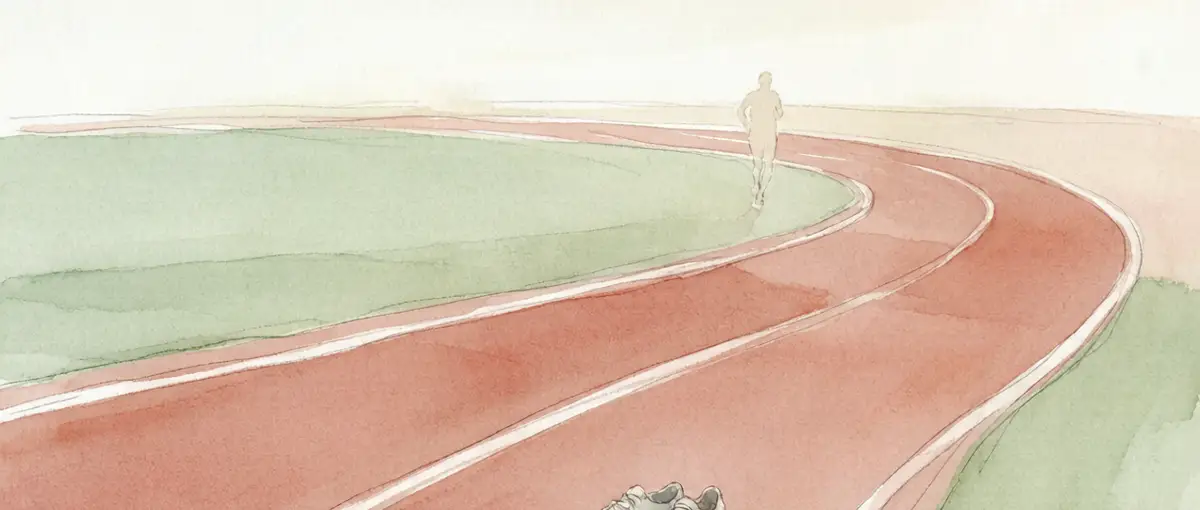
In BaZi chart interpretation, cai — the Wealth Star — is the combined designation for Direct Wealth and Indirect Wealth. It governs pursuit: the drive toward goals, the momentum powered by desire, the internal engine that says go. Cai wang is what happens when that engine tips past equilibrium — pursuit itself becomes a track with no finish line, each arrival barely registering before the next signal fires. This is not an assessment of fortune or misfortune, nor a guide to dispersing concentrated energy. It is an attempt to trace the texture of an experience: lives that run not out of greed, but out of a motor that was never taught how to idle. A treadmill inside the chest, spinning whether or not anyone is watching.
Not Greed — Just a String That Never Slacks
When the wealth star runs hot, the outside world reaches for words like driven or, less generously, never satisfied. From the inside, though, it rarely registers as wanting more. It registers as not being able to stop. Direct wealth sets the steady rhythm: a stable job, a reliable income, a progress bar with a visible end. Indirect wealth injects the thrill: an untested direction, an unexpected opening, the electric hum of what if this actually works. The two alternate like runners in a relay — each kilometer done, the next spark already gesturing from around the bend. This is not greed. This is a list that regenerates faster than checkmarks can cross it off. A string pulled tight — not because it refuses to loosen, but because in the rare seconds it does, something deeper begins to panic.
Arriving and Feeling Almost Nothing
There is a hidden hollow that comes with cai wang: reaching a destination and barely registering the arrival. While others celebrate, the mind has already launched the next spreadsheet. While others post the achievement, the next calculation is already running. Whatever direct wealth delivers lands flat — useful, but somehow only that. Whatever indirect wealth seizes comes as a gust of thrill that blows through and is gone before it can be named. Quiet envy grows for those who can sit with a win for days, because the inner reservoir of satisfaction leaks somewhere en route — a cup freshly poured but riddled with invisible pores, half-emptied before the first sip. The sharpest edge of this state is not the chase itself. It is the quiet recognition, in the stillness after a summit, that the summit does not register as arrival. This is not ingratitude. It is a machine with no gear marked enough.
The Machine That Drowns Out Everything Else
Cai wang carries an overlooked cost: too many targets occupy too many channels, and the volume drowns out everything else. Friends invite conversation, and the mind is already running projections. Family speaks, and the brain is arranging next quarter's architecture. It is not a deficit of care. It is attention — a finite resource — requisitioned by an endless queue of things still to do, leaving the people in the room too small a ration for genuine presence. Those inside this engine glimpse themselves from the outside: watching others talk, feeling out of place, physically here but mentally stationed three days ahead. The running capacity cai wang grants is formidable — formidable enough to squeeze out the capacity to pause. Others' voices come through, but through a layer of static: the ambient hum of not yet done. It is not unwillingness to hear. It is that the hum has grown so loud that machine and person blur into one vibration.
Not Utilitarian — Just Security Tied to Progress Bars
The gaze from outside tends to read cai wang as transactional — all about the money, purely utilitarian. From inside, the fixation is not on the number. It is on the bar itself. What is being chased is not accumulation but the sensation of being in motion. Direct wealth whispers: a stable income equals a stable life. Indirect wealth counters: seizing opportunity means not being left behind. Security gets segmented and tied, centimeter by centimeter, to these bars — when a bar stalls, the internal ground softens; when it advances, the ground firms. This is not the worship of money. This is a quiet substitution: I am moving has become the only acceptable translation of I am okay. Those who understand this engine see a fierce refusal to lose — a stubborn, almost beautiful refusal. Those who do not see someone who lives too hard. Those inside know: living hard exhausts, but living still exhausts more.
In the Quiet, Waiting for Oneself
Those running cai wang rarely rest in any meaningful sense. Yet occasionally — a late night with the phone turned off, an unplanned weekend morning with no agenda — a stillness descends that feels foreign. Inside it there are no progress bars, no next targets, no not there yet. There is only the self, seated in place, heartbeat a few ticks slower than normal. The stillness registers as strange, even alarming — like an engine cut from its fuel, vibration gone, silence flooding the cavity left behind. And yet it is inside that alarm that something flickers: the recognition that not running is not the end of the world. This is not an exhortation to abandon every goal. It is an invitation to leave a small patch of unpaved ground between the tracks — a piece of dirt with no lane markings, no countdown timer. It need not be large. Just enough to stand on and take a breath. The dirt yields softly underfoot. No echo returns — and perhaps the echo was never necessary. Standing there, there is no audience and no trophy, only wind and one's own shadow. This is the scene cai wang most naturally avoids. It is also the scene most in need of being learned.
Installing a Pause Button on the Machine
Return to the engine itself. Cai wang is not a sin and not a curse. A machine built to run fast has only one flaw: it cannot shut itself off. The gentlest intervention is not stop chasing. It is to install a pause button — not to dismantle the machine, only to create, when the roar peaks, five seconds of stillness. Five seconds is brief, but enough to register the sound of one's own breathing. Start small: flip the phone face-down for a single meal. Turn one gray cell on the planner into blank white. After reaching a goal, resist the reflex to ask what next. Say instead: not bad. The goal is not to become someone who slows. The goal is to carve out, inside the speed, a sliver of room to check: is this thing I am hurtling toward something I actually want, or is the machine calling the turns on my behalf? Pause it for five seconds. The first sound may not be a goal collapsing — it may be one's own breath. That breath is not a figure on any progress bar. It is yours. No one else can draw it for you.
A Modern Way of Putting It
In psychological language, cai wang approximates goal-directed overactivation: a state in which self-worth is wired so tightly to external achievement and visible progress that the brain's reward system adapts rapidly to completion, dulling satisfaction and compelling the search for the next target just to regain the same dopamine baseline. This is not greed. This is a cognitive habit built across years of anchoring identity to output, where running has been mistaken for being alive. The path toward recalibration does not require renouncing ambition. What it asks is cultivating non-instrumental anchors outside the achievement loop: a relationship that exists for no productive reason, a walk taken without a camera or caption, a dinner eaten with no screen at the table. The invitation is not to stop. It is to make room, somewhere, for the version of the self that is not chasing — to let that version claim a small patch of ground where progress bars hold no authority, where no gaze is being served, where standing still is permitted. The patch need not be large. Room enough to slip off the running shoes for a moment — that is enough.
What does Cai Wang mean in a BaZi chart?
Cai Wang describes a chart where Wealth Star energy is especially strong, using traditional language for a pattern of constant pursuit. It does not promise wealth or predict financial outcomes. A more useful reading asks how ambition, security, and satisfaction are working together right now — and where a little room to pause might make success feel real again.
Want to explore the money and work themes in your own chart?
A glossary can name the pattern; a personal reading can place it beside your actual work, money, and relationship questions. Start a personal BaZi reading for a guided interpretation without a fixed-fate verdict.
Keep reading: Jin-Han: When the Edge Is Wrapped in Frost · Mu Wang: That Upward Drive You Can't Hold Down · Ri Zhu: Whether the "I" Inside You Stands Steady
Written and reviewed by DustEcho Editorial for self-reflection and cultural inquiry—not counseling, medical advice, or a clinical diagnosis.
Not sure where to begin?