Guan Sha Hun Za in BaZi: Two Inner Standards
DustEcho Editorial
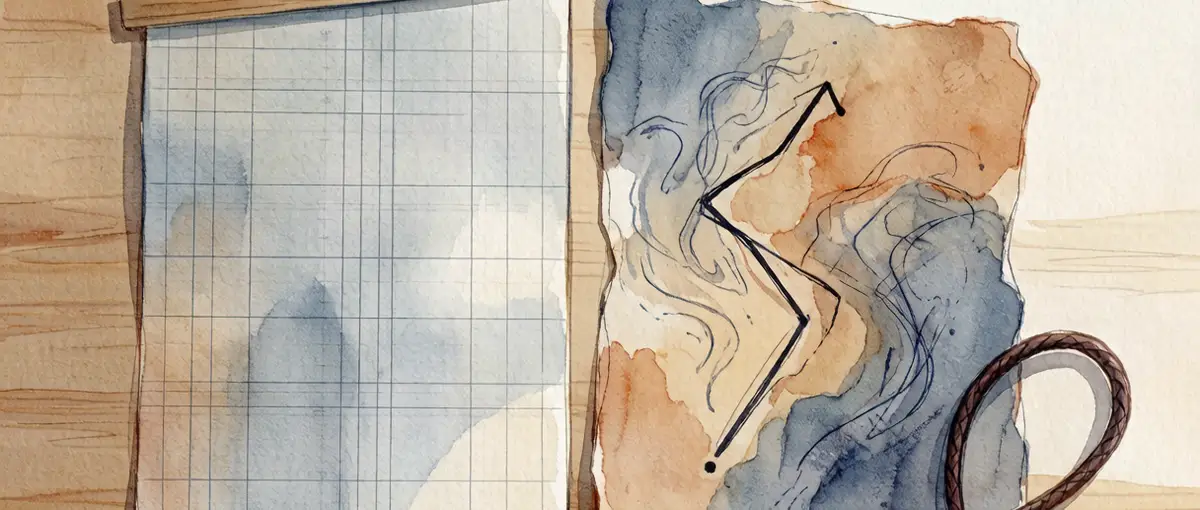
In BaZi, Guan Sha Hun Za — often translated as mixed officers — describes Direct Officer and Seven Killings pressure appearing in the same chart. One voice values order, rules, and responsibility; the other brings challenge, confrontation, and the force that does not play by the rules. Like two foremen living inside the same chest, each calls out a different command. This is not about fortune or misfortune, and it will not teach how to "purify" the chart. It names the experience of being pulled by two standards at once, standing before two maps that both make sense but lead somewhere different.
One Voice Says Be Gentle, the Other Says Be Fierce
What wears down most in guan sha hun za is that the standards fight. Zheng guan says: be on time, be polite, follow the procedure, do it beautifully. Qi sha says: don't back down, charge forward, forget what others think. So on the same day, in the same life, there might be careful note-taking in a meeting, and then, turning around, a fist slammed on the table over a matter of principle. Others see gentleness and then fury and call it a strange temper. But the one living it cannot figure out which face was the "right" one. It is not a lack of principle. The principle was written in two halves by two different systems, one half saying "endure," the other saying "strike," and the halves never merge. Late at night, turning over in bed: was that slam qi sha stepping forward, or zheng guan already regretting it?
Rules and Wildness, Pulling the Same Rein
There is often a tautness in the body, like a horse pulled by two reins in different directions. Zheng guan leads toward the proper path, toward good schools, stable work, becoming respectable. Qi sha pulls toward the wild road, refusing to be tamed, wanting to break something, wanting to try what others dare not. The effort is not absent. The effort keeps leaping between "obey" and "rebel": filling out reimbursement forms properly in the morning, then in the afternoon wanting to quit and do something reckless. The exhausting part is not the work itself. It is the voice that runs underneath the work, asking: is this right? Would the other way have been better? Both reins chafe the neck raw, and neither is something to let go.
Not Moody, Just Pushed by Two Forces in Turn
Those nearby often read the shifting as moodiness. But this is not emotional volatility. The inner drive was never a straight line. Zheng guan gives a push toward steadiness, restraint, being fair to others. Qi sha gives a push toward risk, breakthrough, being fair to oneself. The two forces take turns, and the state shifts with them: when zheng guan is on duty, there is the air of a seasoned clerk; when qi sha is on duty, there is the air of a misfit. The hardest part is not the forces themselves. It is that they never consult each other. Zheng guan says "endure a little longer" while qi sha is already kicking from behind. Caught in the middle, like a soldier receiving orders from two directions at once, running either way invites blame, and the blame is all self-supplied. Self-supplied blame is the hardest to digest, because the one accusing and the one accused share the same mouth.
Both Roads Lead Somewhere, but One Must Be Chosen First
Guan sha hun za is not "no choice." It is "both roads look right." Others walk one path to its end; this one stands longer at the fork. Not from indecision, but because the logic of each road is visible and valid. There is the capacity to be steady, thorough, watertight. There is also the capacity to venture, to stir the whole board. Both are within reach, so "choosing one" becomes a costly act. To choose one road is to bid farewell to the self on the other, and that feels like snuffing out half of oneself with one's own hand. But roads only open by walking. The point is not to kill qi sha or tame zheng guan. The point is to learn: when steadiness is needed, let zheng guan hold the wheel for a while; when a charge is needed, let qi sha step on the gas. The two foremen do not have to argue for a lifetime. Maybe they just need a schedule. Nothing elaborate, one column for morning, one for afternoon, written clearly, and both will abide.
Not Split, Just Two Forces That Feel Equally Real
Guan sha hun za is easily misread as duplicity or fragmentation. But there are not two faces. There are two fuels in one body. Zheng guan's fuel burns quiet and long, suited for the flat road. Qi sha's fuel burns fierce and short, suited for the steep climb. The road ahead is, by nature, a mountain with both long flats and steep grades, the quiet stretches needing zheng guan, the steep ones needing qi sha. It is not a surplus of masks. It is that the road itself demands two gaits. Others only see the switching. They do not see that each switch requires a full reassembly of parts inside. They see the speed of the switch, not how hard those two fuels burn in the same furnace. But anyone who has crossed a mountain knows: the firewood for the climb and the firewood for the flat are not meant to be the same log.
A Scheduling Table for Those Two Foremen
Returning to guan sha hun za itself. It is not an illness, and it does not need curing. Two foremen are not the problem. What's fearsome is when they never sit down and speak to each other. The practical work is not "pick one." It is learning to demarcate territory for each voice: when steadiness is called for, let zheng guan take the main seat; when a charge is called for, hand the microphone to qi sha. Not to fuse them into one, but to let them learn shift work. It is possible to keep the rules without losing the nerve. It is possible to charge without losing the baseline. These two forces are not adversaries. They just have not been given a proper table yet. Once the table is set, the ruler and the whip can rest on the same surface, each tending its own. One table, two seats. If that's not enough, add a chair. The chair need not be fine. Four steady legs, a back to lean against, and that will do.
A More Modern Way to Say It
In the language of psychology, guan sha hun za resembles a dual-constraint motivational conflict, when the drive to comply with norms and the drive to confront pressure oscillate endlessly. The decision-making system sits under chronic cognitive load: neither trusting pure compromise nor daring to risk pure confrontation. What comes with this is often a higher situational sensitivity, precisely because both the rule and the way to break it are visible at once, making choosing harder. The way forward is not "remove one side." It is cultivating the flexibility to switch between contexts, allowing different drives to be summoned in different scenes, and trusting that this flexibility is not hypocrisy but a way of staying alive in a real world. There is no need to cut away half of the self to fulfill the other half. What's needed is to give both selves a table where they can set down their tea. The table need not be large. Big enough for two cups, and that's enough.
What does Guan Sha Hun Za mean in BaZi?
Guan Sha Hun Za refers to a chart where orderly constraint and sharp pressure are both active. It does not mean a person is inconsistent or divided. A gentler reading asks when each force is useful, and how to give both of them a clear role instead of letting them issue competing orders all day.
Want to explore those two standards in your own chart?
A personal reading can help connect this traditional term to the choices and pressures you are actually carrying. Start a personal BaZi reading for a guided interpretation without a fixed-fate verdict.
Keep reading: Jin-Han: When the Edge Is Wrapped in Frost · Mu Wang: That Upward Drive You Can't Hold Down · Ri Zhu: Whether the "I" Inside You Stands Steady
Written and reviewed by DustEcho Editorial for self-reflection and cultural inquiry—not counseling, medical advice, or a clinical diagnosis.
Not sure where to begin?