Han Nuan Shi Heng: The Broken Thermometer Inside the Body
DustEcho Editorial
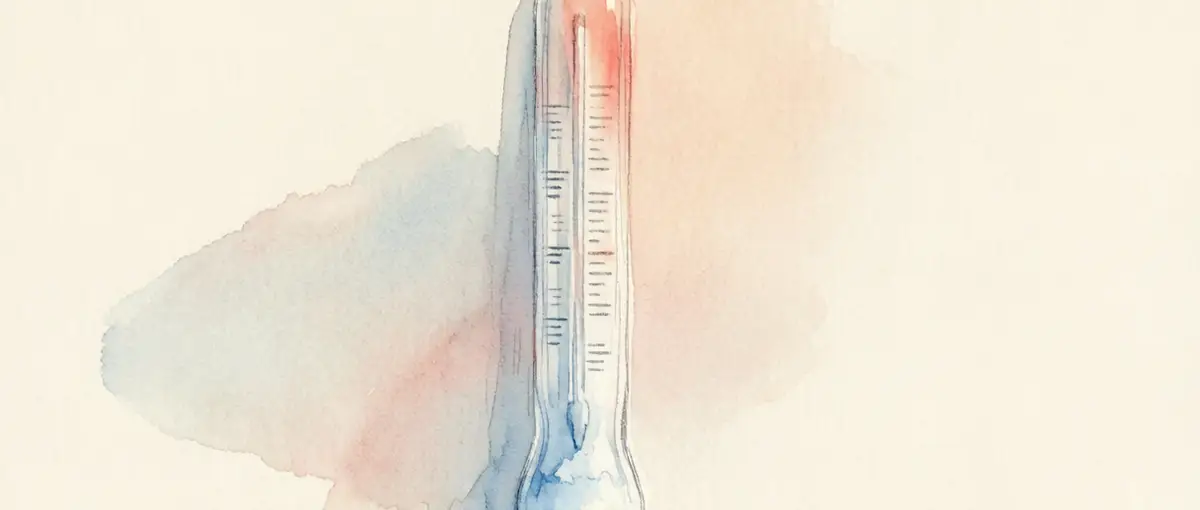
In the five phases of traditional fate study, "cold" and "warm" form a pair defined by temperature. Cold governs storing, stillness, the inward pull of chill. Warm governs generating, reaching outward, the unfolding spread of heat. When the ratio of cold and warm in a chart falls out of balance, becoming what is called han nuan shi heng, the inner thermostat never settles. Either it runs cold all the time, curled and motionless, or it flares hot, radiating fire outward, rarely pausing at the gentle warmth of just right. This is not about fortune or misfortune, and it is not reading anyone's fate. It is about describing a misalignment, the sense of a broken thermometer inside the body. The trouble is not a fear of cold or a fear of heat. The gauge is stuck at a reading it cannot deliver accurately. And that inability to settle is not a flaw. It is that the cold and the warm each want too badly to decide for you.
It Is Not About Being Cold, the Thermometer Is Stuck
The state of living with cold-warm imbalance often resembles a room with a broken thermostat. The heating is on, yet the hands stay icy, a blanket pulled tight, the body curled into a corner. Then by afternoon a flush of heat rises, the face burns, a nameless fire presses against the chest, and opening a window feels dangerous because the cold will come rushing back. The confusion is genuine: the same day, how does it swing from deep winter to high summer. This is not a delicate constitution. The inner thermometer is caught at a mark it cannot read. It cannot tell whether this moment calls for gathering in or reaching out, so it slides toward cold, then surges toward warmth. Others see the fluctuation and call it moodiness. Only the one inside it knows how much of that wavering is the body trying to regulate heat it cannot pin down.
The Cold End, a Winter That Will Not Thaw
Picture "cold" as a winter that refuses to leave. Everything pulls inward, movement slows, words thin out, even joy arrives with a lag. When the cold is heavy, it feels like being wrapped in a thick quilt, unwilling to socialize, unwilling to move, postponing what can be postponed. It is not laziness. The impulse to rise is frozen somewhere inside. A friend once said the hardest thing during a cold spell was hearing "can you be a bit more positive," because the will was there but the body felt rusted, unable to turn. It is not an absence of warmth. The warmth is there, pressed to the bottom by the weight of cold, unable to surface. There is always a winter like that, lingering while everyone else has reached the start of spring, waiting for warmth to climb slowly back into the fingertips.
The Warm End, a Nameless Fire in the Chest
When warmth overflows, the scene flips. Words come fast, ideas arrive urgently, a small spark can fan a full blaze of heat that will not stop or quiet. It is not a short temper. There is simply too much heat, burning through what should be held in reserve. The hardest part is not the burning but the emptiness after, the hollowed-out fatigue that follows the surge, heavy eyelids despite no hard labor. The fire is not grandstanding. It consumes the energy that could have been spent slowly. When the fire dies the room is still cold, and whether to light the next one means shivering through the decision first. Cold and warm take turns at the stove, and the one in the middle cannot say which holds the reins.
Not Flipping Hot and Cold, the Middle Setting Is Gone
Cold-warm imbalance is easily dismissed as "running hot and cold" or "hard to please." The truth is less about changing and more about losing the temperate middle. When cold, the gathering holds. When warm, the opening flows. But rarely is there a moment that is both warmly expansive and quietly settled. So the distance to others keeps shifting. Warmth reaches toward someone, then the shell closes again. It is not deliberate distance. It is that no one can predict whether the next tide will be cold or warm. And the most exhausting part is that unpredictability. More than anyone, the one living it wants to know what temperature tomorrow will bring, but the gauge never tells in advance.
Not Fragility, the Temperature Has Nowhere to Land
There is a common impression that those with han nuan shi heng are delicate or fussy. But from the inside, it is not fussiness. It is "I do not know whether I should be warming up or cooling down right now." When cold, what is needed is a heat warm enough to thaw the hands. When warm, what is needed is a breeze cool enough to lower the temperature. These two needs often clash within the same evening. It is not oversensitivity. The temperature inside is always searching for a mark where it can rest, pulled from both ends, settling nowhere. Asking for stability might miss the point. Better to help nudge the gauge gently toward a reading that is not extreme. Not forcing stillness, but letting it be known that when the heat and cold swing, someone will not make it harder.
Steady by Day, Burning Awake by Night
There is a hidden rhythm to cold-warm imbalance. By day, in the presence of others, there is a holding together, pressing the cold down, appearing composed and capable. Then night arrives and the warmth that was suppressed all day surges back, baking away any chance of sleep, the mind spinning through everything meant to be done and said. It is not insomnia. It is the "normal temperature" borrowed during the day, repaid with interest after dark. The reverse exists too: flushed and warm by day, then curled and shivering at night, two blankets and still cold feet. This day-and-night misalignment grinds the most. Others see only the daytime version and never learn about the private season that arrives after dark. So it can look like one face by day and another by night. It is not a mask. The gauge simply reports two different numbers at the two ends of the day.
Finding a Steady Mark for the Thermometer
Returning to han nuan shi heng itself. It is not fierce, and it does not deserve to be resented. A stuck gauge, given a steady mark to rest on, can still measure well. For those living with cold-warm imbalance, the most important step is not forcing constant temperature. It is admitting first that this temperature does need support. It can start with something small. When cold, allow five minutes of warming before answering. When warm, let one full exhale escape before taking on anything new. Steadying is not freezing in place. Give the swing a mark that does not move, and the cold can hold the warmth, the warmth can carry the cold. There is no need to be forever neither cold nor warm. What matters is remembering, while swinging, that a breathable middle degree is possible. It does not need to be grand. Enough to draw one breath is enough.
What can “cold and hot” emotional swings mean in everyday life?
As a modern metaphor, the image can describe moving between shutdown and overactivation: feeling unable to start, then unable to stop; feeling numb, then suddenly flooded. It is not a diagnosis or a traditional medical conclusion. Persistent sleep disruption, severe anxiety, pain, or other physical symptoms deserve assessment from a qualified healthcare professional.
How can I find a steadier middle?
Track the pattern without judging it: what happened before the shift, what your body did, and what helped it settle. Small routines—food, sleep, movement, pauses, and supportive contact—can give the system more predictable reference points. If the swings are intense or impair daily life, seek professional support.
Want to understand why your inner temperature never seems to settle?
If you keep moving between freeze and flare, gentle self-exploration can help you notice the first change before it becomes a full swing.
A Word From the Modern Side
In the language of psychology, cold-warm imbalance resembles a dysregulation of arousal at the bodily level. When the rhythm between sympathetic and parasympathetic branches, or between temperature and emotional regulation, falls out of sync, the experience swings between "energy that cannot be released" and "energy that cannot be stopped from leaking," rarely settling in the temperate middle where one is both warm and clear. It is often tied to chronic tension, disrupted sleep, and autonomic nervous system imbalance. The body, habituated to alternating between freeze and flare, loses that quality of being calmly online. Finding the mark is, in essence, a practice of rebuilding bodily rhythm and self-soothing. A little warmth for the frozen, a little coolness for the overheated, until the gauge slowly learns to pause in the middle. In that paused moment, there is a first discovery: a temperature that is neither cold nor warm is real, and it is far more comfortable than imagined.
Keep reading: Jin-Han: When the Edge Is Wrapped in Frost · Mu Wang: That Upward Drive You Can't Hold Down · Ri Zhu: Whether the "I" Inside You Stands Steady
Written and reviewed by DustEcho Editorial for self-reflection and cultural inquiry—not counseling, medical advice, or a clinical diagnosis.
Not sure where to begin?