Huo Yan in BaZi: When Fire Burns Too Bright
DustEcho Editorial
In BaZi, Huo Yan describes Fire energy running especially strong and outward: warmth, expression, and enthusiasm that may overwhelm others. It is not a verdict about your temper or your future. It is a warm, non-predictive lens for noticing when brightness and expression turn up faster than your boundaries can follow. Traditionally, Fire points to light, warmth, and upward reach; when that function burns too bright, the work is not to extinguish it, but to regulate its intensity.
The Light Goes Full Blast the Moment You Speak
You probably know the habit: you jump into the group chat the instant a topic opens; in meetings, ideas tumble out; on your feed, a post becomes a long essay. Not to steal the spotlight, but because the fire cannot hold its tongue. What huo-yan corresponds to is exactly this—an urge to express that overwhelms any sense of proportion. The words you say are often hotter than you intend: meant as liveliness, they sometimes land as a sting. You mean no harm; the light is simply too bright. You take it for honesty; the other receives it as pressure. The light is not wrong—only never adjusted. The more you want to "say it through," the more the other feels cornered by the glare, and your sincerity reads as dominance. You wonder, "Wasn't I just telling the truth?" But the truth, too bright, is also a weight. Later you learn to leave half a beat before speaking—yet the fire snatches it. You don't refuse to wait; the light is too impatient, and jumps out before you finish counting.
Enthusiasm Is a Gift, and a Hot Spot
People with strong fire are called "infectious," and "too much." The same heat reads differently by distance: those near are warmed; those far are scalded. You host with everything you have, yet the other feels buried; you help, and others feel overstepped. Enthusiasm is a gift, but with no vent it becomes a burden. The lived experience is a grievance: "I clearly meant well, so how did I mess it up again?" You can't make sense of it; you only feel you did too much once more—when really the fire had no shade, its heat spread everywhere, singeing those who never asked to be warmed. The more sincere you are, the easier it is, for lack of proportion, to spoil a good thing and push others back. The fire is too strong, and it licks into corners you never noticed.
Can't Be Hidden, Can't Be Taken Back
The hardest part is the drawing back. The words leave your mouth before you feel their weight, the person already gone; the emotion rises like a lit fuse, too fast to put out. You don't lack composure—the fire arrives ahead of the mind, and by the time you try to stop it a stretch has burned. Many misunderstandings aren't malice; they're that your light came up too fast, leaving no room to adjust. You apologize and make amends—but the fire has already crossed their edge. The cost of expression lies not in what you said, but in how fast and how full: the other had no time to catch it before being singed. You blame your quick mouth, yet the next time the fire rises you still can't hold it—because the fire never waits for you to think.
Wanting Too Much to Be Seen, You Lose Sight of Yourself
There is a deeper exhaustion in huo-yan: so used to being seen, you depend on that beam. You share, express, fuss, and arrange—largely because being seen confirms you are alive and cared about. Yet when it goes quiet and no one applauds, you suddenly feel empty. It's not vanity; the fire has gone unextinguished so long you've forgotten what you look like when not glowing. So you keep shining outward until you've no strength to turn back and look within. For many with strong fire, the real fear isn't conflict—it's that soundless moment alone after the fire dies, the self you haven't learned to be with. You've used the brightness to cover the stillness, and the quiet self not yet seen.
You Mean to Warm People, but Often Scorch Them Away First
The most repeated trap of huo-yan is wanting to draw near yet always pushing away. The moment you like someone, you hand them the whole fire: instant replies, constant thought, fussing, an open heart. But before they come close, that heat has warmed them into retreat. The more you fear losing them, the fiercer the fire; the fiercer it burns, the more they retreat—with your own hands you scorch out the door the very person you wanted to keep. You weep, "I cared this much," yet can't see the fire burned the boundary away long ago. Real warmth is the right degree of heat; your trouble is the degree never needs to be "right"—it only knows "fiercest." Turning the fire down one notch keeps people beside you far better than adding another log.
You're Not Unable to Be Still—You've Just Let the Fire Burn Too Long
One night you turned off your phone, posted nothing, and only listened to an old record. The dim room, for once, gave the fire nothing to ignite. You discovered the quiet self is not empty at all, only a little soft, a little warm—the afterglow left when the fire dies, not cold but steady. Only then: what you feared as "not being seen" is, another way, never having the chance to see yourself. When the fire is too strong you see only others' lit faces; when it dims, you make out your own outline. You grew used to confirming existence with brightness, yet forgot it can stand without the light. Letting the fire go out now and then is no loss; it lets that fire burn more precisely and gently, reaching who it truly means to. Try one evening a week with the fire at its lowest, glowing for no one but yourself—to hear a song, watch the night. That is not waste; it gives the fire back its original temperature: not to light others, but to warm you.
It's Not That You're Too Sharp—the Fire Is Just Too Strong
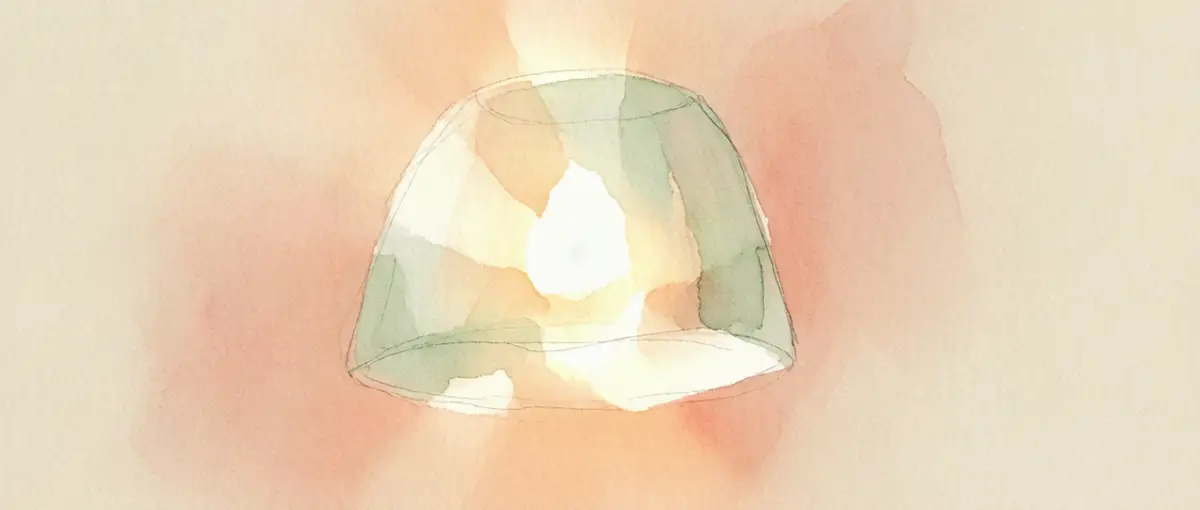
To call huo-yan "you're just hot-tempered" is too hasty. What it describes was never character, but a tilt of energy: the outward radiance is turned up too hard while restraint runs relatively weak. Seeing this, you need not blame yourself each time for "losing control." You only need to give that fire a lampshade—not to put it out, but to soften the light and let it shine longer. Your native fervor is a gift; only, a gift must be wrapped so it doesn't scald. Learn to leave half a sentence, slow by half a beat, and that fire will reach people farther off, instead of branding a scar only on those nearest.
A More Modern Way to Put It
In psychology, people with high extraverted arousal and intense expression easily "overload" others—much like huo-yan. The only difference: the metaphysical system treats it as a person's underlying energetic hue, while the modern account treats it as an "expressive regulation" that can be practiced. Naming it is not resigning to fate; so that the moment you think "I said too much again," you feel less chagrin, more ease—"oh, the fire's strong again, I'll leave half a sentence next time." Seeing it as a tendency, not your identity, lightens the self-doubt that lingers in relationships.
What does Huo Yan mean in BaZi?
Huo Yan means that Fire energy is especially strong and outward in a BaZi chart, symbolically emphasizing warmth, visibility, expression, and intensity. In a modern reading, it can help name moments when enthusiasm or honesty arrives too fast for another person to receive comfortably. It is not a fixed personality label; the useful practice is learning where to add space, shade, and timing.
Want to understand your intensity and boundaries?
If this description feels familiar, start a personal BaZi reading to explore the pattern through your own chart and lived experience. The goal is reflection and practical clarity, not a fixed prediction.
Keep reading: Jin-Han: When the Edge Is Wrapped in Frost · Mu Wang: That Upward Drive You Can't Hold Down · Ri Zhu: Whether the "I" Inside You Stands Steady
Written and reviewed by DustEcho Editorial for self-reflection and cultural inquiry—not counseling, medical advice, or a clinical diagnosis.
Not sure where to begin?