Tu Chong: When Steadiness Grows Into Stickiness
DustEcho Editorial
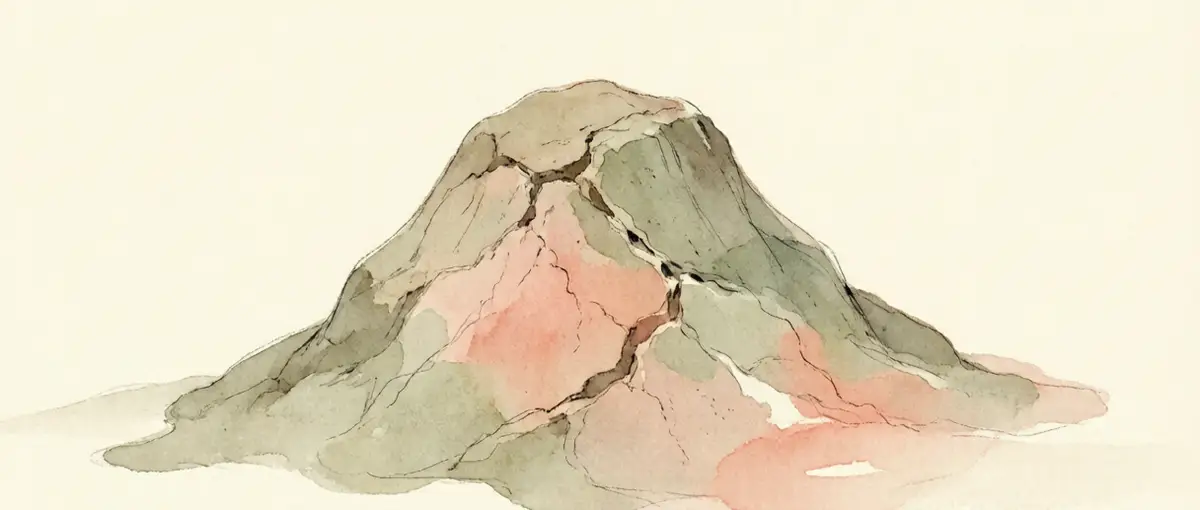
In the five elements of Chinese metaphysics, "Earth" governs bearing, containing, and holding things steady. Unlike Wood rushing upward, Fire blazing outward, or Water spreading everywhere, Earth simply stays, steady in place, catching what falls and keeping people close. But when Earth in a chart grows too thick, too dense, becoming "earth-heavy" (tu-chong), it is no longer merely stable. It hardens into hardpan. Like a field that has been trampled flat, soaked by rain, then baked dry — the surface hard enough to stand on, but no air reaching what lies beneath. This piece is not about fortune or fate, and tells no one's future. It only describes a way of being: a state of "too steady to move." You are not unwilling to move. The earth is simply, very heavy.
What does tu chong mean in Chinese elemental thought?
Tu chong, often described as “earth-heavy,” is a symbolic way to talk about steadiness becoming inertia: carrying too much, holding too tightly, and finding movement unusually costly. It is not a prediction, a diagnosis, or a judgment that someone is lazy.
How can I loosen a life that feels too stuck?
Start with one small release: clear one old item, name one limit, or ask for one practical kind of help. Explore the pattern gently if being reliable has gradually turned into feeling unable to move.
It is not a flaw — it is "bearing" turned up too high
The earth-heavy are often the people others lean on most. Calm in a crisis, they keep every promise. When a friend needs a place to land, they are the first call. Bearing is Earth's very nature, and there is nothing wrong with it. The trouble begins when that bearing energy is set too high: a person shifts from "someone who can hold things up" to "the ground everything gets piled onto." They are not untired. But once the earth piles up, even saying "I'm tired" feels like loosening the foundation. So the steadier they are, the less they dare to collapse; the less they dare to collapse, the more they pack themselves down. To others they are a mountain to lean on. Inside, they are a slab of stone nearly cracked through.
Like a mountain — steady, but compacted
Picture earth-heavy as a mountain. A mountain is beautiful, reliable, present every season. But a mountain also does not walk. The earth-heavy often carry a kind of "stuck-in-place-ness": they think about changing jobs for three years without moving; a relationship long drained is still dragged along; the city they live in, the faces they see, the life they lead — a decade, unchanged. Not for lack of wanting. Every "move" means moving the mountain that is themselves. The mountain's weight becomes both shell and cage. A colleague once asked if he'd consider a transfer out of town; he froze for a long moment, then said "I'll have to think about it" — and that thinking lasted two years. A friend says he dreads being asked "what do you want to do with your life," because he can't answer. Not for lack of ideas, but because each idea, the moment it surfaces, gets pressed back into the ground by the mountain. Others envy his stability. Only he knows how much is "dare not" and how much is "got used to."
You are not lazy — the earth is just too solid to move easily
Earth-heavy is most easily misread as "lazy." But laziness is "unwilling to move," while earth-heavy is "unable to move" — not a matter of will, but of inertia. A patch of hardpan: the first hoe strikes hard, the second finds a crack, the third loosens it. The earth-heavy face unusual friction just to start: a small thing, put off, becomes a stone in the chest. They are not without drive. Their "earth" must first be turned over; the turning itself spends what little momentum they had. So before calling it procrastination, look at the ground beneath their feet — has it hardened until no footprint shows? Sometimes it isn't delay. It's waiting for a force large enough to pry the hard crust open.
They can hold on, but not let go
Earth's other face is "keeping." The earth-heavy hoard remarkably: money, things, ties, grievances. A ticket stub from childhood, an ex's text, a coworker's careless remark — each gets filed in some inner drawer and locked. This makes them solid, and also heavy. The hard part isn't keeping; it's releasing. Once earth piles thick, even "throwing away" feels like cutting flesh from their own body. So the room fills, the heart thickens, and they stand in the middle, boxed in by what they've kept. It isn't nostalgia. The earth is simply too solid; releasing is something they haven't learned. Once, clearing an old phone, the photo album held two thousand pictures; deleting the last one, his hand shook — not at a picture, but at a foundation he couldn't bear to let fall.
Catching others, yet burying oneself
The earth-heavy are often the "ground" in their relationships. Whoever breaks, they hold up; whoever cries, they catch; whoever's mess, it lands on their desk. This is Earth's virtue, and Earth's burden. Rarely does anyone ask: has this ground ever itself been caught? Most earth-heavy can't answer, because they long ago pressed their own needs to the very bottom, under three layers of steadiness, two of being good, and one of "I'm fine." They can hold the whole world, except the self that also wants, once, to be held steady. So the more needed they are, the lonelier — because everyone stands on them, yet no one sees they too can cave in. They don't lack for people. They made themselves, first, into something that must not collapse. On holidays they are busiest, laying a table so everyone has a home to return to, while they themselves often eat standing at the kitchen door, bowl in hand.
It isn't stubbornness — the ground just hasn't been turned in too long
Earth-heavy is often called "stubborn," "single-minded." But to them it isn't stubbornness; it's "once I've settled, I don't change." Once earth hardens, the first thing lost is give: new ideas can't enter, old methods won't be dropped, even a joke may be taken as a real barb, a stab at the foundation. This isn't a character flaw. It's earth left too long un-turned: no fresh air, no fresh water, roots dead. To ask them to "bend" is less useful than giving them room to loosen: don't yank the roots at once; first help pry a seam in the surface crust. They aren't deaf to advice. Until that seam opens, no words reach the hard earth.
Loosen the soil of life a little
Back to earth-heavy itself. It is not cruel, and it should not be scorned. A patch of hardpan, once loosened, can still grow things. For the earth-heavy, the most important step isn't "forcing yourself to move," but first admitting: this earth really does need turning. Start tiny — clear out one box of things kept three years; tell a drained relationship, once, "I'm tired"; allow yourself one "unreliable" small indulgence. Loosening is not collapsing. Loosen the soil, and light and wind get in; roots can set again. You don't need to become a flowing river. You only need to stop packing yourself into a stone. A stone doesn't tire. But you do.
A more modern way to say it
In the language of psychology, earth-heavy comes close to an "over-functionalized sense of stability" — meeting the world through reliability, bearing, and immovability, until, over time, one's true desires and vulnerabilities are pressed below awareness, forming a kind of psychological hardpan. It often links to a high-responsibility upbringing and the early need to "be good and sensible": when voicing needs felt unsafe, a person learns to become a soundless foundation. Loosening the soil is the practice of rebuilding elasticity and boundaries — allowing uncertainty, help, and not being needed. Earth was always able to bear. Only don't let it bear so much it forgets it too gets thirsty. When thirsty, drink. It isn't shameful, and it isn't collapse — you were never born to hold up everyone.
Keep reading: Guan Sha Hun Za: Two Foremen Inside, Each Giving Different Orders · Han Nuan Shi Heng: The Broken Thermometer Inside the Body · Huo-Yan: When the Light Comes On Too Fast, It Also Burns
Written and reviewed by DustEcho Editorial for self-reflection and cultural inquiry—not counseling, medical advice, or a clinical diagnosis.
Not sure where to begin?