Yun: Gathered, It Scatters; Scattered, It Gathers
DustEcho Editorial
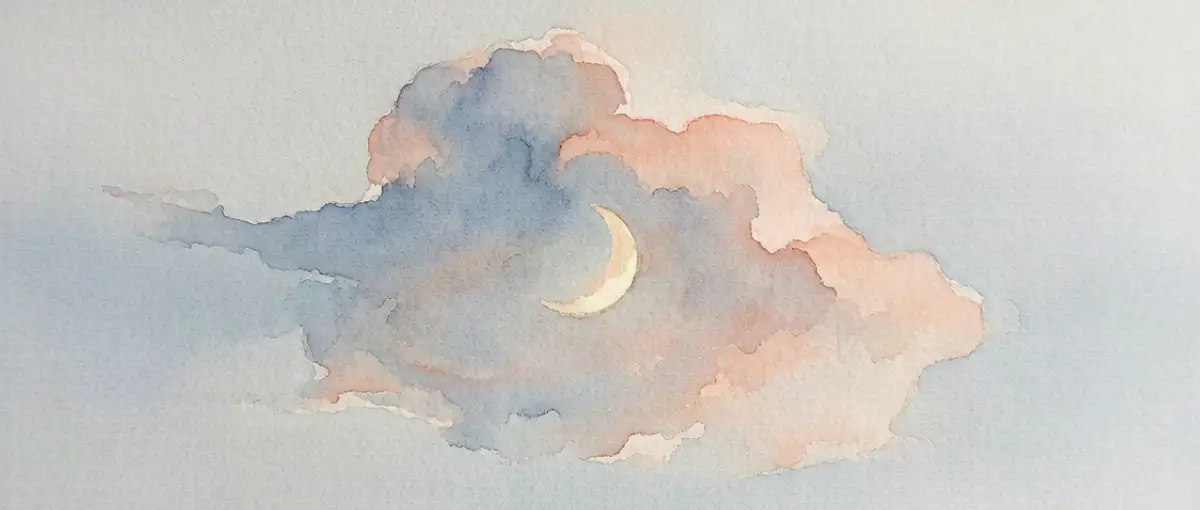
In traditional culture, the cloud is what "qi" looks like as it gathers and then dissolves. Earth-vapor rises, meets the cold and condenses into cloud; the cloud drifts for a while, then scatters back into emptiness. Tao Yuanming wrote, "the cloud leaves the rift without a thought" — meaning the cloud has no mind of its own, settling wherever it pleases, coming and going on the wind. So what the cloud points toward is an experience: no fixed form, and no clinging to any one form; gathered it is itself, scattered it is still itself, free in both coming and going.
What does the cloud symbolize in traditional Chinese thought?
The cloud symbolizes changing form, gathering and scattering, and the freedom to move without treating one role as your whole identity. In everyday life, it can help you hold transitions more lightly while still taking your responsibilities seriously.
How can I change without losing myself?
Name the role you are in, but do not confuse the role with the whole person. Let a form end when it has finished, and leave room for another to gather. Explore the idea gently if holding one identity too tightly makes every change feel like a loss.
It has no shape, yet has been every shape
The wonder of the cloud is that it has no definite form. One moment it is like a mountain, the next like a horse, then it spreads flat into a single sheet. It does not protest "I am not a mountain," nor does it linger fondly on "I was a horse just now." A push of wind and it changes. If people could be like this, much of their inner tangling would untie itself — at this moment you are a subordinate, a parent, a friend; these are only the cloud's temporary shapes, not you yourself. Take them not too seriously, and changing roles brings no panic.
Too many people weld a single identity onto themselves: "I am the strong one," "I am the one who was wronged." The cloud laughs at such welding. It knows the form is borrowed, to be returned the moment the wind passes. The tighter you grip one shape, the more easily you are torn when the wind comes — loosen a little, let forms come and go, and you are still you. A role is something you wear for a stretch of weather; it is not the weather, and it is not the sky.
It can cover the moon, and reflect the rosy glow
The cloud wears two faces: when thick, it presses the moon down and people below curse it; when thin, the setting sun passes through and sets it burning into a skyful of red clouds, and everyone photographs it. The same cloud, by its thickness and position, becomes another's darkness or another's light. So it is with people: a word of yours, a silence of yours, falling into different eyes, may be an obstruction or a reflection. You cannot control where it lands; you can only accept the account.
So do not fuss too much over "am I a good person" — the cloud does not agonize over whether it blocks the moon or mirrors the glow; it simply drifts. You do what you should do; where it lands, what it is taken for, is half beyond you. Accept this and you loosen: no longer struggling to manage every impression, only drifting at ease, and when it is time to mirror the glow, you mirror it naturally. The more you try to control every landing, the more tired you grow; let go and drift, and good light often falls on you by surprise.
It comes and goes, leaving no trace, and cannot be kept
The cloud never makes a home on any peak. It drifts past; the mountain remembers it, but it does not remember the mountain. This ease of "being remembered while not remembering" is something many cannot learn — forever seeking a sense of existence in being remembered, yet the cloud does not care. It drifts its own way; whether the mountain remembers is the mountain's affair. You cannot keep the cloud, cannot pinch it, cannot seal it under glass. So it often is with the gatherings and partings of people: some accompany you a stretch, thick as if forever, yet when the time comes they scatter, and you clutch and clutch and come away with empty hands. What the cloud teaches is — drift well when it comes, do not block it when it leaves.
Those who can keep company lightly all understand the cloud's logic. They do not cling, do not press "why did you not stay," do not endlessly replay after parting whose cloud moved first. They know that meeting is luck and parting is the cloud's nature. Keep what can be kept; what cannot, see it off as it drifts away, and go on drifting yourself. Not that they do not care, but they know the cloud you clutch, once in your hand, is only a pool of water — its true form lives only in the sky.
It does not explain its own changes
This moment the cloud is like a horse, the next like a mountain; it never explains "why was I a horse just now," nor apologizes for "how am I a mountain now." Change is simply change; it owes no one an account. Yet people love to explain: I changed because of you, because of circumstances, because... In truth what the cloud teaches is — change needs no reason; reasons are invented afterward for the ears of others.
The more you love to explain your changes, the more easily you are bound by your explanations, afraid to change next time. The cloud explains nothing, and so it can keep changing, changing with ease. Learn to say less, to yourself and to others, "this is why I became this way." It changed, so it changed; it drifted, so it drifted. Those who understand will understand naturally; those who do not, would not understand even with explanation. The cloud never defends itself, because it knows the evidence of its passing is all in the sky and needs no mouth — believe it and it is still there; disbelieve and it will not chase you.
It is high, therefore sees things lightly
The cloud is very high up; watching the quarrels of the human world, it is perhaps like watching ants carry grains of rice. Not that it is cold, but with enough vantage the things cease to be matters of life and death. Climb to a certain height, live through a certain depth of experience, and a person too "becomes cloud" — not turning high and mighty, but finding that what once made them leap with anxiety, seen from afar, is only a gust of wind that scatters.
So the other experience the cloud offers is "the lightness that height brings." Sunk inside it, you feel the sky is falling; step out, rise up, and find it is only a small clump on the ground. Learn to give yourself a layer of height: not to flee, but to borrow a vantage and make human affairs a little smaller, so you free your hands to do what you must. Not teaching you coldness, but teaching that when you are spinning inside, remember you still have a vantage that can rise — rise a layer, and the thing is still the thing, only less crushing. The quarrel does not disappear; you simply stop standing inside it.
It gathers and scatters, but scatters and gathers again
The thing the cloud least teaches is despair: when it scatters, it is not gone, it has returned to emptiness, and when the vapor rises again it gathers into new cloud. There is no forever-scattering, no forever-gathering; it is a cycle. When a relation thins, when a matter falls through, do not take it as an end — the vapor remains, and when the time comes, it gathers again in another form. Cling to gathering and you suffer; cling to scattering and you suffer too; know it is a cycle and you simply watch it turn.
Many are stuck at "scattering means it is over." The cloud says no. That you are alone now is the cloud scattered; after a while a new cloud rises from elsewhere and there you are within it again. Allow gathering and scattering to be as natural as breathing, and you neither fear loss nor crave possession — after all it will come again, after all it will leave again.
It is light, therefore goes far
The cloud can drift across all under heaven precisely because it is light. Once it grows heavy — soaked with rain, formed into hail — it falls and is trapped where it lands. Lightness is not weightlessness; it is just enough weight that it does not fall. So with people: the more solid the things you carry (fixations, identities, things you must prove), the less you can fly, and you can only dent the ground where you stand.
Learn to be a little lighter. Not unserious, but do not weld every matter into a lifelong weight. The cloud is light, and so it has been to the highest sky and the farthest mountain; you, a little lighter, can also reach farther places. Grow heavy and you fall — this is the cloud's iron law, and the person's. When you envy someone "living lightly," it is mostly not that they have no troubles, but that they are willing to set down, one piece at a time, the weight of things they simply must prove — setting down is not discarding, it is learning not to clench every cloud into hail.
Back to ourselves
The image of the cloud speaks of a state of "not clinging to form, coming and going at ease." It has no fixed form yet has been every form, it covers the moon and mirrors the glow, comes and goes leaving no trace, sees lightly from on high, and cycles through gathering and scattering.
You have probably all been cloud — dense beyond dissolving in some relation, feeling yourself gone when it scattered; or the reverse, forever drifting, afraid to land. The cloud's lesson is: whether you land or not is fine, only do not take some form as the self. You can be a while a gathering cloud, and a while a scattering cloud; both are you. Just drift. You need not forever gather into a clump for others to see, nor fear that scattering leaves you as nothing — when the cloud scatters, the vapor remains, and so do you. Do not fear gathering and scattering, nor fear lightness — you are light, and so you can drift; you scatter, and so you can gather back. The cloud's way of living is to leave blank space for yourself and for others. Gathering, scattering, coming, going — these are its duty, not its debt.
Keep reading: Shan: Always There, Unspeaking and Unyielding · Shi: Silent, Yet Holding Everything · Water: The Softest Thing That Always Finds the Crack
Written and reviewed by DustEcho Editorial for self-reflection and cultural inquiry—not counseling, medical advice, or a clinical diagnosis.
Not sure where to begin?