Huo: The Upward Surge That Cannot Be Held
DustEcho Editorial
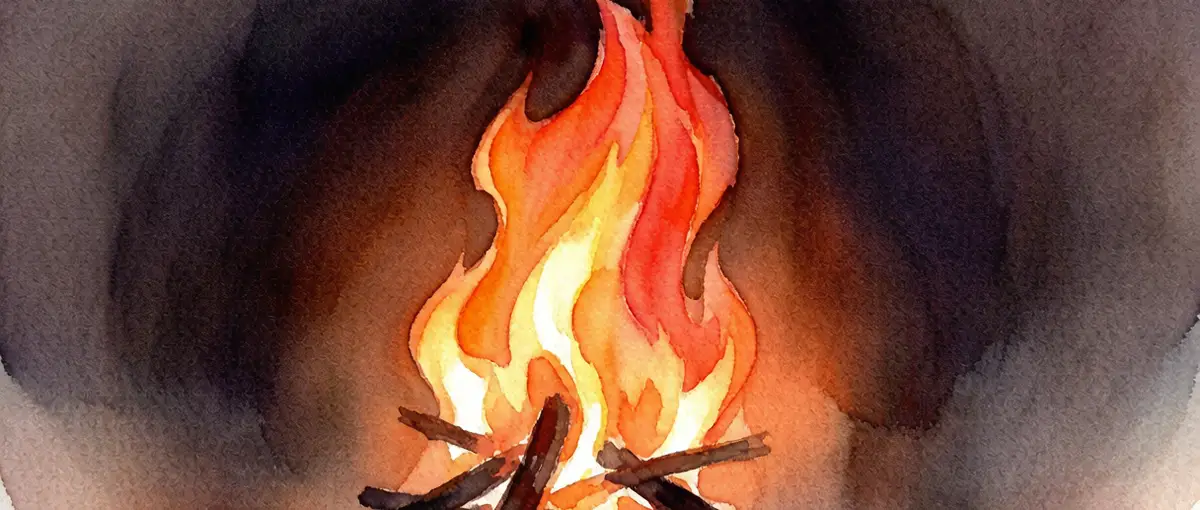
Fire, in the old cosmology, is the thing that "blazes upward." Among the five phases it governs propriety, and its nature is to flame aloft—never downward, never lying still, always surging and shining toward the sky. Rubbing wood to coax out a spark, people gained fire and with it drove back the night, warmed the body, cooked the food. So what fire stands for is an experience: an urge that cannot be suppressed, to rise, to shine, to grow hot; it is joyful, and it is brief; it illuminates, and it burns itself away.
It Only Rises, Never Turns Back
Fire never burns downward. Once lit, it races upward and ignores whatever lies below. This upward-blazing drive is fire's most fundamental nature. There are people like this too: they only reach upward, never settling, never lying flat—even if they burn fast, they mean to shoot high. You would not call them steady, yet when they blaze, they truly light up a stretch of darkness. The steady ones keep the lamp burning; the fiery ones light up the night—both are precious, only the fiery kind asks more of you, that you bear with how fast they burn, and not wait until they are gone to remember how bright they were.
This drive is the shape of creativity. Many things are done not by "steadiness" but by that upward-leaping fire—catching first without counting the cost, burning out a form. Those too afraid of burning out have never shone at all. Fire teaches: there are seasons when you must let it leap, and stop trying to "keep" it. The precious thing about that leaping drive is precisely that it does not plan to stay—it comes to flare once, and if you force it to "burn safely for a lifetime," it goes out in a sulk. Some fires live only for that one moment of height. Have you seen the brightest fire in the night? It does not plan to stay, yet in the few seconds it shone, everyone in the room could see each other's faces—maybe that is all fire asks for, those few seconds of clarity.
Its Warmth and Its Burning Are One and the Same
Fire's warmth and fire's destruction are the same fire. Draw near and it warms you; draw too near and it scorches; wrap yourself in it and it burns you. There is no fire that only warms and never destroys. Human warmth is like this too: warmed by someone's heat, perhaps burned by the same. They did not change—fire has always had two faces, and closeness scalds.
So to be with a fiery person is to be with fire: keep your distance. Not far, so it warms you; not pressed close, so it cannot burn you. Too many relationships spoil at "just a little closer"—close enough that fire loses its boundary, and its power to warm. Those who understand fire do not fling themselves upon it; they stay at the distance where it is exactly warm. Easy to say, hard to do—people cannot help leaning in a little more, thinking closer means warmer, when closer only means scalding, scalding means retreating, retreating means cold, and after a few rounds both the fire and you are exhausted.
It Lights the Dark Yet Burns Itself Out
What fire gives most generously is its light. In the darkest room, a single flame and the dark recedes. Yet fire itself is brief—when the oil is spent, the wood finished, it goes out, and how long it shines is not its own to decide. Those "glowing" people are the same: they have lit the way for many, yet their own stretch burns faster than anyone's. If you have borrowed their light, do not think it inexhaustible.
So fiery people are to be cherished, and to be self-aware: that you shine is good, but you must add wood for yourself, not only burn without renewing. Too many burn for a while, hollow themselves out, and wonder why they went out. Fire does not deceive you—it said long ago that it is brief. Shine earnestly while you shine, and keep some wood for yourself. But do not let "keeping wood" become an excuse for "daring not to shine"—many hoard wood all their lives and never light a single fire; that wood just sits there damp, amounting to nothing.
It Turns to Ash in a Breath, and the Ash Holds New Life
Fire teaches least of all to cling to "being." A roaring night, and at dawn only a heap of ash remains. Yet the ash is not left for nothing—plants and trees burned to ash make the finest fertilizer, on which next season's shoots depend. Fire's "going out" is another kind of "giving." So it is with people: when something that burned is scattered, do not see only the ash and miss the fertilizer beneath it. The intensity you lived through all ends up in the soil of your next stretch.
Many are stuck at "how did that fire go out." Fire says: out is out, and from the ash something else grows. You need not keep every fire; what you can keep is the layer of fertilizer added to your field after it burned. To allow going out is fire's greatest generosity—it grudges not being there, so long as it shone and fertilized. This is the hardest lesson: wanting to keep what burned, yet ash kept but not turned into the soil is only black on the ground. Turn it under, and it truly becomes fertilizer.
When It Dies, the Light Lives On Elsewhere
The most comforting thing about fire: it goes out, yet those it lit carry that light away. The fire in the room is out, but the brightness stays in your eyes; a person's fire disperses, yet those warmed by him become the next source of light. Fire's contribution does not end with its ending—it hands the light over.
So fiery people, do not fear going out. That stretch you shone has already been planted in others' eyes. You need not burn forever to prove your worth; when you go out, the light goes on shining elsewhere—the best proof you ever burned. Allow going out, and trust what continues after. You shone a while, and that light is no longer yours but belongs to those who borrowed it—and that carries farther than clutching the torch forever.
It Purifies, and Tests Your Measure
Fire can purify. The ancients used fire to clear filth, temper metal, boil water and kill germs. Fire burns, and the dirty is gone, the pure remains. Yet purification and destruction are a hair's breadth apart: right heat and the metal is purer; too much and it melts. The "fire" in people—that earnestness, that anger, that drive to change one's fate—can burn the grime off the self, or burn the self up by the roots.
So what fire tests is your measure. That upward-leaping drive, aimed at the grime, is tempering; aimed at yourself, it is destruction. To lead the fire outward against the grime, not inward against your own roots—only then does this fire become useful. Fire that burns wildly leaves only ash; fire that burns well tempers out gold.
It Is Tended by People, Yet Fears Being Worshipped
Fire cannot do without human care—adding wood, shielding the flame, not letting the wind put it out. People tend fire, and fire feeds people; this is mutual dependence. Yet tending too much also spoils things: crowd too close to the hearth and you are scalded; enshrine fire as a god and you dare not add wood, and the fire smothers itself. What fire wants is "to be just tended," not "to be lifted so high you dare not touch it."
Fiery people also fear two kinds of worship: one that borrows your light regardless of whether you live or die, exhausting you; another that enshrines you as a symbol, not letting you go out, not letting you be human. Fire wants equal dependence—you add wood, I burn bright, and neither kneels. The worshipped fire is the easiest to put out. Fire wants someone to tend it, not someone to kneel to it; tend it and it cools, care for it and it flourishes.
Back to Ourselves
The image of fire speaks of a drive that "surges upward, illuminating and burning out." It only rises and never retreats, its warmth and destruction share one source, it shines and is brief, it goes out and becomes fertilizer, it purifies and tests your measure.
You have probably been fire—some stretch when the unstoppable urge to shine and rise burned you happy and hollow; and you have borrowed others' fire, been warmed and scalded. When that urge comes again, do not hold it in—let it leap; but remember it is brief, it has two faces, and it tests where you lead it. Fire need not be kept; to have shone, purified, and fertilized is enough. That upward-leaping urge in you is a gift, not a debt—leap when you should leap, go out when you should go out, and do not tether it with "must be useful." You shone, and someone borrowed your light to cross the dark; you went out, and that light remains in others' eyes. Whether a life of fire was worth it is not measured in how long it burned, but in who it lit.
Written and reviewed by DustEcho Editorial for self-reflection and cultural inquiry—not counseling, medical advice, or a clinical diagnosis.
Not sure where to begin?