He-Liu: Keep Moving, and You Will Reach the Sea
DustEcho Editorial
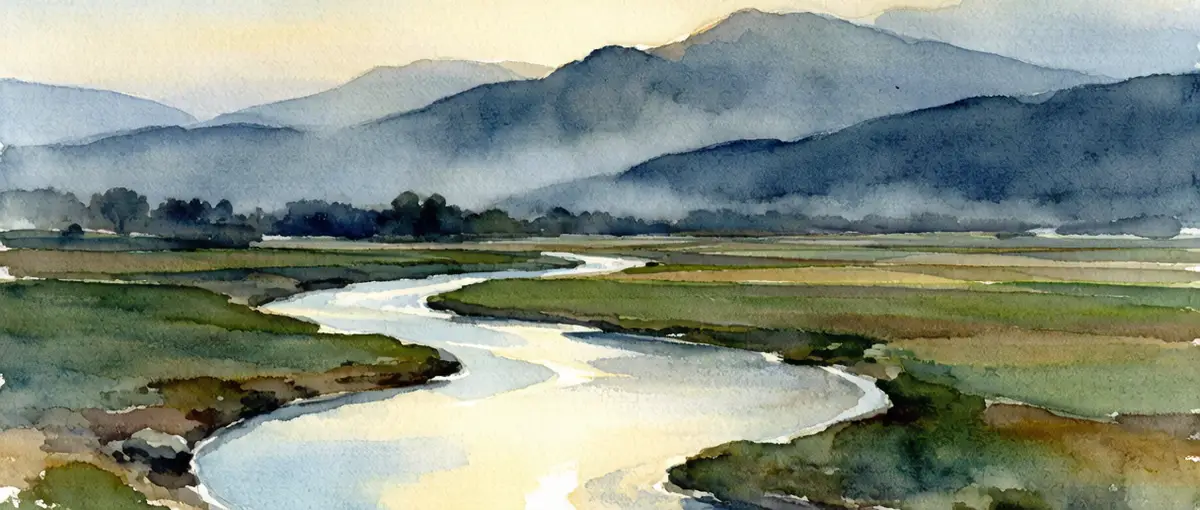
In traditional culture, a river is the most tangible image of time. Standing by a river, Confucius said, "Thus flows that which passes away — never ceasing day or night." What he saw was water that keeps moving and never turns back. Every river has a head and a mouth: it begins as a single spring in the mountains, gathers into a brook, gathers into a river, winds through countless bends along the way, yet its direction never changes — downward it goes, and onward to the sea. What the river stands for is an experience: it is not fast, but it does not stop; it winds, but it does not go back. Keep moving, and only then do you reach the distant place.
It Is Not the Fastest, but It Gets There
Water coming down a mountain could take the fastest path — plunging straight into a waterfall. But the river does not choose that road. It follows the lay of the land, curving here, curving there, seeming to dawdle, yet never pausing. In the end, it is not the waterfall, which flashes once and is gone, that reaches the sea, but this river that walks slowly and walks always.
Think of those who "made it overnight." Most are like waterfalls — fierce while their momentum lasts, but once the force is spent they scatter; they cannot hold on, and they cannot go far. The river is different. It dissolves that momentum into a long channel, flowing a little each day, flowing all its life, and finally entering the sea. Slow and stopped are two different things: the river is slow, but it never resets to zero; the waterfall is fast, but it vanishes in an instant.
People often make the mistake of impatience: they want to arrive at once. Yet many things have no straight-plunge path, only a river that bends as it goes. In your hurry for "speed," you are more likely to break, to crash, to dry up halfway on the rocks. It is all right to be slower; the key is not to stop. The river does not win on speed — it wins because it never lifts its feet.
It Bends, but Never Changes Direction
The most marvelous thing about a river is its bending. When it meets a mountain, it goes around; when it meets a ledge, it pools and gathers before moving on; it never forces a head-on collision. Yet if you trace its bends backward, every single one is heading toward the sea. The bend is the method; the sea is the direction — and the river keeps the two perfectly distinct. Too many people read "going around" as "giving up." In truth, going around is also advancing; it simply refuses to wrestle with the stone.
There are far too many things blocking the road of life. Those who ram straight into obstacles tire after a while and sit down, refusing to move, even comforting themselves with "it was fated to be so." The river does not think this way. It bends because the mountain cannot be moved, but the sea is still over there. Those who know how to bend preserve their direction and let go of the struggle against insignificant obstacles.
It Has a Source, and It Has a Mouth
To understand a river you must look at both ends: where that first drop at the source came from, and where the estuary is headed. Looking at only the middle stretch, you cannot understand why it flows as it does. People are the same — the temperament and the way of living you have now have a source behind them (where you came from, what shaped you) and a hope ahead (where you are going, what you are after). If you fix your eyes only on the present stretch, many things cannot be explained.
So do not be harsh on yourself for "the middle stretch." The bend you are in now may have been set by an early source; the sea you will enter someday may not yet be visible. Hold both the source and the mouth, and you will be a little more forgiving toward yourself, and a little more understanding of others — no one has flowed into who they are for no reason at all.
It Can Carry a Boat, and Capsize One
That river water holds up a boat is common knowledge; yet when the water swells, it capsizes the boat too. A river has two faces: when it is deep and steady, it is a road, a passage — you set your things upon it and it carries them for you; but when it floods, that same stretch of water becomes a hazard. Thus the old saying, "Water can carry the boat, and it can overturn the boat" — not because water is wicked, but because the same force, with a different measure, yields the opposite ending.
So it is with how we "hold up" others. Supporting someone, bearing them forward, is a good thing; but if you hold them up until you drown yourself, or until they never learn to walk on their own, then the holding becomes the overturning. Those who know how to hold understand the depth of the water, and know to let go when it rises. It is not that they refuse to help — they know where the help becomes shore, and where past that line lies the abyss.
It Never Stops, Day or Night, and Never Waits for You
The most unsentimental temper of a river is that it does not wait. You stand dazed at its bank — it flows on. You are busy — it flows on. You are finally ready — and it has already flowed past a stretch. What Confucius sighed over was exactly this: not that the water flows fast, but that it never consults you at all. Time is this river; whether or not you take part, it flows.
Many people keep "I'll do it when I have time" on their lips, but the river does not flow backward. Most of those "times" you wait for will never arrive on their own. The river's reminder is blunt: do the thing you want to do while the river is still in this stretch; once it has flowed past, that stretch is truly gone. This is not anxiety — it is honesty. The river does not wait; that is simply true.
Many people understand this only at fifty, unfortunately after the river has flowed past the stretch that could have borne them up best. But to understand is never too late: you need not chase back to the upper reaches; stand in the stretch where you are now and keep flowing downstream. The river never stops because "I wasted that earlier stretch" — it only begins again from the drop at its feet, continuing toward the sea. Neither should you.
It Reflects a Sky Larger than Itself
The river has another wonder: it is level, and so it can reflect. Stagnant dead water reflects nothing; a rushing living current reflects clearly — because the river's surface is always moving, yet always level. You look into the river and see not the river but the sky, the mountains, the people walking on the shore. The river borrows things far larger than itself to appear to have content.
People are the same. One who keeps moving and stays level can "hold" more — not because he is more capable, but because he does not wobble or clog; things flow through him, and in him they reflect a larger world. Those who churn at the slightest thing have a surface all shattered, reflecting nothing but their own little spray of waves. The river teaches: if you want to see the large, first walk yourself level.
It Is Muddy Because It Has Passed Through So Much
No great river is clear to its bottom. It flows through cities, farmlands, valleys where mud and sand come down together — how could it still be like that first drop at the source? Yet it is precisely this "dirt" that makes it a river — it has weight, it has the power to nourish, it can sustain both banks. A brook that stays forever clean can sustain nothing.
Have you met that kind of "too clean" person? Touching nothing, committing no fault, yet also shouldering nothing. Cleanliness is easy; what is hard is to flow through mud and sand and still go forward, still willing to nurture something on the bank. The river does not disdain its own murk; it only flows. The murk is proof of where it has been, not its shame. Do not keep staring at the little matter of not being "clean enough" — the mud you have passed through all ends up on the road to the sea.
Do not fear being "impure." What you have experienced, compromised over, the mud you have been stained with — these keep you from being that thin single spring, yet they make you a river that can bear things up. Loftiness is easy; what is hard is to flow through mud and sand and still go forward, still willing to nurture something. The river does not disdain its murk; it only flows. Do not keep staring at the little matter of not being "clean enough" either.
What does a river symbolize in traditional imagery?
A river can symbolize time, persistence, direction, and the ability to bend without losing a larger course. It does not promise a straight or clean journey; movement can include mud, detours, and changed banks.
How can I keep moving when progress is slow?
Choose a direction you can return to, then make the next workable move rather than demanding a perfect route. If you are exhausted or stuck, pausing to repair the vessel is part of continuing, not evidence that you have failed.
Want to understand how detours can still belong to the journey?
If every bend feels like wasted time, gentle self-exploration can help you see what the current is still carrying forward.
Back to Ourselves
The image of the river speaks of a kind of "continuing, directional, bend-knowing forward movement." It is not fast, not straight, not waiting, not pure — yet it reaches the sea.
You have probably all been the river at some point — a stretch that bent so much you wearied of it yourself, a stretch that swelled so frighteningly, a stretch so muddy you did not want to claim it. Yet as long as you have not stopped, have not turned back, those bends, those swells, that murk all finally count toward the road to the sea. The river never turns back to count how many bends it has made. Neither should you.
Keep reading: Shi: Silent, Yet Holding Everything · Water: The Softest Thing That Always Finds the Crack · Xingchen: The Highest Place, the Steadiest Order
Written and reviewed by DustEcho Editorial for self-reflection and cultural inquiry—not counseling, medical advice, or a clinical diagnosis.
Not sure where to begin?