Shan: Always There, Unspeaking and Unyielding
DustEcho Editorial
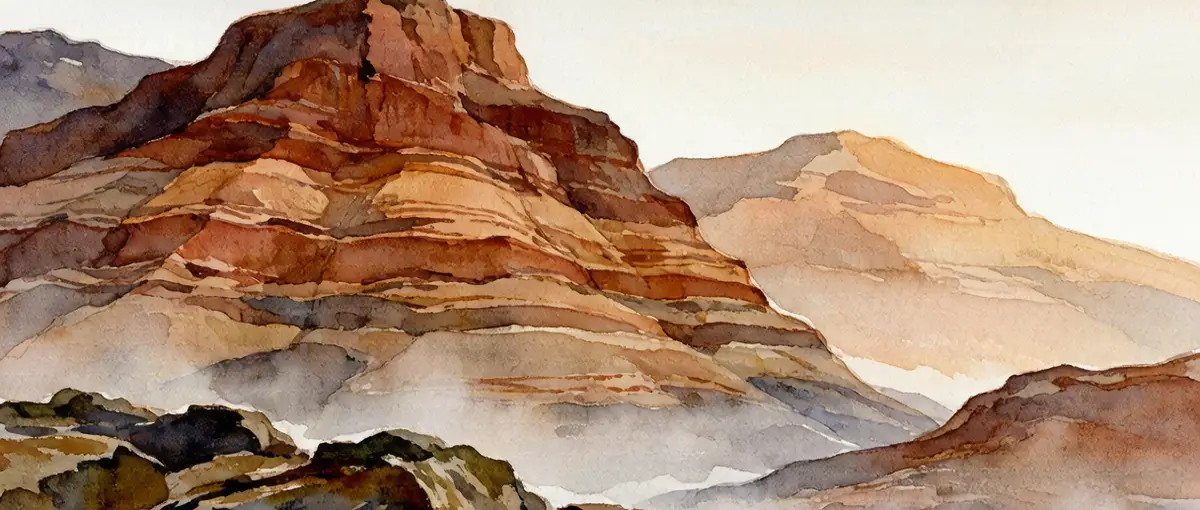
The mountain is the oldest image of reliance in traditional Chinese culture.
In the Yijing, the Gen hexagram corresponds to the mountain, and its guiding virtue is "stopping" — to halt, to hold steady, not to move lightly. Confucius said, "The wise find joy in the mountain," linking it to a warmth and solidity that can be entrusted with weight. In the Five Phases, the mountain belongs to earth, and earth governs trust and bearing. What the ancients placed upon the mountain was never sharpness or edge, but a kind of steadiness that says, "You're here, and so am I." That steadiness is still recognizable today.
Stillness Is the Mountain's First Meaning
When everything descends into chaos and everyone is in motion, there is always one person who doesn't panic. It's not that they have no reaction — their reaction simply comes half a beat slower, a notch steadier. While others rush to declare their position, they take another look at the situation. While others have already started arguing, they're still confirming what actually happened.
This slowness is not dullness. The mountain stays where it is not because it's stupid, but because it knows: the moment it shifts, everything leaning against it sways too. So it would rather be called slow, rather hear "why aren't you worried yet," than take that step lightly. In everyday life, this is the kind of steadiness that says, "No matter how urgent it gets, I need to understand things first." It makes people feel grounded, because you know in your heart that this person won't let panic drag the whole direction off course. Panicked people make wrong decisions; steady people are slower, but rarely wrong about direction. The cost is real — in fast-paced environments, this slowness works against them. Bosses want instant replies, colleagues want you to pick a side, and that brief pause gets read as hesitation. But when something actually goes wrong, the person everyone turns back to find is still them. The mountain doesn't run. The mountain has always been right where it was. That is its most reassuring quality, and also its most exhausting one.
Leaned On Long Enough, It Takes the Shape of a Mountain
The mountain wasn't born this steady. It was leaned into shape.
Think about the person in a family whom everyone goes to for everything, the person on a team who comes to mind first when something goes wrong. They didn't necessarily start out that way. Maybe once, just once, everyone else panicked and they didn't. Everyone else pulled back and they held their ground. Then the next time, people went to them again. Once, twice, ten times, twenty times, and a layer of weight slowly settled onto them.
This weight isn't performed. It's borne. When you carry things long enough, your spine genuinely stiffens, your voice genuinely drops, and even sitting still, you make people feel that you are solid. The mountain is the endpoint of that process: you've been leaned on for so long that you've forgotten you were once allowed to fall. Many people don't set out to be mountains. They get leaned into being one. And when they turn around, everyone behind them is counting on them, and even if they wanted to fall, they don't dare.
Steady People Don't Say Much
The mountain has another quality, one that gets misread easily today: it doesn't explain much.
People who are steady tend to talk less. It's not that they can't express themselves — they just feel that saying something once is enough, and that explaining at length is less useful than simply getting the thing done. But in relationships built on instant replies and emotional responsiveness, this silence is often read as coldness, as not caring, as "what are you even thinking?"
It isn't that. People who talk little aren't lacking things to say. They feel that too many words dissolve the weight. A truly steady person turns a sentence over in their mind several times before letting it out — not to polish it into something beautiful, but to confirm that after saying it, they can still stand behind it. So what comes out is usually the one sentence that actually matters. But the cost is real: the people closest to them sometimes feel they can't quite reach them. They're right there, yet something seems to stand between. That something isn't a wall. It's the layer of steadiness they use to hold themselves together.
This Steadiness Carries Weight
The mountain's least visible side: steadiness has a price.
The people leaning on the mountain only see that it doesn't move. They can't see how many layers are pressed down beneath it. A person who has long been relied upon carries a great deal — other people's hopes, other people's hardships, the weight that others shift onto them when they can no longer hold it themselves. None of this will make them collapse. But it will make them heavier and heavier.
This heaviness isn't the kind of breaking down that says, "I can't take it anymore." It's the kind of stifling that says, "I'm still fine, just getting quieter." They can bear anything, catch anything that falls, but it gets harder and harder to read any ease on their face. It's not unhappiness. It's that the tension holding them steady has been pressed down for so long it can't loosen anymore. This is the part of the mountain's steadiness that most deserves tenderness: it will never collapse in front of you. You think they're fine because they haven't let you see otherwise. They've grown accustomed to catching everything, and after catching it for so long, they've stopped saying even to themselves when they started to buckle.
The Mountain Doesn't Vie for the Highest, It Just Stays
Mountains rarely compete with each other over which is taller.
Take a walk in the mountains and you'll notice: range after range, not a single peak is wrestling with its neighbor. It doesn't jab at the sky, doesn't fight for first place. It simply stands where it stands, as tall as it happens to be. This is a different logic from the one that dominates today — "always climb higher," "be the fastest, the tallest, the strongest." The mountain's steadiness doesn't prove itself by winning. It proves itself by remaining.
This isn't a lack of ambition. The mountain knows its worth doesn't lie in being taller than someone else, but in how much it holds up beneath. A truly steady person doesn't need to compete — they know their own measure, and don't need to outdo anyone to confirm it. That certainty is another kind of confidence the mountain offers. Look at the people who have held up an industry, a family, a relationship for many years. They are rarely the ones at the very front shouting the loudest. They're in the latter part of the pack, and when the people ahead have tired or veered off course, they're still where they were, step by step, never having stopped. The ones who last are usually the ones who don't compete.
Too Steady to Move
The mountain has its own difficulty. Gen governs "stopping." Stopping is steadiness, but stopping is also standing still.
A person accustomed to being steady can easily nail themselves to one place. When it's time to change, they don't. When it's time to go, they stay — not because they don't want to, but because they're too heavy, and moving takes too long. Someone else makes a decision and moves on in three months. They make a decision and are still in the same place three years later, because every time they shift, they have to make sure the people and things depending on them won't sway. To others, this slowness looks like stubbornness. To them, it feels like responsibility. But responsibility carried too long welds them into that position. Sometimes it's not that they don't want to move — it's that they can't. If they step away, the empty space they leave behind has no one to fill it.
Sometimes, what the mountain needs to learn is the skill of water: loosen up a little, move a little. The sky won't fall.
What does the mountain symbolize in traditional imagery?
The mountain can symbolize steadiness, reliance, boundaries, and the quiet weight of being the person others turn toward. It can also remind dependable people that they are allowed to rest and be supported in return.
How can I be reliable without becoming everyone’s support system?
Name your capacity before agreeing, ask others to share the weight, and schedule time when you do not have to hold the room. A stable person is still a person, not public infrastructure.
Want to understand why being strong has started to feel lonely?
If everyone leans on you but nobody asks where you rest, gentle self-exploration can help you let the mountain have a cloud day.
In Today's Terms
People don't say "the wise find joy in the mountain" much anymore, but the feeling of "you're here, so I feel grounded" — everyone recognizes that.
The name "mountain" marks a kind of experience: you may not be the brightest, the fastest, or the most visible, but you are the one people look for when they panic. This steadiness is something you've carried into being, and it is also something that can stifle you. If you are that mountain, remember to let yourself be a little less heavy sometimes — even mountains have moments when they want to turn into clouds and drift for a while. And if you have a mountain beside you, don't just lean on them. Let them lean too. They've been holding for so long. Let them know that if they fall just once, the sky won't come down.
Keep reading: Huo: The Upward Surge That Cannot Be Held · Shi: Silent, Yet Holding Everything · Water: The Softest Thing That Always Finds the Crack
Written and reviewed by DustEcho Editorial for self-reflection and cultural inquiry—not counseling, medical advice, or a clinical diagnosis.
Not sure where to begin?