Gen: The Mountain That Stands to Show You the Edge
DustEcho Editorial
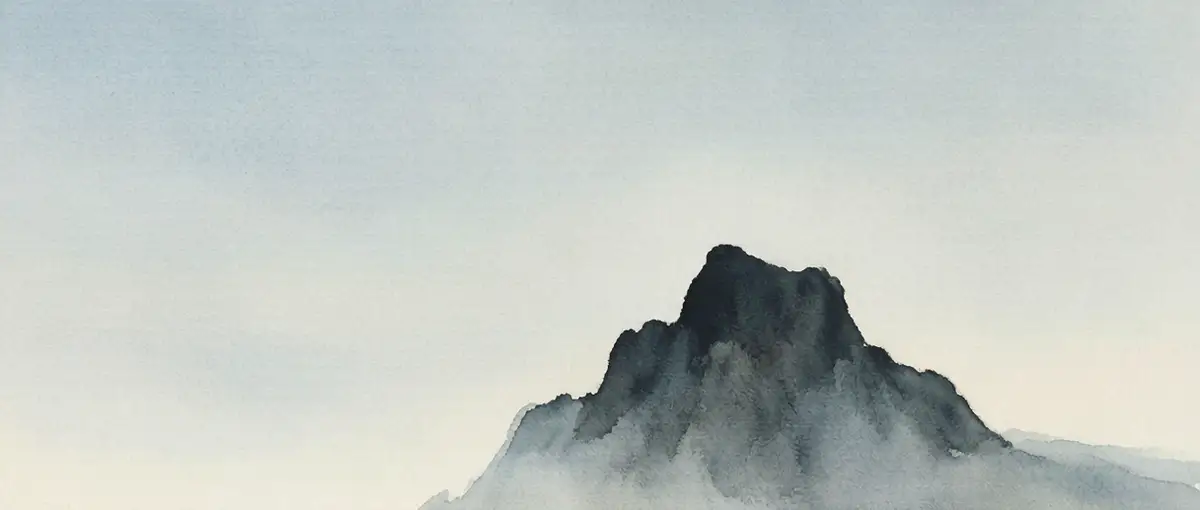
In the I Ching, Gen is the mountain trigram. The ancients saw in a mountain not its height but its stillness—it does not chase, hurry, or move. So Gen speaks of "stopping": rest, boundary, knowing where to draw the line. When something reaches the foot of a mountain, that is where it should stop.
In the eight trigrams, Gen means the northeast and the youngest son. Mountain, northeast, youngest son—same wisdom: not every direction must be traveled; some places are simply the edge.
It does not move forward, and has no plan to
What reassures us about a mountain is that it is never in a hurry. Rivers flow, wind runs, thunder cracks, but the mountain just stands. Gen's stopping is choosing not to. Many are tired because they never stop. Gen says stopping is a state of being.
One solid line on top: the grip at the peak
Gen has only its top line solid, the two below broken. Like a mountain, that line is the summit, anchoring the trigram. In a person it is knowing when to close the book: you stand once you reach the top. Have you seen a mountain chase the clouds?
Stopping is not wasting
Gen is easily misread as laziness—it does not move, unlike Qian's self-strengthening. But stopping is another force. Crops stop when the season turns; only by stopping do they form grain. A person who runs too hard needs a Gen to brake.
The mountain tells you where the edge is
What a mountain does best is draw a boundary. You walk forward, meet a mountain, and know: the road ends here, turn. Gen's "stopping" is often knowing the boundary—where a relationship should end, when a project is done, the edge of your ability. The mountain tells you the edge is here.
The image of the youngest son: still young, first learn to stop
Gen is the youngest son. Children want everything, charge at everything, cannot stop. Gen's lesson is precisely "stopping"—still tender, do not rush everywhere; first learn to stop where stopping is called for. Drive is good when young, but not every door needs pushing open.
Stop when the time calls for stopping, move when it calls for moving
The weightiest line of Gen says: stop when the time calls for stopping, move when it calls for moving. Stopping and moving are not a choice of two; it is timing. Move when you should, stop when you should. Many enshrine "perseverance" as a god. But Gen says stopping is also a skill.
The person who never stops needs a Gen most
The more someone cannot stop, the more they need a Gen before them. Without a mountain they run until spent. Gen is not for the lazy but for those who cannot stop—it draws a line so you can gather in while you can.
Only by stopping can you see the path you came by
Sprinting all the way, the only thing in view is the next step. The moment Gen stops, the world goes quiet, and you see where you came from and where you are going. The mountain's use is that instant it forces you to pause—the answer rises on its own.
Do not read stopping as losing
What Gen's stopping fears most is being read as giving up. Some meet a mountain midway and think, I can never pass. In truth the mountain tells you to stop, to consider another road. To live your stopping as a loss is the only real loss. Gen wants you to stop; it does not want you to abandon.
Those who can stop have the longest staying power
The person who never stops looks driven but runs out halfway. Gen's "stopping" leaves room for endurance—walk, pause, go on. Many who accomplish real things know best where to brake. Stopping is not a break; treat it as rest, not the finish.
What does Gen mean in the I Ching?
Gen is associated with a mountain and the ability to stop. It does not glorify passivity or failure; it asks whether pausing is the action that protects your energy, boundary, or judgment.
How can I know when to stop?
Look for repeated signals: diminishing attention, rising resentment, physical exhaustion, or a task that is no longer producing useful movement. Set a defined pause and decide later whether to continue. Rest is not a verdict on your ambition.
Want to understand why stopping feels harder than pushing through?
If you keep treating every pause as lost ground, gentle self-exploration can help you discover the mountain edge before you cross it.
So to write of Gen is to write of a stillness brave enough to stop
We do not write those ruled by Gen must stop and so are stuck. We write this: when you are breathless yet dare not stop, is there a mountain in your heart willing to draw that line for you? The mountain does not chase clouds; it simply stands. You do not have to keep running either.
The hard part was never to move, but to dare to stop at the right moment. Do not mistake stopping for being unable. The mountain never explains why it will not walk. It simply stands, there.
Keep reading: Kun: It never steals the spotlight, yet everything rests upon it · Li: It shines because it first found something to cling to · Qian: Heaven never stops moving, so it never grows old
Written and reviewed by DustEcho Editorial for self-reflection and cultural inquiry—not counseling, medical advice, or a clinical diagnosis.
Not sure where to begin?