Kan: Water is always there, so learn to stand in it
DustEcho Editorial
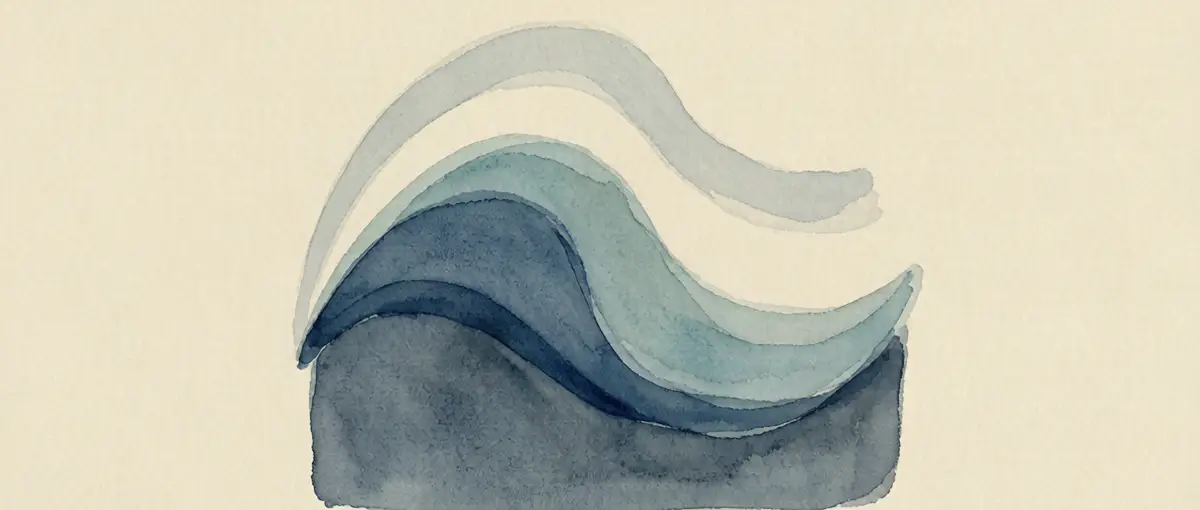
In the I Ching, Kan is one of the eight trigrams. Its symbol is two yin lines above and below with one yang line in the middle (☵), standing for water, and also for "sinking" and "danger." It is not the same as the "water" we wrote about before — that piece was about seepage, about overcoming the hard with the soft. Kan isn't about water's gentleness; it's about water's difficulty: that stretch of life's danger that keeps coming back, that you can't get around, that rises like water again and again. The hexagram's very name is "repeated Kan," meaning "doubled danger" — not once, but layer upon layer.
The ancients tied Kan to the "heart," saying "only the heart goes through; it is because of the firm center." Meaning, no matter how big the waves outside, as long as that yang line in the middle — your composure — remains, you get through. What Kan teaches isn't how to dodge water, but how not to sink in it.
When it comes, you can't block it
The image of Kan is "water comes in succession" — wave after wave. The difficulties in life are often like this too: just handled one, the next floods up; just caught your breath, another pit. The more you think "once this passes, total peace at last," the more the next wave floors you. The first, thoroughly discouraging but true thing Kan teaches: danger is the norm, not the exception. Accept that water is always there, and you free up energy to think about how to stand, instead of cursing daily why water came.
Sinking in isn't the end
Kan is "sinking," a pit. The moment you fall in, instinct is to panic, to thrash upward — and the more you thrash, the deeper you sink. The wisdom of Kan is in that middle yang line: it doesn't leave you flailing on the surface in panic; it lets you settle, find the solid bottom of the pit, and use that to get out. When a person meets a great setback, the worst trap is the story "I'm finished." The pit is a pit, but you are not the pit; you fell in, yet you can still climb, still use the walls to go up.
Water goes around; you should too
Water's power isn't in charging, but in going around. Facing a rock in its path, it doesn't crash head-on; it flows around and continues. The danger Kan describes is usually solved not by "meeting it head-on with force" but by "taking another road." Many mistake "hard resistance" for courage; Kan calls that not knowing how to swim. Real composure is seeing this wave can't be forced, then stepping aside, turning, waiting for the water to drop — going around isn't cowardice; it's the survival art water has taught for thousands of years.
Its deepest place is, paradoxically, still
Kan is water; the deeper the water, the stiller. What churns on the surface is the shallow part. If a person's heart crashes like surf every day, they're mostly still floating in the shallows; reach the depths and it grows calm. What Kan trains is that "depth" — not an absence of storms, but storms come and the water below doesn't move. What deep sea have you seen overturned by waves? That stillness is what you practice.
Only amid doubled danger do you see who is steady
Anyone walks steady on a flat road. The meaning of Kan shows itself only in "doubled danger." Through days when everyone sails smoothly, you can't tell who has bottom; when wave after wave of trouble comes, who still holds that middle yang line is clear at a glance. So don't resent always meeting Kan — meeting Kan is when your "firm center" gets called by name. It comes to test you, not to destroy you.
It can also carry, not only drown
Kan is water; water can drown a person and can also carry a boat. In the same hexagram, danger and use are two sides of one thing. A hard stretch, looked back on after you get through it, is often the stretch where you built strength fastest — because water both drowns you and holds you up. To read Kan only as "bad luck" misses the other half; what it gives and what it can take are the same thing.
Danger can grow things too
Kan is water; water both drowns and nourishes. After a flood passes and recedes, the banks are richer for it. A stretch of doubled danger, looked back on after you get through, is often the stretch where you rooted fastest — because water takes the loose away and leaves the solid. To read Kan only as "bad luck" loses the other half; what it takes and what it settles and gives you are the same flood. One who handles danger knows, after the water recedes, to look down and see which part of themselves got packed firm.
The pit is a pass-through, not a home
When people fall into Kan, the easiest mistake is to treat the pit as the whole of things — as if life is stuck here, no other view left. The "repeated" in Kan's name means again and again, familiarity, and also a reminder: you've seen this water, it's a regular visitor, but you didn't come to live here. Plant your footing, borrow the force, get out. The pit is to be crossed, not lodged in. Only if you squat at the pit's bottom and won't leave does the pit truly become your fate; treat it as one stretch of road, and it's only a puddle on the way.
Kan too needs an outlet
Water trapped in a pit, left long, stinks and silts. The solving of Kan's danger ultimately is "flow-through" — give the water somewhere to go, and it stops drowning you. When a person is stuck in some difficulty, the worst is to seal themselves shut: not speaking to anyone, not finding a foothold, not changing perspective, and the water rots inside. One who handles danger knows to open an outlet for themselves — even just saying it out loud, even just shifting the view. With an outlet, the danger is already half reduced. Brooding on forever is what sits you deeper into the pit.
Don't turn Kan into your identity
After living with danger a long time, people easily take "my fate is just bad," "I'm always in a pit" as a label, telling everyone they meet. Kan never tells you to accept that fate — the pit is a pass-through, not your surname. One who handles danger shakes the water off on climbing out, and doesn't carry it everywhere proving how miserable they are. Turning Kan into an identity is the real sinking, the never getting up; treat it as a flood you've just crossed, and you stay light.
What does Kan mean in the I Ching?
Kan is associated with water, danger, and repeated difficulty. Read as a life metaphor, it asks how to stay oriented inside a hard situation without pretending the danger is not real or making the pit your identity.
How can I get through a difficult period without becoming it?
Separate immediate safety from long-term meaning. Get around what can be avoided, ask for help where the water is too deep, and focus on the next stable place to stand. If you are in immediate danger or cannot function, seek appropriate professional or emergency support.
Want to understand why a difficult chapter has started to feel like who you are?
If the pit has become your whole self-description, gentle self-exploration can help you find the shore and the next workable step.
So writing Kan is writing a strength that stands in water
We don't write "the Kan direction clashes, so this year goes wrong," nor "how to break a fate that carries Kan." What we write is this: when you find life again sending wave after wave of difficulty, do you have a capacity to not sink, to go around, to keep a still bottom. This old symbol, drawn with one firm line in the middle and two soft waters above and below, looks at everyone dazed by the waves — water won't stop, but that line in your middle can stay hard.
Real security isn't "may there be no more water"; it's "however much comes, I can stand inside it." What Kan teaches was never to avoid danger, but to handle it.
Keep reading: Zhen: The Thunder That Wakes Before It Warns · East: The Direction That Greets Every Morning · Dui: The Marsh That Is Also a Mouth
Written and reviewed by DustEcho Editorial for self-reflection and cultural inquiry—not counseling, medical advice, or a clinical diagnosis.
Not sure where to begin?