Qian: Heaven never stops moving, so it never grows old
DustEcho Editorial
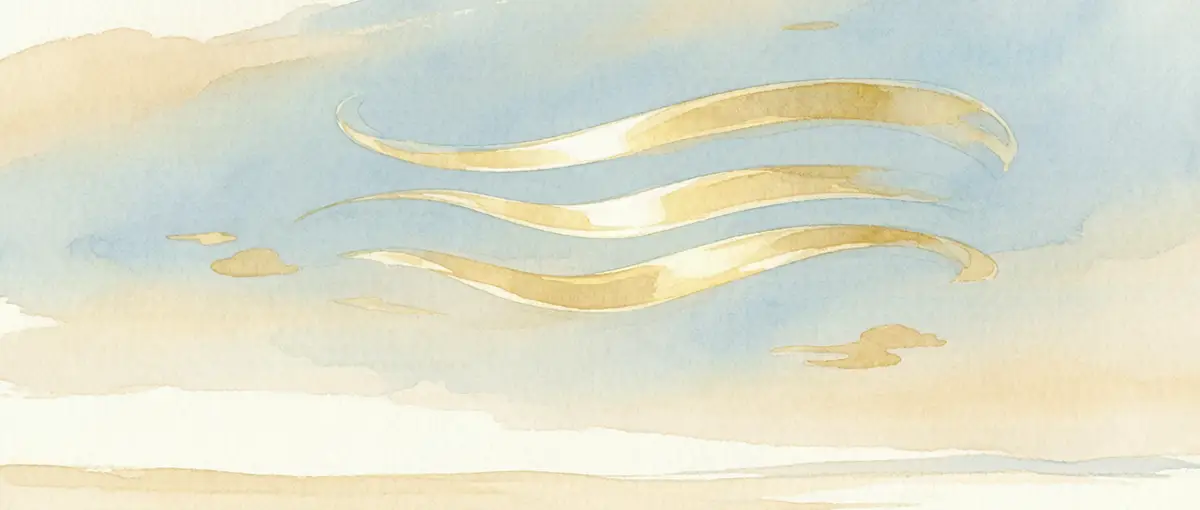
In the I Ching, Qian is the first of the eight trigrams. Its symbol is three unbroken yang lines (☰), standing for heaven. When the ancients looked up at the sky, what struck them most wasn't its size but its refusal to stop — sunrise and sunset, the waxing and waning moon, the turning of the seasons, never a mistake, never a rest. So the I Ching's words for Qian are: "As heaven moves with vigor, the superior person never stops striving to improve." This isn't praise for how impressive heaven is. It describes a condition: always moving, always new, needing no one's permission.
Qian connects to the "dragon" we wrote about before, but lands somewhere different. The dragon is a concrete image, about the rhythm of hiding and showing. Qian is the deeper "movement" itself — why does everything move? Because heaven moves, and heaven never explains why.
It doesn't wait for a push
Qian is a trigram of pure yang; none of its six lines is a yin line, which means its drive comes from within, built in. In a person, that's the kind of energy that says, "I'll take the step myself, no need for someone to call me." Not dragged forward, but a fire inside that burns on its own. A lot of people blame "no motivation" on a bad environment or no one to guide them. Qian points elsewhere: real movement is something generated from inside. Have you ever seen a sky that only turns because someone pushed it?
Strength is steady, not explosive
The character "jian" (vigor) is often misread as "fierce." But Qian's strength is endurance, stability, continuity. Heaven moves with vigor, not with violence. Anyone can sprint for a stretch; the hard part is doing it year after year, day after day, without showing fatigue. Modern people love to "ignite" — posting resolutions on social media. That isn't vigor; it's the last flare before burnout. The strength Qian speaks of is that constant, unhurried current.
From hidden to soaring, it has its own stairs
Qian's most famous part is the progression of its six lines: the hidden dragon does not act; the dragon appears in the field; all day long one is vigorous and wary; one leaps at the precipice; the flying dragon is in the sky; the arrogant dragon feels regret. This isn't a fortune-telling formula. It tells a plain truth — everything grows by its own stages, and you can't rush it. When a person wants to make something of themselves, it follows the same order: first sink down and learn (hidden), then show your head and try (appear), then polish day after day with caution (all day vigorous), leap only when you can (leap), and only once you've risen do you fly steady (flying dragon in the sky). Treat this order as a law of nature, not as a success manual, and it becomes steadier.
Whoever leads must turn first
In the trigram's analogies, Qian is the ruler, the father, the horse, the leader. It doesn't build authority by "managing" others, but by moving and setting the tone first. In a team, the anchor — if he stops, everything scatters; if he turns steadily, others follow naturally. So Qian's "leading" is demonstration, not command. What sky have you seen that makes the seasons come by issuing orders?
It doesn't explain; it just runs
Heaven never speaks, yet "the four seasons do not err" — spring, summer, autumn, winter never miss. In Qian's strength there is a silence of "doing without talking." People are different. Modern people report too much, prove too much — "look how hard I'm trying" — as if it doesn't count unless shouted. Qian watches from the sky, as if to say: whether you run well or not, the result will show itself; no narration needed. Some things, the doing itself is the answer.
The arrogant dragon's regret is a brake for the strong
Qian's last line is "the arrogant dragon feels regret": fly too high, fill too full, and you'll regret it. This line is especially clever — it gives the whole "vigorous and unceasing" its complete shape. Not charging until you explode, but knowing to ease off once you reach the top. A person who only moves forward and never stops will sooner or later trip somewhere; the one who leaves half a step at the peak is the one who truly lives "vigor." Braking isn't weakness; it's the measure that vigor carries within it.
Pure yang doesn't mean no shadow
Some read Qian as "always sunny, always positive," flattening the symbol. Qian's pure yang means the drive is pure and the direction clear — not that it has no low points. Heaven has overcast days too, but overcast is part of heaven's turning. A person admitting they get tired, get empty, doesn't stop them from "never ceasing to strive" — precisely because they can empty, they need to rekindle themselves again and again. Qian doesn't deny exhaustion; it only denies "lying down and never rising."
It allows you to slow, but not to stop
In heaven's steady movement there's no "closing for business," but there's "rhythm." Look at the sky — short days in winter, long days in summer; it adjusts too, only the overall direction keeps forward. A person can go slower today, ease off this week; Qian makes room for your catching of breath. But if from then on you lie on the ground saying "I won't turn anymore," that isn't rhythm, that's a stall. The truth of vigor is to treat "slow" as a breath, not as an endpoint. Most people don't fail by not moving; they fail by turning one rest stop into a permanent lie-down.
Qian's firmness is trained from the soft
Many think Qian, being pure yang, is all hardness, all edges. But heaven can be vigorous precisely because it makes room for the softness of clouds and clearing — only by not refusing change hard does constancy show. A person's firmness isn't cutting off all softness, but being soft, being empty, and still willing to turn. A truly vigorous person isn't without a soft side; it's that after the soft, they still rise. Reading "firm" as "no softness allowed" is exactly what breaks most easily; able to be soft and firm is the real shape of the yang line in Qian.
What does Qian mean in the I Ching?
Qian is associated with heaven, strength, movement, and self-renewal. It is not a command to work without rest or conquer other people; durable momentum includes pacing, humility, and recovery.
How can I stay motivated without burning out?
Build a rhythm you can repeat, define what “enough for today” means, and leave room for help. Self-driven does not mean unsupported, and slowing down can protect the ability to continue.
Want to understand why stopping feels like losing your strength?
If your value depends on constant forward motion, gentle self-exploration can help you distinguish renewal from relentless pressure.
So writing Qian is writing a self-driven, unending renewal
We don't write "you are of Qian fate so you must be noble," nor "how a Qian-type personality should be." What we write is: that drive in you which moves forward without external force, and knows to follow its own rhythm, deserves to be seen and treasured. This old symbol of Qian has hung overhead for thousands of years, watching everyone still waiting for "someone to push me" — heaven never waits to be pushed; it turns on its own. Neither should you.
The truly hard part was never the single act of "moving," but moving today and again tomorrow. What Qian teaches, said plainly, is: don't stake all your hope on others or the environment pushing you. The machine inside you comes with its own engine.
Keep reading: Zhen: The Thunder That Wakes Before It Warns · East: The Direction That Greets Every Morning · Dui: The Marsh That Is Also a Mouth
Written and reviewed by DustEcho Editorial for self-reflection and cultural inquiry—not counseling, medical advice, or a clinical diagnosis.
Not sure where to begin?