Dui: The Marsh That Is Also a Mouth
DustEcho Editorial
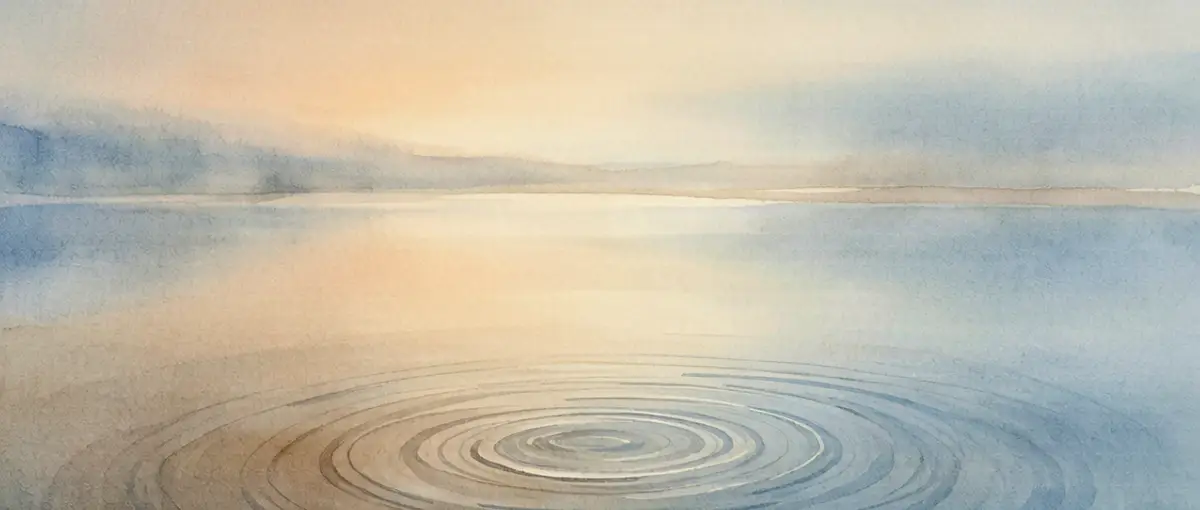
In the Book of Changes, Dui is a trigram for the marsh: a broken line above two solid lines ☱, the still pool at the water's edge. The ancients loved a marsh not for depth but for joy — a flat, bright surface mirroring the sky, relaxing to look at. So Dui means "joy": gladness, speech, an open mouth. Unlike Kan's dangerous water or Li's fire, the marsh is calm and bright; it lets you come close.
In the eight trigrams Dui is the west, autumn, and the youngest daughter — the maiden, light and easy to be near. Marsh, west, maiden share one temperament: open your mouth and you loosen; meet it and you are glad.
It is not deep, but it is bright
The marsh is not the sea. The sea frightens with depth; the marsh shows its bottom. Yet shallowness has a good: a bright surface puts you at ease. Dui's joy is this light happiness — ease, not wild swings. Many good things are like this: not strong, yet worth approaching daily. The first lesson is gentle: joy need not shake the earth.
One yin on top, that opening
Dui's shape has only the top line yin, the rest yang. It resembles a lake surface where water meets sky, and an open mouth with parted lips. Dui is the "mouth," and this is the opening: speech, expression, letting the inside out. What marsh keeps a clenched face?
Joy is not silly laughter
Dui's joy is easy to misread as mindless giggling. But it is ease from within — the natural gladness when things go smoothly, words are spoken. To demand "always positive" is to fake it; real joy keeps its wrinkles and stays bright.
Dui is the mouth: speak it, and you loosen
The mouth speaks, not only eats. Many carry something balled up inside, heavier the longer they hold it; with the right person and moment, saying it lets the pressure leak out and loosen. Read Dui well: give the heart's words an exit.
The young maiden: not heavy, yet she draws you near
Dui is the youngest child, the maiden. She does not weigh on others; she laughs, talks, stays light, and people sit by her. In a person, Dui's joy is this — no airs, not heavy, yet worth approaching.
The lake mirrors the sky — its quietest joy
The marsh's best moment: wind stops, surface flattens, the whole sky mirrors in. Dui's joy holds this quiet layer. A churning heart rarely finds joy; only when restlessness settles, flat as the lake, does gladness rise. To find joy, first let the water grow still.
It can also be a gap
The character Dui also means "gap." Open the mouth and words leak. So Dui shows its other face: opening loosens, but do not open too wide. Speak all and joy leaks; hold back and it stays.
Those who know joy pause before they speak
The mouth heals or wounds. Read Dui well: pause before speaking, let the joy settle first. Speak too fast and gladness becomes a barb; a half-beat slower and the words turn soft and warm.
Do not turn pleasing into fawning
Dui speaks of joy and drawing near, but lost center it slides into fawning — folding yourself away to please another. That is not Dui; it makes your mouth a loudspeaker for someone else's wants. Real joy loosens you first, then lets others near. Joy lets both shine, not you dimmed so the other may glow.
Two marshes joined make the beautiful marsh
A line in the Dui hexagram reads: "Linked marshes; thus the gentleman, with friends, discourses and learns." Dui's joy carries sharing — your light and mine, side by side, mirror the sky deeper.
What does Dui mean in the I Ching?
Dui is often associated with a lake, an open mouth, and joy that comes through expression. In daily life, it can be read as the relief of saying what is true and sharing warmth without turning openness into people-pleasing.
How can I express joy without performing for approval?
Say one genuine thing without checking whether it will earn the right reaction: “I’m glad you’re here,” “That helped,” or “I want to celebrate this.” Joy can be light without being shallow, and honest speech does not require a grand disclosure.
Want to understand why speaking honestly can feel relieving?
If you keep storing every word until it becomes pressure, gentle self-exploration can help you open the mouth before the lake overflows.
So to write Dui is to write a joy that loosens upon opening
We do not write "those ruled by Dui are talkative" nor "how to shut up when Dui afflicts you." We write: when something is balled up and grows heavier, do you have a mouth willing to open, to let those words out and loosen? This old symbol, one soft yin above two solid yang, sits in the autumn west, watching all who swallow their words.
The hard part was never to smile, but to open your mouth when the heart is clogged. Dui's lesson is light: do not pickle your words inside. The lake opens and sky-light enters; you open your mouth and joy loosens.
Keep reading: Li: It shines because it first found something to cling to · Qian: Heaven never stops moving, so it never grows old · Xun: The Wind That Finds Every Crack
Written and reviewed by DustEcho Editorial for self-reflection and cultural inquiry—not counseling, medical advice, or a clinical diagnosis.
Not sure where to begin?