Feng: Invisible, Yet It Truly Came
DustEcho Editorial
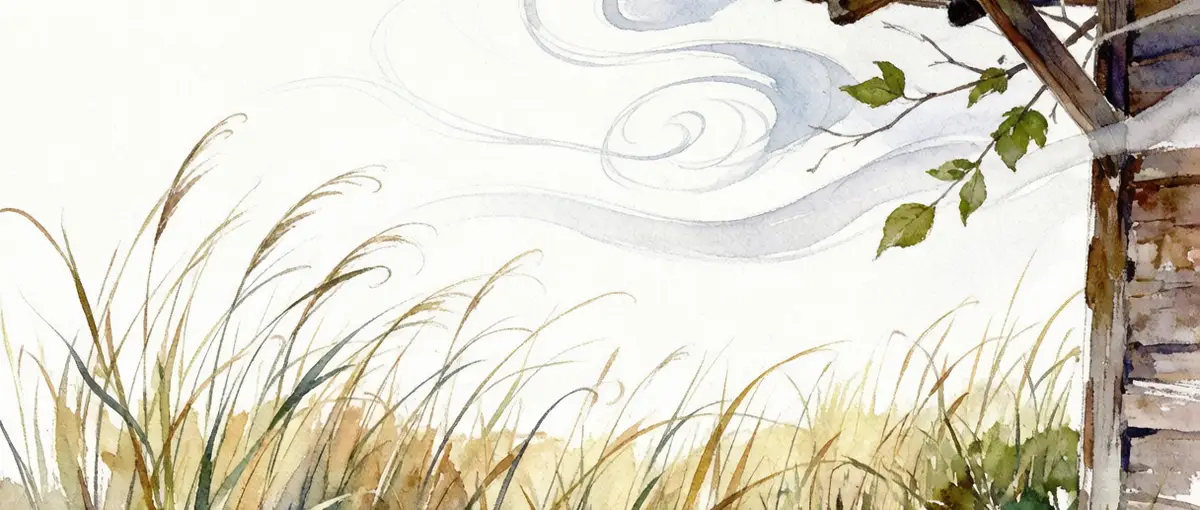
In traditional culture, wind was never merely weather. It was "qi" on the move — yang energy rising, yin energy sinking, the two pushing back and forth until something flowed between them, and that flow was wind. The Xun trigram stands for wind; its virtue is to enter and to permeate, which is to say wind has no shape, yet it finds its way into every crack. In the five phases, even the wood energy needs room to stretch, and it takes a breath of wind to set that stretching right. The ancients also divided the year into the "eight winds," each gust marking the turning of a solar term. So what wind truly signifies was never wind itself, but an experience: you never saw it, and yet it genuinely changed something. To live with wind as a quiet teacher is to start noticing what moves the world without ever being seen.
It Has No Shape, Yet Nothing Can Block It
What is most peculiar about wind is that it has no form. You cannot grab it, cannot bottle it, and yet the moment it arrives the trees move, your clothes billow, and the stuffiness of a whole room lifts at once. A quiet person often carries something like this: he does not show off, does not fight for the floor, and you might not even notice whether he is present. But the day he is gone, you realize the air has gone stale — there were things he had quietly smoothed over, and once he leaves, those things simply clog up where they were. The room does not announce his absence; it simply stops breathing well.
Such a person never says what he has done. Neither does the wind. It passes through an entire forest, the leaves rustle, and the credit goes to the trees. Yet without that gust, the forest would be silent. Think about it: the "key players" around you are mostly like this — absent from the honor roll, absent from the first sentence of any post-mortem, yet without that wind many things simply would not turn. They are used to stepping outside the credit, not out of modesty, but because they know their role is to "pass through," not to "occupy a piece."
It Rises by Borrowing Force, for It Has No Root of Its Own
Wind does not generate itself. It begins at the tip of a duckweed leaf, where the ground grows warm and the sky grows cold, and the temperature difference drives the air until it becomes wind. So wind never stands "on its own" like a great mountain — its force is entirely borrowed. And this is a kind of clarity: much of the influence that carries real weight is not propped up by sheer self-assertion, but comes from spotting the trend, riding that gradient, and giving one light push until it becomes a climate of its own.
The person who forces things always wants to do it "on my own strength," but wind teaches a different lesson: you need not have roots; you only need to recognize where the trend lies, borrow onto it, and that is enough. A borrowed force is no smaller than a force of your own; a wind that borrows the right trend travels far farther than the person who pits brute strength against the wall. The mountain is admired, but it is the wind that moves the forest.
You Know the Season Has Turned Only When It Arrives
When the spring wind blows, people need no calendar to know winter has passed. Wind is the messenger of the seasons; it arrives before the flowers, stirs before the leaves. So it is with people, too: there are those you have not seen for a long time, and a single phone call, a single message, and at once you recover the self that lived in that state — not because he gave you anything concrete, but because the energy about him drew you out of the stagnation you were sitting in.
The reverse holds as well. There are environments where, having stayed too long, you no longer notice yourself sinking, until you change your circle, change your rhythm, and a "new wind" blows through and you realize with a start: so I had been stifled all along. What wind signifies is this "wordless reminder" — it does not lecture you; it simply arrives, and you wake.
It Never Stops Anywhere, and Cannot Be Kept
The greatest temper of wind is that it does not dwell. It blows through and leaves, never making a home in one place. You cannot store a gust to use tomorrow. Human states have their moments like this, too: one afternoon you are suddenly perfectly clear, perfectly eager to do things well, yet the moment you try to "fix" that feeling, it runs away. The harder you try to hold it, the less it stays.
So the old saying goes, "A good wind lends its force" — not to tell you to grab the wind, but to recognize the instant the wind comes and open your sail to it. Wind is only responsible for arriving, not for staying. He who knows how to borrow goes farther than he who tries to keep.
It Slips Through the Narrowest Crack
The Xun trigram speaks of "entering," and wind's gift is precisely permeation. A wall stops a person but not the wind; a door shuts, yet wind still slips in under the gap. Consider it: the truly difficult knots in life are mostly not forced open by the stronger side, but seeped through by the side better at finding the crack. Wind does not argue with the wall; it goes around the wall, entering from where the wall never expected — which is more refined than a head-on contest, and easier, too. There is such a force in life: a matter that will not yield to hard confrontation gets through instead by a softer method, seeping in from an angle no one noticed. It is not that you are stronger than anyone, but that you did not wrestle the wall — you found the crack.
Some people handle conflict exactly this way. They do not charge head-on, do not rush to argue; first they smooth the atmosphere, then slip the words in from the side. It looks like no effort at all, yet every place that needed entering, they entered. This takes less effort than a frontal crash, and reaches further than one. The wall does not step aside because it is soft; yet wind enters precisely where the wall cannot yield — softness is not weakness; it is that wind found the entrance hardness could not.
Too Strong, and It Becomes a Disaster
Wind is not always gentle. When a typhoon comes, it overturns everything. The ancients knew wind had two faces: a small wind is a messenger, is ease; a great wind is destruction, is loss of control. So in traditional culture, to speak of wind was never to deify it — for wind to be good, it had to be "harmonious wind," the breath just enough to scatter the stuffiness. Too weak, and the air dies; too fierce, and things are ruined.
So it is with people. The drive that pushes others, used rightly, is support; used past the mark, it is oppression. The more you want to "lead" someone, the harder you push, the more they want to hide. A breeze, and people move on their own; a gale, and only wreckage remains. Proportion is wind's lesson, and the human's as well.
Look at those who truly hold influence: they are never the loudest voice. They are like a gentle wind; you could not even say how you were carried along, only that "after that wind passed, I felt I ought to move." Those who frantically demand you move, by contrast, make you instinctively shrink back. Wind never chases the leaves; it only blows, and the leaves decide for themselves whether to sway.
It Blows Through and Claims No Result
Wind carries seeds to distant places; the seeds sprout, and no one calls it wind's doing. Wind never answers for the result; it is only passing through. And this is a rare kind of ease: for many things you took part in, pushed forward, smoothed the stuck places, yet the fruit could not be hung under your name, and you accept it. Not detachment, but clarity — you are that gust of wind; you blew through, the forest turned green, and that is enough.
Too many people turn "I helped" into "it should count as mine." Wind does not reckon so. It knows its role is to pass through, not to harvest. He who understands this helps and leaves, does not cling to the result, and next time others still welcome his passing through.
What does wind symbolize in traditional imagery?
Wind can symbolize invisible influence, movement, change, and the power of entering through a narrow opening. It can be gentle or destructive; the useful question is not whether to move, but how much force the moment can hold.
How can I create change without forcing it?
Look for existing momentum, a small opening, or a person who is ready to move with you. A steady invitation often travels farther than pressure. If a situation is unsafe, do not romanticize “going with the wind”; use clear boundaries and practical support.
Want to understand what has been changing even before you could see it?
If subtle pressures keep shaping your choices, gentle self-exploration can help you notice the breeze before it becomes a gale.
Back to Ourselves
The image of wind, in the end, speaks of a kind of "formless influence." It relies on no force, on no occupation, on no name left behind — it simply arrives aptly, leaves aptly, and smooths what was stuck.
Around you there is likely such a wind — silent as usual, yet at the crucial moment drawing you out of stagnation; or conversely, in some relationship you yourself are that gentle wind, blowing through, taking nothing, yet things are not the same.
Wind never needs to be seen to exist. It came; the forest knows, the clothes know, and you know it too.
Keep reading: Shi: Silent, Yet Holding Everything · Water: The Softest Thing That Always Finds the Crack · Xingchen: The Highest Place, the Steadiest Order
Written and reviewed by DustEcho Editorial for self-reflection and cultural inquiry—not counseling, medical advice, or a clinical diagnosis.
Not sure where to begin?