The Moon: Borrowed Light That Travels Far
DustEcho Editorial
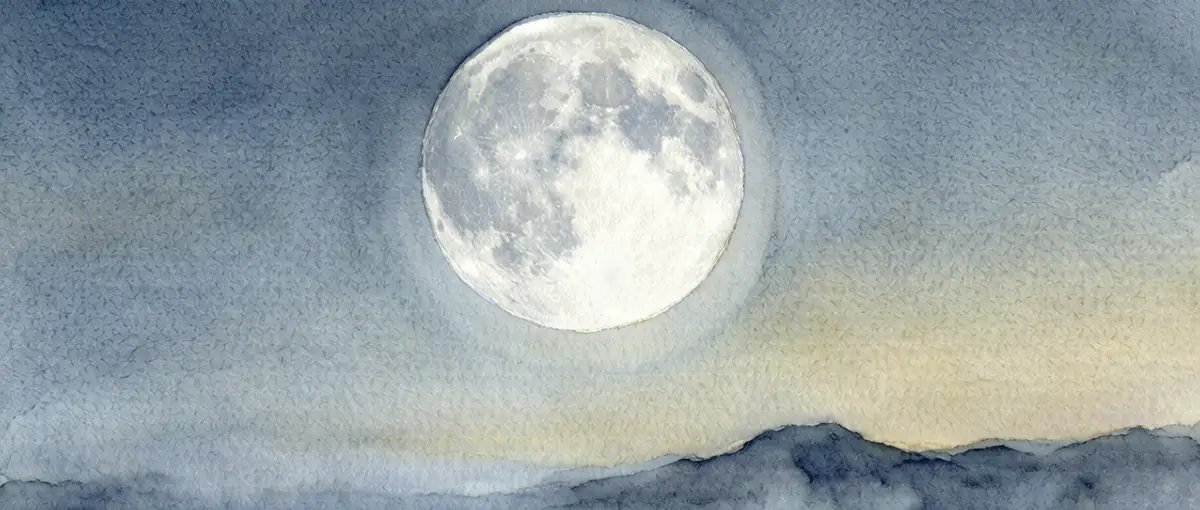
Among all the bodies scattered across the sky, it was the moon that the ancients wrote about most often. Of all the lights above, they returned to this one again and again.
The moon gives off no light of its own; it shines only by borrowing from the sun, and the ancients understood this long ago. It waxes to full and wanes to nothing, then begins the turning once more, round after round without end. So they used it to mark the seasons, to set the solar terms, to count the passing days. Even earlier than that, they had already made it a vessel for longing: no matter how far apart two people stood, they lifted their eyes to the same moon. This is why, in traditional culture, the moon was never merely a celestial object hanging overhead. It was a feeling — the feeling of being present across a distance, of staying near even when you are far.
It Doesn't Shine on Its Own, Yet It Lights the Way
Moonlight is not like sunlight. The sun comes straight down, bright and scalding, impossible to avoid; the moon is borrowed, soft and cool, never forcing your eyes open.
You probably know someone like this: he is not the most dazzling person in the room, never stands at the center of the stage, never grabs the conversation away from anyone. Yet when you are lost, you spend a little time with him and something inside clears. He points you to no obvious road, makes no decisions for you, but his quiet presence lets you figure things out for yourself. He does not fill the silence with answers; he simply lets the silence do its work.
This is moonlight-style illumination. It does not scorch, does not blind, does not make you feel preached at. It is simply there, glowing with a thin layer of light; look if you wish, and if you do not, no harm done. And yet it is precisely this light that stays the longest — the sun sets, but the moon remains. The experience the moon stands for is this: "I gave you nothing, yet because I was here, you saw a little more clearly." Such a person will never top your list of thank-yous, because he did nothing concrete that anyone could name. But when you look back on your most chaotic stretch, he seems to have been there the whole time — not too near, not too far, silent, just enough for you to take a couple of steps by his light. He asked for nothing, and so you remembered him least, which is exactly the quiet bargain moonlight makes.
Waxing and Waning, Waning and Waxing
The most honest thing about the moon is that it never pretends to be whole.
Every month it has its waning phase, slowly filling from a thin hook of light until it rounds for a single night, then begins to wane again. The ancients did not see this as a flaw; they took it as the natural order — "the moon has its dark and bright, its waxing and waning," as Su Shi captured in a single line. Full is good, and missing is good too, because after the missing comes the full again.
People have a harder time accepting this. What we want is to stay full, stay complete, stay online forever. When we are doing well, we wish it would last always; the moment we slip, we panic, convinced something has gone wrong. But the moon tells us one thing: slipping down is not the end, it is this cycle nearly finished and the next one nearly here. In those times when you think "I'm not doing so well lately," think of the moon — it also wanes, yet no one thinks the moon is broken. Missing is part of it, and so is full. The moon does not disdain its own missing; people do. We always treat the low point as an anomaly, but to the moon it is the most ordinary stretch of its cycle. Accept that you have your missing times, and you actually come back to full; insist on never allowing yourself to be missing, and when you finally let go, you fall harder. The fullness you force is more fragile than the fullness you let return on its own.
The Dark Days of Hui Are Not an End
There is one stretch of the moon most easily overlooked: the last few days of each month, when it is almost invisible. The ancients called this "hui."
On those nights the sky is especially black, as if the moon had vanished entirely. But it has not vanished; it has only turned to its shadowed side. A couple of days later, a sliver of new moon appears again. In the moon's rhythm, darkness is not an ending but a passage it must pass through.
People are the same. There are times you feel you have nothing left to give, your state is low, you don't want to talk to anyone, as if every bit of light inside you has gone out. The "hui" experience the moon stands for tells you: this is not the end, it is just this cycle turned to its shadowed side. Don't rush to force yourself to shine; wait a couple of days, and the light will return. The hardest part is not the darkness itself, but believing in the darkness that you will never shine again. When you sit in that black stretch, remember the moon does not worry about being unseen — it simply waits, and the light comes back around.
Far Apart, Yet Surely Present
The moon also marks a very particular experience: certainty within distance.
Two people are not together; by day each is busy with their own affairs. But at night, they lift their eyes to the same moon. You need send no message to confirm the other is still there; the moon is there, as if keeping watch over the two of you. The ancients wrote "a thousand miles share the same beautiful moon," and this is what they meant — not that the moon is so beautiful, but that it makes "not being together" a little less hard to bear.
Some relationships in life are just like this: not seen every day, not chatted with every hour, yet you know he is there and he knows you are. Distance lies between you, but that distance is filled by a quiet understanding of "we are looking at the same moon." Such a relationship makes no noise, clings to nothing, yet it is steady. Part of the moon's experience is this ease of "not by your side, but in your heart." This kind of relationship needs no forceful upkeep; it stays steady on its own — because the thread between you is not maintained by daily meetings, but by the understanding that "no matter how far apart, the sky above our heads is the same." You do not have to hold it tightly to keep it; you only have to remember, now and then, that it is there.
Moonlight Doesn't Burn, but It Stays
Sunlight and moonlight differ in one more way: when the sun beats down you grow hot, you sweat, you want shade; the moon shines all night and you feel almost nothing, yet the tight string in your chest loosens.
This is the character of moon-style companionship — it does not scald you, does not hurry you, does not make you feel you owe anything. Some people's care is like the sun, fierce, direct, unstoppable; you are grateful, yet a little breathless. Some people's care is like the moon, faint, unhurried, so subtle you barely notice — yet looking back, it was that thin light that got you through the hardest nights. The moon's companionship claims no credit, so it is easily overlooked. But think truly: those who, when you were low, did not urge you to "get better fast" but simply stayed quietly beside you — what they gave was moonlight. They never asked to be remembered, which is precisely why they are the ones you ought to remember most.
Always Lighting the Way for Others, It Too Can Go Dark
The moon has its own difficulty, and a hidden one.
It keeps shining to light the way for others, yet all its light is borrowed. Not shining on its own means that the moment the sun cuts off, it goes dark. Moon-style people easily fall into this: used to being the quiet one who lights the way for others, they pour all their light into other people's affairs, until finally they find themselves empty — not tired, but not knowing where their own light should go.
The moon's lesson is to learn to claim its own source of light. Borrowing light is no crime, but there must come a day when you know what is yours besides reflection. Otherwise you light everyone and never see yourself. Moon-style people most easily forget themselves in the process of helping others — not because they don't care about themselves, but because they are used to casting their light outward and never think to turn it back. The care you give so freely to others deserves, now and then, to be turned toward the one who is doing the giving.
Putting It Another Way
We don't look at the moon much these days; city lights are too bright and it seems pale. But the experience the moon stands for has not gone out of date: borrowed light can still light the way, waxing and waning are both the norm, the hui days are not an end but only a turning from the light, and across any distance you can still be present.
If you carry the moon's spirit in you — quiet, never scalding, lighting the way for others — remember now and then to ask yourself: have you kept a little of your light for yourself? And if there is such a silent person lighting your way beside you, don't wait until the moon goes dark to remember to look up. The moon is always there; it is only that, used to having light, you forgot where it came from.
Written and reviewed by DustEcho Editorial for self-reflection and cultural inquiry—not counseling, medical advice, or a clinical diagnosis.
Not sure where to begin?