Yu: What Falls From the Sky Is Never Just Water
DustEcho Editorial
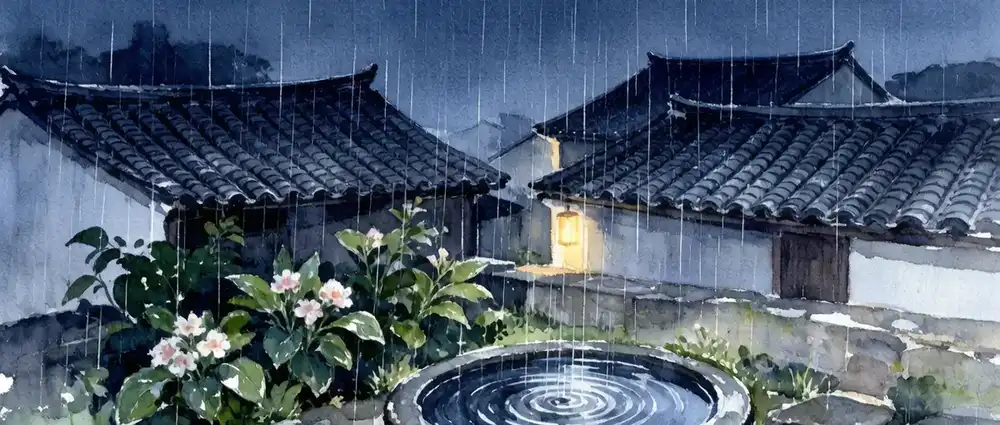
Rain, in the old way of seeing things, is the moment heaven and earth meet. The breath of the earth rises, the breath of the sky descends, and the two meet halfway, condensing into rain. So it was never a one-sided gift from above; it is a meeting of heaven and earth — the earth must first hold a wish, and only then does the sky answer. "Good rain knows its season" means it arrives at the right moment. What rain points to is an experience: when it comes at the right time, everything comes alive; when it comes at the wrong time, everything drowns.
What does rain symbolize in traditional Chinese thought?
Rain symbolizes timely nourishment: support that arrives when the soil is ready, in an amount that helps rather than overwhelms. In everyday life, it can remind us to notice timing, consent, and proportion when giving or receiving care. It is a cultural image, not a prediction.
How can I support someone without flooding them?
Ask what they need, offer one specific form of help, and leave room for their own strength. Explore the idea gently if your good intentions often become pressure for you or someone else.
When It Comes at the Right Time, It Is a Blessing
The same rain that falls on a field just planted with rice seedlings saves lives; the same rain in a season that should be dry is a disaster. Rain itself carries no good or bad — the good or bad lives in the timing. The things we give others work the same way: a word of comfort, offered when someone has just broken, becomes a ferry across; offered when someone is trying to stand alone, it becomes an intrusion. What you gave was not wrong; what was wrong was whether, in that moment, they wanted it.
Which is why the old saying goes, "it moistens things without a sound" — not that the rain is small, but that it falls aptly. The soil happens to be thirsty, the shoots happen to be ready to joint, and the moment it comes, everything receives it. Whoever supports others well learns not to "give more," but to "see whether the soil is thirsty before letting fall." Fall at the wrong moment, and even good intent becomes a flood.
It Falls Evenly, Without Choosing Who
Rain comes down onto flat ground and rooftops alike; the broken tiles of the poor and the courtyards of the rich catch the same rain. It does not pick its object, does not distribute by rank. In this evenness there is a plain fairness: the nourishment heaven and earth give was never concerned with who you are.
People should carry some of this evenness too. Some reserve their kindness only for those who are "worthy" — the likable, the useful, those who give something back. But rain does not reckon that way. It falls because it is time to fall, not because the earth below will be grateful. Learn to let your kindness fall more evenly, without picking the receiver, and you become lighter, and you actually nourish those who ought to be nourished.
What It Washes Reveals Its True Form
After a rainfall, the leaves brighten, the streets are clean, and that earthen smell in the air is proof the earth has been washed. Have you noticed that the world after rain is not "something added," but "what was always there, shown"? The dust is washed away and the color returns; the stuffiness clears and the scent becomes clean. People are the same: much of what we call "not feeling like myself" is not that something is missing, but that a layer of dust has settled on top. Wash it, and the original you is right there beneath. Rain has a washing function — not carrying dirt away, but letting what was covered show itself again.
Sometimes what you need is not to gain anything, but a rain to drench you, to wash that layer away, so you remember who you were to begin with. A good cry, a long journey, or simply stopping for a few days — all of these are that rain.
It Falls at Night, Leaving the Least Trace
Good rain knows its season; in spring it comes forth, drifting on the wind into the night, moistening things without a sound. The ancients placed the best face of rain in the night — not that it cannot fall by day, but that falling at night, no one sees, no one applauds, and only at dawn do you find the green of the courtyard deepened by another layer. This nourishment that "falls as if it never fell" is the most precious of all.
The support people give also splits in two: one kind beats a gong as it falls, afraid the other won't know; one kind falls quietly in the night, and by daylight the other has grown something of their own, and looking back, only then savors it — "oh, that word that night." The latter rain, the soil drinks most quietly, and it reaches the roots most deeply. Rain that scrambles to be seen falls in a rush, and only splatters mud everywhere.
Only After It Stops Does the Earth Know What It Took In
While the rain falls you cannot see the effect. The soil drinks slowly; the shoots joint quietly in the night. Only when the sky clears do you find that yesterday's rain has already entered the roots. Much support is like this: when you give it the other shows no reaction, perhaps does not even say thank you, and you think it fell for nothing. But the soil is drinking; it simply makes no sound.
Do not decide it was useless just because there is no echo in the moment. Rain never chases the soil for a receipt. The kindness you let fall has mostly entered another's roots in silence; only when one day they grow something do you see clearly — oh, that was the rain. Rain was never for being remembered.
Rain that takes "being remembered" as its purpose never falls naturally. It falls while counting "did he thank me," and counting, it falls crooked — either too heavy and it beats the shoots limp, or too light and it never reaches the soil. The one who truly knows how to let rain fall looks up at the sky when finished, to see where the next shower is. The business of roots, leave to the roots themselves.
It Can Also Flood, and Too Much Becomes Harm
Even the best thing, in excess, is disaster. A month without rain is drought; three feet down in a single day is also calamity. Rain speaks of "measure" — restraint, just enough. In the old teaching of balancing yin and yang, rain is the very type that needs balancing: too much or too little, neither works; moistened just right, it is true blessing.
People's support speaks of this measure too. You want so badly to help that you spend the other's own strength for them, and they fail to grow roots. Knowing to pull back the moment the other has just enough is harder than pouring it all at once, but it is the only way to truly know how to let rain fall.
Recall those good intentions that left you unable to breathe — not that the other was bad, but that the rhythm of their falling was wrong; it came down in torrents, you could not catch it, and you were washed sideways. The good of good rain lies entirely in that restraint. The one who knows how to let rain fall drops a spell, pauses, sees whether the soil has drunk, then decides the next. This is respect for the receiver, not calculation.
It Does Not Wait for You to Be Ready, but You Can Wait for It
People always want to "wait for a good moment to begin," but rain does not understand your schedule. It comes by the rhythm of heaven and earth; if it does not come there is nothing you can do, and if it comes there is nothing you can block. What you can do is prepare the field while the soil is thirsty, so that when the rain arrives, you catch it all. Not chasing the rain, but preparing yourself.
This is a way of living that saves strength: arrange what can be arranged, and leave the rest to timing. When the wind comes, raise the sail; when the rain comes, ready the field. You spend no brute force, yet miss nothing. The steady put themselves in order, and the weather arrives on its own.
Back to Ourselves
The image of rain is not about the physical fact of "water falling from the sky," but about a kind of "nourishment that arrives exactly in time." It is even, it washes away dust, it keeps measure, it falls and never chases a receipt.
You have surely played both roles: been caught by a rain that fell exactly right, and been flooded by good intent at the wrong moment. Whether you are letting rain fall or catching it, remember the old line — it moistens things without a sound. Not small, but apt; not little, but exactly enough.
Keep reading: Shan: Always There, Unspeaking and Unyielding · Shi: Silent, Yet Holding Everything · Water: The Softest Thing That Always Finds the Crack
Written and reviewed by DustEcho Editorial for self-reflection and cultural inquiry—not counseling, medical advice, or a clinical diagnosis.
Not sure where to begin?