Yin Wang in BaZi: When the Room Is Too Warm to Leave
DustEcho Editorial
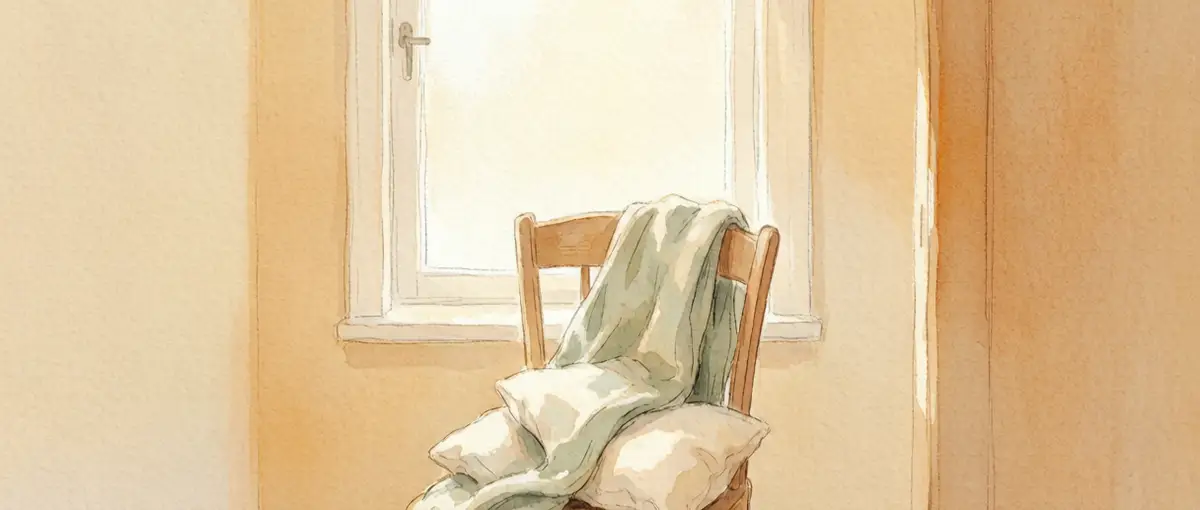
In BaZi, Yin Wang is the name for the Resource Star — Zheng Yin and Pian Yin, the Direct and Indirect Seals — running especially strong. It points to shelter, nourishment, being cared for, and the slow absorbing of what is taught. When that sheltering force overfills, the room becomes so warm and steady that the person inside forgets there is wind beyond the glass. This is not about fortune or misfortune, and it is not a lesson in how to "break the seal." It is a way to name the experience of being protected so well that the legs forget how to step. You are not lazy. The room simply has not made leaving feel necessary.
Not That You Don't Want to Leave — It's Just Too Comfortable Inside
Those who carry strong yin hear, often, that they are "content with too little" or "not hungry enough." But from the inside it does not feel like contentment; it feels like "where I am is already fine." The care may have been meticulous since childhood, or it may have been built later by one's own hands into a small, steady world: income enough, days untroubled, nothing that must be fought for. It is not absence of ability. It is the push, the forward lean, being absorbed by layer after layer of soft padding. Someone says: every time the thought of leaving the job rises, the boss is decent, the commute is short, and the thought cools before it warms. Not absence of ambition. Only ambition that the warm air keeps cooling before it can hold its heat.
The Thick Quilt That Wraps the Feet You Should Be Moving
The experience of heavy yin is like being wrapped in a thick quilt. Warm, yes; safe, yes. But try to turn over, try to rise, try to reach an arm out for something beyond the edge, and it tugs you gently back. There is a recurring instant: the plan rehearsed three times in the mind, the body still sunk into the sofa, not even lifting the cup. This is not procrastination. It is the action being softened away by the gentle resistance of yin. The better the protection, the thinner the conviction that, in the end, one must rely on oneself. The quilt blocks the rain and the wind outside, and in passing it softens the calluses that were meant to grow. No one is more aware than this one that "I could be more," and each time a step is about to be taken, the door of the warm room seems to close a little, on its own.
You're Not Slow — Your Alarm Was Disarmed
There is a hidden side to yin wang: the perception of risk runs blunt. Where others see the gust and the crisis, the habit has long been "it's fine, someone is holding the floor." Perhaps there was always someone to clean up after, early on, and later the unspoken belief sets in that if the sky falls, someone else will be the first to hold it. The bluntness has its bright side: no dread, no scramble. And its dark side: the belatedness, realizing only after the others have run far that the rain falling is one's own. Not stupidity. Only that no one ever taught how to pull the alarm for oneself. The room is too soundproof; the thunder outside always arrives a few seconds late to the ear.
Not That You Don't Need to Try — You Haven't Met What Forces You Out
Yin wang is not the absence of drive. It is the absence of the reason that makes leaving non-negotiable. Ease fills the day so completely that there is no seam through which to ask, "what else do I want." But some day something flicks: a book that cannot be put down, a face that makes sitting still impossible, and the warm room begins to feel close. Not a change of character. Only the "I want," long pressed beneath the seal, finally lifting its head. Not every door needs to be pushed from outside. Some are pulled open from within. The hand trembles when one pulls for oneself, yet that trembling does more than all the force ever applied from behind.
The Quiet Side Is Not Weak
There is one side of yin wang that is often overlooked: when still, it is not doing nothing. It may be observing, absorbing, digesting the world at its own tempo. It does not burn outward like fire or spread like water. It resembles a plant on a windowsill, slow in its growing, with roots going down. From outside it reads as "dull," but inside the dullness is often a steadiness that feels no need to prove anything. It is not that one does not go out; one has not yet chosen a pair of shoes that fits. No one else can choose them, and the choosing may not be immediate. But once the looking down begins, the road is not far.
Leave a Window You Can Push Open
To return to yin wang itself: it is neither flaw nor fault. A warm room is not the problem; the only question is whether the window has been welded shut. For the one inside, the lightest first step is not to tear the house down but to leave one window that can be pushed open. No need to jump out; only reach a hand out and test the wind. From very small things: a decision made without leaning on another, an outcome borne with no one holding the floor, or simply a road never walked, taken on a weekend. Not to bid farewell to ease, but to leave, within ease, a crack that leads toward what is not ease. The crack need not be wide; wide enough for one hand is enough. When the hand goes out the wind may be cold, but after the cold passes, it becomes clear for the first time that one's own body heat is more trustworthy than the heater in that room.
Not Lacking Energy — Comfort Has Filled the Time Too Full
Occasionally the question comes: "Don't you want to try something else?" The answer is "maybe later," but a thought flashes beneath. Not that one doesn't want to, but that the days are too full. So full there is no gap in which to imagine another way of living: the familiar rhythm fills each day just enough, lacking nothing, with no reason that demands overturning. Not absence of energy. Only that ease has quietly diluted the impulse to change into "it's also fine not to." Dilution is not disappearance; the concentration is simply too low, so low that even one's own nose cannot catch it. But the scent has always been there, and one day, when a draft of new air pours in, it may be discovered for the first time that this warm room can be aired out. Airing does not require the great door; a side window will do, pushed open half a leaf, enough to catch the damp smell of earth.
A More Modern Way to Say It
In the language of psychology, yin wang is close to a motivational blunting within an over-safe environment. When one dwells long under protection, with resources sufficient and risk filtered out externally, the inner drive and the threshold of risk-perception quietly lower themselves. This is not a defect of ability; it is the surplus of safety squeezing out the occasions that would have trained self-efficacy. The first step of rebuilding is not to force oneself to become driven, but to deliberately fashion small, controlled discomforts: decide for oneself, bear the outcome for oneself, walk a road never walked. Safety is not given by a warm room; it is given by the window one pushes open with one's own hand, knowing it is cold outside, and knowing one can come back, and can leave. The moment of stepping out, the wind on the face may draw a shiver, yet in that shiver, the heartbeat one hears is far truer than the low hum of the air conditioner.
What does Yin Wang mean in BaZi?
Yin Wang describes a BaZi chart where Resource Star energy is especially strong, using traditional language for a pattern of protection, learning, and comfort. It does not mean that someone is lazy or destined to stay still. A more useful interpretation asks where safety has helped you grow, and where it may now be keeping a small next step out of reach.
Want to understand your own chart more gently?
If this warm-room image feels familiar, a personal reading can help you separate real support from the habits that keep you waiting. Start a personal BaZi reading when you are ready to explore that distinction.
Keep reading: Huo-Yan: When the Light Comes On Too Fast, It Also Burns · Jin-Han: When the Edge Is Wrapped in Frost · Mu Wang: That Upward Drive You Can't Hold Down
Written and reviewed by DustEcho Editorial for self-reflection and cultural inquiry—not counseling, medical advice, or a clinical diagnosis.
Not sure where to begin?