Xun: The Wind That Finds Every Crack
DustEcho Editorial
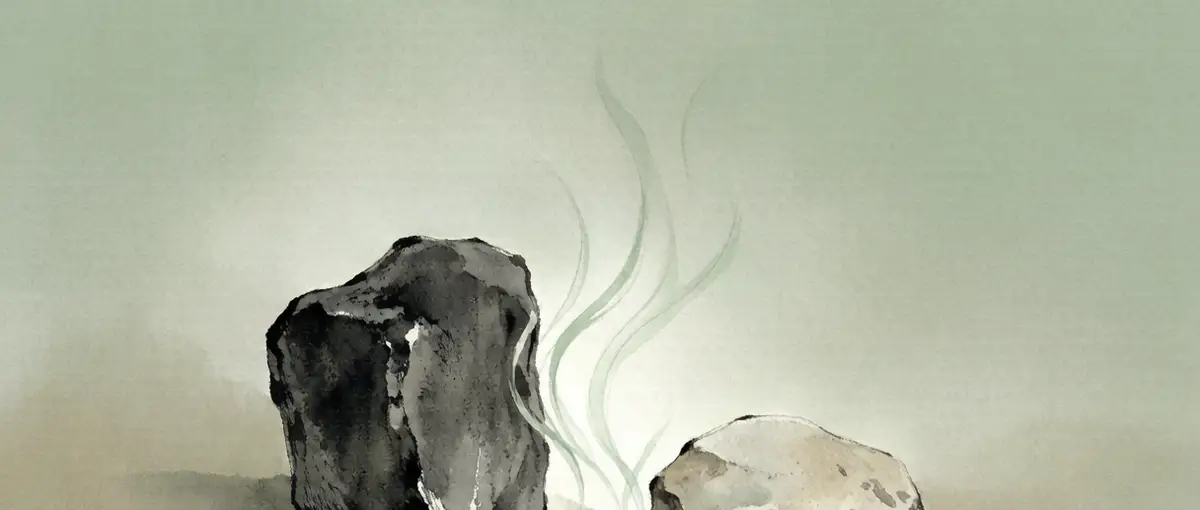
In the I Ching, Xun is a trigram: a broken line below, two solid above ☴, meaning wind and wood. The ancients admired not its force but its way of getting in — a wall stops a person, stops a stone, never the wind, which seeps through seam, gap, leaf. So Xun speaks of "entering" and "yielding": it follows the opening, shows no form, yet reaches everywhere. Not the "wind" we wrote of before — wind's way of living, the ability to get in.
In the eight trigrams Xun is the southeast and the eldest daughter — seldom the loudest, yet she settles everything. One wisdom: softness enters, yielding accomplishes.
It Doesn't Ram the Door; It Waits for a Crack
The wind never fights the wall. Door shut — it waits for the seam. Wall blocks — it goes around, seeps through the gap. A hard charge bounces back; borrowing the crack gets you in. Xun's lesson: look first for the crack.
One Yin Below: Soft Overcoming Hard
Xun's shape: only the bottom line is yin, the two above are yang. A single softness lifts the firmness; the soft bores upward. In a person this reads as "I won't lock horns with you, but I'll slip into your heart from below."
Yielding Is Not Cowering
Xun's "yielding" is easily misread as cowering — losing yourself. But it follows the trend: see which way the wind goes, then borrow that momentum. Not submission, but entering with intelligence. The one who fights the current ends battered; the one who goes around arrives.
Where It Slips In, Hard Things Cannot
Where wind enters, stone cannot, a fist cannot, and the ear reason can't reach — wind slips in anyway. That is Xun's penetration: it does not occupy, it permeates. The person who "won't rush to persuade you, yet slowly warms you open" carries Xun's shadow. Hard things win a moment; soft entering wins in silence.
The Eldest Daughter: Taking Nothing, Yet Everywhere
Among the trigrams Xun is the eldest daughter. In the old household she was rarely the center of attention, yet everything in her hands fell into place. She grabs no spotlight, makes no fuss. Xun's "entering" is often this — invisible, yet present everywhere.
The Wind Leaves No Trace, Yet Things Have Changed
The wind passes; you can't see it, yet the curtain stirs, the treetop leans, a coolness settles — it came, and changed something. Some speak and act so quietly you feel nothing, yet days later your thinking has shifted. That is the depth of "entering" — no clamor, yet it lands.
Follow the Wind, Not the Crowd
Xun speaks of yielding, but there is a line: following the wind means seeing the trend; following the crowd means running blindly. Live "yielding" as "wherever others go, I go" and that is duckweed, not Xun.
It Can Enter, and It Can Scatter
Xun is wind and wood. Wood roots and grows; wind scatters and drifts. Lose the root and "entering" becomes tasting everything, keeping nothing. So Xun reminds us: get in, but also take root. Slip through cracks without rooting, and when the wind stops, you scatter again.
Don't Live Humility as Losing Yourself
Xun is linked with humility, but too much becomes boneless. If wind only slips through every crack and never holds where it should, it is just a draft through the hall. Softness is the way in, not the erasing of oneself.
It Is Not in a Hurry; It Waits for the Crack to Open
Wind enters the seam not by charging but by slowly filling. Xun's "entering" is patient — it waits for the space to loosen, then fills it. Those who wait, go around, let the crack open, end up filling the whole room. The wind is never anxious; it simply enters, and the room becomes its.
What does Xun mean in the I Ching?
Xun is associated with wind, entering, yielding, and influence that works through openings rather than collision. It is not a command to submit; healthy flexibility still has a direction and a boundary.
How can I influence a situation without forcing it?
Look for the smallest opening, use language the other person can hear, and let repetition do some of the work. If “being flexible” always means abandoning your needs, that is not influence; it is self-erasure.
Want to understand why force feels like the only way to be heard?
If you keep pushing against a closed wall, gentle self-exploration can help you find the crack without losing your shape.
So Writing Xun Is Writing a Kind of Entering Without Force
We do not write "those ruled by Xun are destined to yield and so must be safe," nor "how to break the curse of offending Xun." What we write is this: when hard charging bounces back, do you have a softer strength — to switch cracks, seep in slowly? This old symbol watches everyone still ramming the door — the door need not be rammed; the crack has always been there. You need not be hard either.
What is truly difficult was never "entering" but entering skillfully. Xun teaches one thing: don't mistake stubborn forcing for ability. The wind never hits the wall; it simply enters.
Keep reading: Kan: Water is always there, so learn to stand in it · Kun: It never steals the spotlight, yet everything rests upon it · Li: It shines because it first found something to cling to
Written and reviewed by DustEcho Editorial for self-reflection and cultural inquiry—not counseling, medical advice, or a clinical diagnosis.
Not sure where to begin?