Xingchen: The Highest Place, the Steadiest Order
DustEcho Editorial
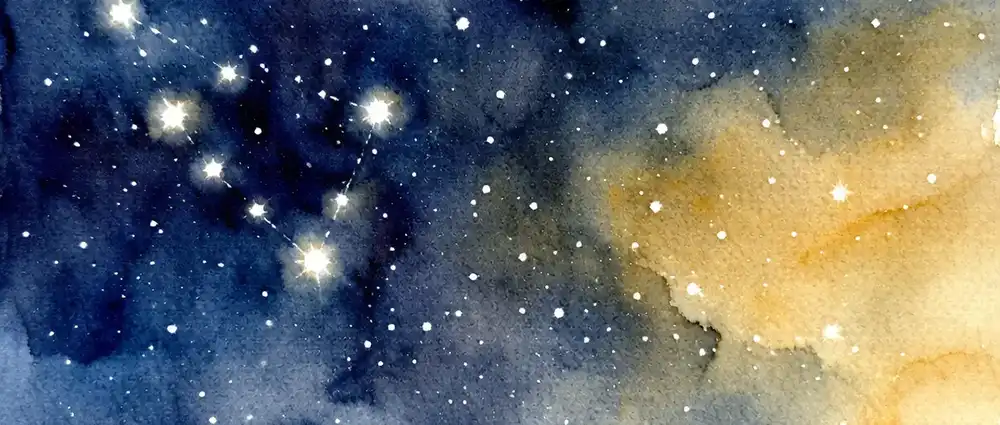
Stars in traditional culture were never merely a night scene. The ancients looked up to find direction and know the four seasons—the Big Dipper pointed north, the celestial tracks kept their constancy, and when a given star reached its station, the solar term had come. The stars were the sky's earliest coordinate system; before humans had maps, they had the stars. So what the stars mark is an experience: that in the midst of greatest chaos, you can still lift your head and find something unmoving, telling you where north is and where the road lies.
Farthest Away, Yet the Most Dependable
A star is so far that its light takes decades to reach us, and yet it is exactly this distant thing that shows the way to those on the ground. The lamps nearby go out, the markers beside you get moved, but only the stars hold one position for ten thousand years. Think how many "always there" people later vanished, and how many "rarely in touch" ones never once strayed—this is what the stars teach: what stays constant is often far; what clings close every day is the quicker to drift. People are the same. Some relationships are quiet, not present every day, yet when you are truly lost, the few you think of are still them. They are far, but they do not float; they do not cling to you, but you know they are in that sky, forever pointing the same direction.
This "distant yet steady" is more precious than "near yet swaying." Someone too close sways right along with you at the slightest trouble; the distant and steady one does not move himself, and by his light you recover your bearing. The stars teach that those who can truly serve as a coordinate are often the ones who do not orbit around you every day. You flip through your contacts, and the numbers you can actually dial in an emergency are usually not the ones liking your posts daily, but those who "stay silent usually, and are surely there when things go wrong"—they are like distant stars, not clinging to you, yet when you lose your way, they are the first you think to look up at.
Each in Its Own Place, None Crowding Another
The starry sky is beautiful because every star sits in its own position and does not seize another's place. Dense, yet not chaotic; many, yet not colliding. The ancients watched the stars precisely for this order—no one overstepping, and the whole sky stays clear. Look at a crowd of people by contrast: many feel uneasy because everyone pushes toward the middle, everyone wants the brightest patch, and in the end no one can see clearly.
Those who understand "staying in one's place" do not steal the show or block the lane; they shine their own light from their own coordinate. They are not conspicuous, yet the whole sky is complete because of that position of theirs. The kind of person beside you who "never grabs the spotlight yet is indispensable when absent" is a star each in its place—he does not move, and the surroundings stay steady. Reversely, if in a circle everyone wants to stand at the brightest point, no one can light up anyone else; leave a few willing to dwell at the side, and the whole becomes bright.
It Does Not Chase Your Gaze — You Look Up Yourself
The stars are always there, never chasing anyone saying "look at me." It is the lost person who lifts his own head and borrows their light. This is crucial: the stars give direction, but not comfort; they do not come down to fetch you, they only stay there—whether you look up is your affair. Too many wait to be "pulled" out of trouble, yet the logic of the stars is: I do not move, you look up, you walk yourself.
People should learn this measure too: you can be someone else's coordinate, but if you come down to carry him on your back, he will never learn to read the stars. The best support is to stay steady there and let him look up himself. The more you try to find the road for him, the less he learns the road; the more you simply stay there, the more he develops the skill of reading the sky.
Silent, Yet Keeping the Longest Time
The stars do not speak, yet they keep a time longer than any person. The light of one star may have been sent decades ago and only now reaches your eye. With silence it bears time itself. Among people there are also such "old clocks"—offering no opinions, chasing no trend, yet when you sit with them a while, time seems to slow, and the panicked things lose their urgency.
Such people are like ancient stars, able to stay calm. While all around accelerates, they do not change pace; while everyone shouts, they do not open their mouth. You think them slow, but they are only not in that rhythm. With them you remember again that some things cannot be rushed and must be measured by a longer time. Now everything preaches speed, yet some judgments truly need to be set aside a while before they come clear—their slowness is not backwardness; it keeps a stretch of time for you.
Never Tamed by Anyone
The stars have been named by people, divided into constellations, written into almanacs, yet they never truly belong to anyone. Call it what you will, it remains that star, walking its own orbit. People often mistake "I understand you, I have named you, so you are mine"—the stars smile at this illusion. No matter how intimate the relation, the other is an independent star; you may borrow light, but not possess. Those who understand this do not "name anyone as their own"; they borrow the light and also let the star walk on by itself.
This clarity of "never tamed" is the hardest ground the stars give to relationships. Cling too close in wanting to possess, and the star goes dark to show you—not that it is cruel, but that it was never yours. The tighter you try to grasp, the further it retreats; loosen your hand, and it is there. The measure of relationship, the stars acted out for you long ago.
It Has Its Dark Ones, Yet Darkness Too Is Part of the Sky
Not every star shines. Some are so dim they are invisible to the naked eye, yet they are still there, only not sending light your way. The beauty of the night sky is half in the bright, half in the dark—without the dark to set it off, the bright would not show. People are the same: those "unlit" ones beside you are not without weight; their light simply is not at your angle. Do not take brightness as the measure of usefulness.
Sometimes you feel dim yourself, too tired to shine for others. The stars say: darkness too is part of the sky. Not shining does not mean not being; not lighting anyone at this moment does not mean you have no place. The whole sky needs dark stars, just as a lively circle needs a few quiet ones to hold the bottom.
It Teaches Us to Look Up, Not to Kneel
The stars make people lift their heads; that is their only demand—when you are lost, look up. But looking up is not kneeling. The stars never ask to be worshipped; they only give direction. Too many turn "looking up" into "worship," lowering themselves to reach something far, and end up finding no direction while first losing themselves.
The posture of the stars is: head lifted, person standing straight, borrow the light to fix true north, and walk yourself. Looking up is to borrow a coordinate, not to offer yourself. The person beside you who can truly be a coordinate does not want you to kneel either; he wants that after you look up, you walk steady. One who can truly be a coordinate never asks you to bow and submit; he wants you, by his light, to walk yourself straight—this is the most decent distance the stars give to relationships: I shine mine, you walk yours.
What do stars symbolize in traditional imagery?
Stars can symbolize distance, steadiness, orientation, and a rhythm larger than one person’s immediate urgency. They do not need to be interpreted as personal omens; sometimes a guide is simply a stable reference point.
How can I find direction when I feel lost?
Choose one value, person, practice, or fact that remains reliable, then take the next step that aligns with it. You do not need to become the brightest point in the sky to be guided by a steady one.
Want to understand why distance can feel more dependable than closeness?
If you keep circling for reassurance, gentle self-exploration can help you find an inner coordinate without kneeling to anyone’s approval.
Back to Ourselves
The image of the stars speaks of a kind of "constant sense of coordinate." It is far, it is steady, it sits each in its place, it does not chase your gaze, it bears time in silence, it has its dark ones too—none of these is "brightness" itself, but the order behind the brightness.
You have likely played both roles: looking up to find some star when lost, and being borrowed from when someone else was in chaos. When things get chaotic ahead, do not only lower your head and circle; look up at those few that never moved. If you can be a star that does not move, do not hurry down to carry anyone—staying steady helps more than chasing after people. Next time you feel chaotic, do not hurry to grab someone; look up at those few that never moved—they make no sound, yet the direction is always there. You need not be the brightest star; being one that never moved is enough for many to find for a while. Direction, after all, does not depend on brightness, but on presence.
Keep reading: Shan: Always There, Unspeaking and Unyielding · Shi: Silent, Yet Holding Everything · Water: The Softest Thing That Always Finds the Crack
Written and reviewed by DustEcho Editorial for self-reflection and cultural inquiry—not counseling, medical advice, or a clinical diagnosis.
Not sure where to begin?