Why Do I Feel Uneasy When Someone Takes Care of Me?
DustEcho Editorial
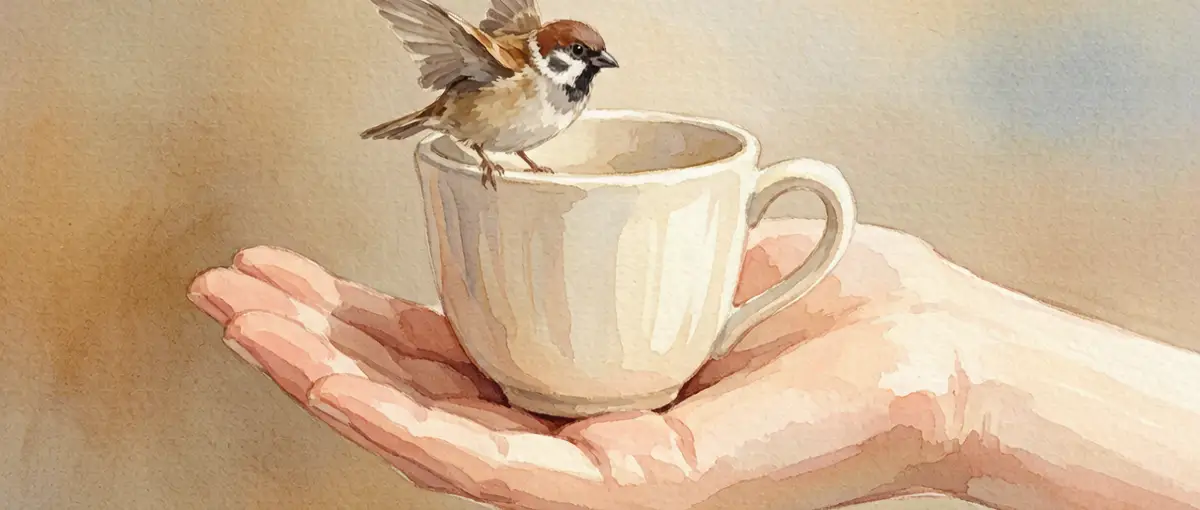
You are not cold, and you are not ungrateful. If someone caring for you makes you restless and uncomfortable — pulse quickening, a urge to get up and do something, a faint shame you can't name — it usually means the "relationship ledger" in your mind suddenly went off balance. You are so used to being the one who gives that the moment you are caught and held, the scale tips. This is completely normal, and underneath it is a string of explainable causes, not a flaw in your personality.
A friend told me recently that she was in bed with a fever, and when her boyfriend brought a bowl of congee to her bedside, her eyes welled up. Not from being touched — from panic. In that moment her mind raced: "Should I get up and wash the pot right now?" "Will he think I'm being needy?" She was simply being cared for, yet her body felt like it was sitting in someone else's chair, restless no matter how she shifted. This kind of panic is common; people just rarely say it out loud. It shows up in small ways too — a colleague who buys your coffee, a roommate who folds your laundry, a partner who quietly handles the errands so you can rest. The care is real, and so is the unease.
Let's take it apart and look at the causes one by one.
Why do I immediately want to "pay it back" when someone is kind to me?
Human beings carry a ledger in every relationship. You take me to dinner, I note it. You help me move, I hold a mental IOU to return the favor someday. This ledger is a reciprocity instinct left to us by evolution, meant to keep relationships flowing instead of overloading them. But the moment the "receiving" column suddenly grows heavy while the "giving" column stays empty, a person can't sit still — it feels like owing a favor whose repayment date you can't name, a weight on your chest even in your sleep.
So you rush to do something: return the invitation, send a gift back, hurry to show "I can take care of you too." The person caring for you may not be waiting for payback at all, but your body panics on your behalf. This is exactly the same thing described in why do I feel awkward receiving kindness — for some people, simply receiving kindness is something that takes practice. The awkwardness is not a character defect; it's a habit of the nervous system that can be gently retrained.
You can try setting the urge to "repay" aside for a moment and writing it on a piece of paper instead: today he cared for me, I felt it, whether I owe anything can wait. Moving the ledger from your head to the page lightens that inner scale a little. You don't have to act on the debt. You only have to stop letting it hum in the background.
Is it that deep down I feel I "don't deserve" to be cared for?
A deeper layer of panic comes from self-worth. If a person subconsciously believes why do I feel I don't deserve good things, then the care someone hands over is not only warmth — it is like a mirror, reflecting the shame of "I'm actually taking something for free." You don't dislike being cared for; you dislike how "being cared for" exposes that you, too, are soft and have needs. The care becomes evidence against the story you tell yourself about being self-sufficient.
This "unworthiness" creates a strange loop that tightens every time someone reaches toward you:
- Being cared for → feeling you owe something, feeling hollow
- To offset it → being extra good to others, climbing back to the safe seat of "the giver"
- Others care for you again → more panic, because the safe seat is flipped over once more
The loop survives because each escape back into the giver role confirms the fear it was meant to soothe. To break it, first acknowledge one thing: the person caring for you is doing it voluntarily. When he handed over the congee, he was not calculating whether you were worth it. Whether you accept or not, it does not change the fact that "he is willing." Separate "am I worth it" from "is he willing," and the first entry in the ledger balances out. His willingness is not a verdict on your value.
Why do I want to pull away and carry it alone the moment I'm cared for?
Another kind of panic is about the sense of control. When you carry things yourself, the steering wheel is in your hands — tiring but steady. Being cared for means handing over the wheel for a while and becoming the passenger. For people who would rather carry it alone, this feeling of "being arranged for, being sheltered" is more unsettling than the tiredness itself — it hints that there are times you can't hold up either, and that hint threatens the story that you are always fine on your own.
More subtly, if early care came with conditions ("I'll love you if you obey"), accepting kindness as an adult triggers instinctive suspicion: why is he being so good to me, does he want something? This suspicion is not paranoia; it's your body remembering an old script. So when intimacy draws near, you pull away without thinking — not because you don't love, but because the old script sounded the alarm first. The care feels dangerous not because it is, but because your history taught your body to read closeness as a setup.
Is this normal? Am I just too sensitive?
It's utterly normal, and not "making a fuss" at all.
The restlessness of being cared for is essentially several things stacked together: the reciprocity instinct, your sense of worth, your sense of control, plus the residue of early relationships. None of them is a sickness; your body is using old experience to protect you. The only difference is whether you're willing to let new experience slowly rewrite the old script. Knowing which layer is active in you is the first practical step toward loosening its grip.
The table below helps you quickly locate which link you're stuck on:
| Your typical reaction | You're probably stuck on | You can try |
|---|---|---|
| Immediately want to return the favor, send a gift | Reciprocity ledger off balance | Write down the urge to "repay," delay it |
| Feel hollow, indebted, undeserving | Low sense of worth | Remind yourself: the other person is voluntary |
| Want to pull away, carry it alone | Sense of control yields | Allow yourself to be passenger once |
| Suspect the other wants something | Conditional early care | Separate "then" from "now" |
Can I feel less uneasy? Start by practicing "receiving"
You don't have to force yourself to enjoy being cared for right away. Like building muscle, practice "catching" from small places, and let the capacity grow at its own pace:
- When someone says "you've worked hard," don't reply "not at all" — just say "thank you, I really am tired" and let being seen land for three seconds.
- When someone brings you food, don't rush to transfer money — first say "then I owe you one" and move the ledger to later.
- Allow yourself one afternoon to do nothing and be cared for — this is exactly what the East calls letting go: set that inner scale down for a while and trust the chair will hold you.
- When the panic rises, name it out loud to the person who cares for you: "I'm not used to this, but thank you." Saying it turns a hidden shame into a shared, manageable moment.
The person caring for you most likely doesn't want anything repaid. What they may want is simply for you to sit steady in that chair and let them see you relaxed. And the starting point of compassion is precisely that you first allow yourself to be treated gently — only when you can catch others' goodness will they dare to keep giving. Receiving is not a debt; it is the other half of love.
Next time that wave of panic rises, remember: you are not ungrateful, you just haven't gotten used to it yet. The ledger will balance, the chair will warm up, and you already deserve to be cared for.
How do I stop feeling uneasy when someone takes care of me?
Slow the repayment reflex down. Say "thank you" once, name what you need, and wait before buying a gift, returning the favor, or insisting you are fine. Let the care be received as a moment of connection rather than a bill that must be closed immediately.
Is it normal to feel uncomfortable being cared for?
Yes. It can feel unfamiliar when you are used to giving, staying in control, or proving your worth through usefulness. The discomfort does not mean the care is wrong or that you are ungrateful. It is a signal to practice receiving at a pace your body can tolerate.
Want to understand why receiving support unsettles you?
If being held makes you want to jump up and repay the kindness, gentle self-exploration can help you build a more balanced relationship with care.
Written and reviewed by DustEcho Editorial for self-reflection and cultural inquiry—not counseling, medical advice, or a clinical diagnosis.
Not sure where to begin?