Understanding a BaZi Chart: Finding the Missing Bridge
DustEcho Editorial
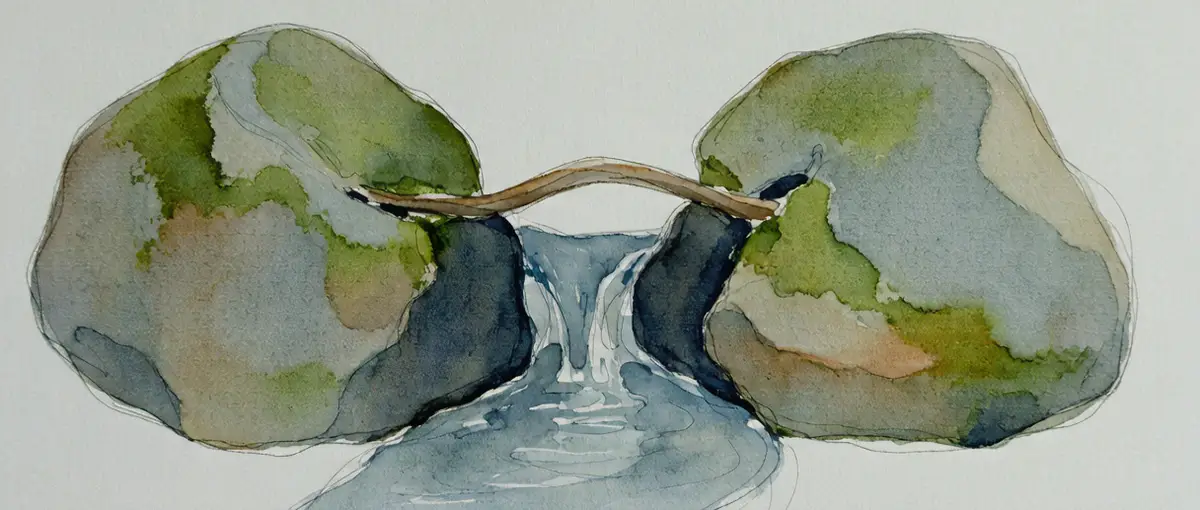
If you are learning how to read a BaZi chart, tong guan — bridging — is a useful way to understand what happens when two elemental forces clash and stall. Traditionally, a third element is introduced to mediate, turning collision into circulation and mutual restraint into mutual generation. It works like an interpreter between two people who share no common language, turning confrontation into conversation. This is not a prediction or a fixed diagnosis. It is a way to name an experience: two forces inside you wrestling, while something in the middle is still missing.
Two Forces, Neither Giving Way
Bridging presumes that two forces have already collided. It might be the drive to excel and the urge to rest inside you. It might be being good to others and being harsh on yourself. It might be the caution that follows every rule and the impulse that says "screw it." Neither force is wrong on its own, but they happen to issue contradictory commands inside the same person, during the same stretch of days. You feel like a rope pulled taut from both ends — not because the rope is weak, but because too many hands are pulling. A friend once told me that after smiling at colleagues all day at the office, he would come home and not want to say a single word, like a wet towel wrung out for eight hours. He was not being fake. It was that his inner accommodation and his inner solitude had been locked in a tug-of-war. Accommodation won the daylight hours, and solitude could not hold the night. So the person leaked.
The Real Problem Is Not Winning or Losing but the Exhaustion
When two forces stay deadlocked too long, a person does not break but gets hollowed out. Metal fells Wood with every chop; Water extinguishes Fire with every pour. Each round of collision costs something. The hardest part of bridging is not the moment you lose. It is the stretch when both forces match evenly and neither retreats — your body becomes a bow neither drawn nor relaxed, the string taut, the arrow never released. You feel as though you have done nothing, yet are as tired as if you spent the day hauling bricks. You cannot pinpoint where the fatigue comes from, because it is not physical. It is two forces fighting an eight-hour match inside you while you stand there refereeing, unable to blow a single whistle. People ask, "Why are you always so drained?" and you have no answer. You cannot exactly say: I have no energy because I am fighting myself, and win or lose, I still take the beating. This kind of tiredness is invisible to others, hard to explain even to yourself. It is a dull consumption lodged deep in the bones — no sharp pain, just a heavy weight.
What You Lack Is Not Victory for One Side but Someone in the Middle
When two forces fight, most people think: "Which side should I take?" Should I be harder or softer? Should I push harder or ease up? But bridging points in a different direction. It does not ask you to pick a side. It asks you to find the one in the middle. That middle figure is not a third party. It is not a peacemaker who muddles everything into compromise. It is a third element — something that can thread the two forces together. When Metal and Wood clash, bring in Water: Metal generates Water, and Water nourishes Wood. The fist that strikes becomes a watering can tending to a garden. Bridging does not eliminate either side. It places a path between two opponents. Many people spend a lifetime circling inside either-or choices — push or rest, hold it in or blow up — never once considering that perhaps no choice is needed, that what is needed is simply an interpreter standing in the middle, connecting the momentum of both ends. That interpreter does not have to be anything grand. Sometimes it is just a habit, a phrase you repeat to yourself, the act of taking a sip of water before you explode. Do not underestimate that sip of water. It might be the thin stream — the one nobody has yet walked — flowing between Metal and Wood.
That Bridge Is Not Far Away but in the Crevices of Your Daily Life
The third force that bridging calls for is rarely earth-shattering. Not quitting your job, ending a relationship, moving to a new city. It might simply be sitting in the car for three minutes after parking, before opening the door to go inside. In those three minutes, the daytime self and the nighttime self meet at the steering wheel and silently hand over the baton. Nothing complicated. Yet those three minutes keep the self that smiled all day and the self that does not want to speak at home from colliding at the doorstep. Bridging is made of small things like this — a crevice wedged between two forces, not needing to be wide, just wide enough for water to flow through. You are not building a bridge across a sea. You are laying a twig between two stones — not thick, just sturdy enough for a strand of waterweed to drift across. Drift across, and bridging happens. Stay stuck, and stalemate sets in — left too long, it rots. But the moment a thread of water stirs between, the whole configuration comes alive. That twig may have been placed by you, or it may have fallen there by accident. What matters is not who placed it, but that it is finally there.
You Do Not Need to Destroy Any Part of Yourself, Just a Path You Can Walk
Returning to bridging itself. Its gentlest quality is this: it passes no judgment on either side. It does not say Metal is too hard, or Wood is too brittle. It simply says: between you two, there is a seam. That seam is the path you can walk. You do not need to force yourself into becoming a different person. You do not need to scold the part of you that wants to rest, nor enshrine the part of you that wants to push forward. You only need to step in when they are about to start fighting, stand there for a moment, and say: "Hold on. I know a way." That way is not long. It might be the few steps from your desk to the balcony. It might be turning your phone face-down and closing your eyes for ten seconds. It might be looking at yourself in the mirror and murmuring, "Today was okay." It is not a hero story. It is not a life turning point. It is an ordinary person, on the day the inner battle was at its fiercest, suddenly pausing, taking a sip of water, and then both forces flowing down together along that sip. What flows down is not a winner but the two forces merged into one — no longer clashing, no longer shoving, just quietly, calmly heading in the same direction. That direction may not lead anywhere remarkable. But it leads to a night without war.
A More Modern Way to Say It
In the language of psychology, bridging resembles third-party mediation in internal conflict. When two contradictory needs or drives remain locked in prolonged opposition, choosing one side through sheer willpower often deepens the depletion. The effective resolution lies in introducing a neutral intermediate variable — something that holds both sides — and turning mutual exclusion into mutual completion. This is not compromise; it is integration. Between pushing and resting, introduce a rhythmic looseness. Between holding it in and blowing up, introduce a bounded form of expression. Bridging does not ask you to be stronger. It asks you to be more flexible — to find, between two strings pulled tight, a third string that can make them resonate together. That third string is not something you are born with. It is something you stumble upon, on some unremarkable commute home, without thinking about anything at all. The moment you touch it, you may not know what to call it. But you know this: from today onward, those two forces inside you no longer need to fight.
What does Tong Guan mean in a BaZi chart?
Tong guan is the idea of using a bridging element or practice when two forces in a chart pull against each other. It is not about erasing one side or choosing a winner. A useful interpretation asks what small support could let both needs exist — a pause, a boundary, a conversation, or another path between the extremes.
Want to explore that pattern in your own chart?
Reading the concept is a first step. A personal reading can help you connect the bridge metaphor to the decisions, relationships, and tensions you are actually living with. Start a personal BaZi reading.
Keep reading: Huo-Yan: When the Light Comes On Too Fast, It Also Burns · Jin-Han: When the Edge Is Wrapped in Frost · Mu Wang: That Upward Drive You Can't Hold Down
Written and reviewed by DustEcho Editorial for self-reflection and cultural inquiry—not counseling, medical advice, or a clinical diagnosis.
Not sure where to begin?