BaZi Reading Basics: What Tiao Hou Means
DustEcho Editorial
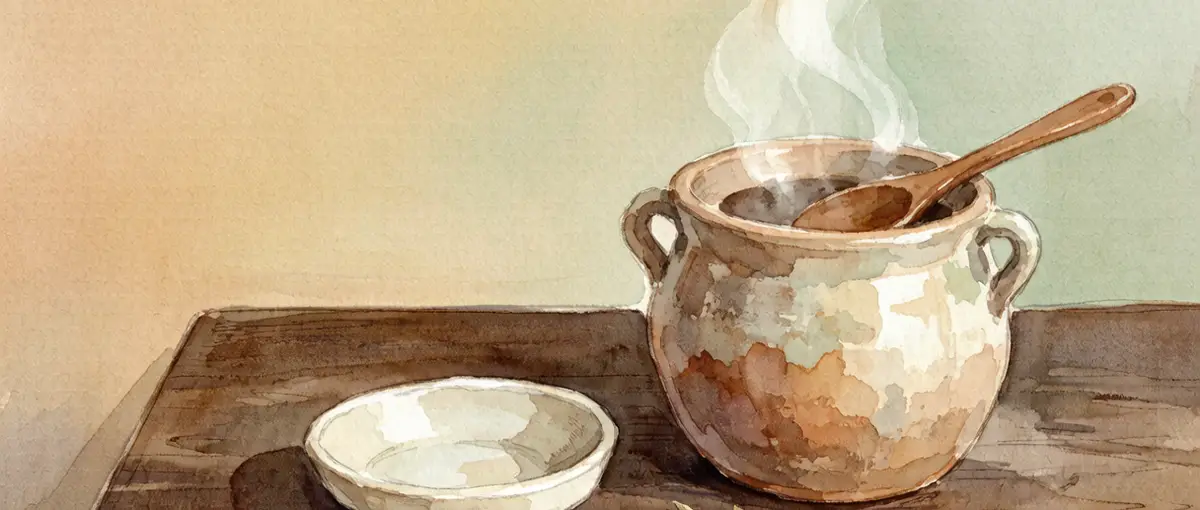
In BaZi reading basics, tiao hou — or climate adjustment — is a way of reading thermal and moisture balance within a birth chart. Too much fire calls for water to cool things down; metal and water running too cold call for fire to warm them. Dryness needs moisture; dampness needs drawing back. Tiao hou does not determine fortune or misfortune. It works more like a cook before the stove, deciding whether the dish needs salt or vinegar. This piece will not prescribe a ritual or read anyone's destiny. It simply names an experience — the one where everything seems fine, yet something is not quite right. You are not being picky. The dish really is missing an ingredient.
Not Bad, Just Not Quite Right
The subtlety of tiao hou lies in that character hou — climate, season, the felt texture of a moment. It is not about dramatic swings between good and bad, but about a temperature off by a fraction of a degree. You sit in an air-conditioned room where the thermostat reads correctly, yet you feel stuffy. You eat a table of dishes, each technically flawless, yet nothing makes you reach for another bite. A life with insufficient tiao hou carries this unobvious wrongness: others see nothing amiss, and the one living it cannot name what is missing, but somewhere inside, a quiet voice keeps asking — is there something more? That something is not a big thing — not a promotion, not a relocation. It is more elemental. Like winter heating that warms the room but leaves the air dry. Like a summer fan that stirs the air but never quite cools. The life is not broken. It is simply missing that one ingredient at exactly the right register — not chili, not sugar, but salt. Salt never calls attention to itself, yet without it, everything tastes scattered.
The Missing Flavor Even He Cannot Name
The difficulty of tiao hou is its unobtrusiveness. Other energy imbalances announce themselves: too much fire makes you restless, too much water makes you heavy, too much earth makes you stifled. But when tiao hou is off, what you feel is indescribable — not wrong, exactly, but never quite smooth. A friend once told me he had changed jobs three times and moved cities twice, each time convinced this would be the one. But shortly after each landing, that familiar emptiness surfaced again. He lacked neither ability nor opportunity, yet his days felt wrapped in cling film — visible, tangible, but the film stripped most of the flavor away. He was not ungrateful; his climate had simply never been adjusted by anyone. Growing up, what he heard was "work harder" and "get stronger." No one ever asked: "Do you feel too cold right now, or too hot?" He could not answer, because he never had that thermometer. He had not even discovered which ingredient was missing.
It Is Not Pickiness — the Ingredient Is Simply Too Subtle
What tiao hou calls for is often the most unremarkable thing. Not a raise, not a career change, not a more charming partner — just pulling the curtains open each morning to let sunlight in for five minutes. Moving a desk from the corner of the room to the window. Reserving one afternoon a week with nothing scheduled, just sitting. These things are so small that saying them aloud feels embarrassing. "What have I been working on? Getting a little morning sun." Yet these are precisely the gestures that adjust a temperature gap of a fraction of a degree. The body has been sending signals all along — not warm enough, or not cool enough. The signals are quiet enough to miss, but the body knows: waking up still tired, afternoon drowsiness that will not lift, a mind racing when the head hits the pillow. None of these are emergencies. But day after day in this not-quite state is like a spring held under gentle, constant pressure — it will not snap, but it will not spring back either. The ingredient is so small that no one else can see what was added, but the cook knows: with it and without it are two completely different pots.
When It Clicks, It Does Not Roar
When tiao hou finally aligns, there are no trumpets, no sudden reversal. It feels more like a small switch nudged into place. You suddenly notice the morning light resting comfortably on your skin. The water in your glass is exactly the right temperature. You feel no need to hurry — walking a little slower feels right. Nothing outside has changed, but your inner climate has settled onto a precise, comfortable mark. The cling film that had sealed your days has developed a small tear; air has begun to circulate. The tear is tiny — maybe you woke up ten minutes earlier, maybe you put the phone away and read a few pages, maybe you walked into a shop you had never entered and had a bowl of noodles. But from that small opening, you realize that life can taste right. Not perfect — just exactly enough. Warm enough, cool enough, just enough to drink the bowl of soup to the last drop. No need to praise it, no need to announce it. You just wipe your mouth and feel that tonight, sleep might actually come. That is the signal of tiao hou properly tuned — so quiet it makes no sound, yet it wakes you more truly than any alarm ever could.
Your Climate, No One Else Can Adjust
The most distinctive thing about tiao hou is this: what works for someone else may do nothing for you. One person finds that daily running fixed everything; another runs for years and feels unchanged. It is not that running is useless — it is that their climate is not missing exercise. They might be missing five minutes of aimless chatter each day, or a weekend afternoon with the phone left in another room, or the simple act of closing their eyes and lying still before ten at night. Tiao hou is not a universal recipe. It is each one's own pot — tasted alone, tested alone, filled alone. What is salt for someone else may be sugar for you; hot soup for one, ice water for another. There is no standard solution, only your own tongue, at some early dawn or quiet dusk, suddenly catching that note of rightness. In that moment you may not weep or laugh — you may simply exhale, as if releasing half a lifetime of misaligned temperature. Only then do you realize that the ingredient you had been missing all along was called "just right."
A Modern Way to Say It
In psychological terms, tiao hou resembles a subclinical dysregulation of the inner sensory environment and circadian rhythm — not a major mental health episode, but a subtle mismatch in daily light, sound, temperature, and emotional pacing that, neglected over time, accumulates into chronic low-grade unease. It is not an illness. It would rarely reach any diagnostic threshold. Yet it settles onto the baseline of life like a thin layer of dust — not dirty enough to demand cleaning, but once wiped, the brightness startles. The way back is not a grand overhaul but micro-intervention: light exposure, ambient sound, thermal comfort, daily rhythm — things so small they barely belong on a calendar, yet these may be exactly the missing ingredient. You do not need anyone to tell you what to add. You only need to begin tasting: taste the morning light when the curtain opens, taste the silence of sitting wordlessly for ten minutes, taste whether the stuffiness lightens when the thermostat shifts a single degree. Once tasted, it is yours. The ingredient is not expensive; it cannot be bought. It hides in the small things you have never treated seriously. Finding it requires no special skill — only the willingness to pause and say to yourself: "This does not feel quite right." Then begin searching, for that one point of just enough. Just enough is enough.
What does Tiao Hou mean in a BaZi chart?
Tiao hou describes the chart's cold, warm, dry, and damp balance. In everyday language, it asks whether your inner climate has enough of what helps you settle and function. It is a lens for noticing fine-grained imbalance, not a promise that one element will determine your future.
Want a more personal reading of your chart's balance?
If the idea of a missing ingredient feels close to home, a guided reading can connect this language to your actual season of life. Start a personal BaZi reading when you want to explore it with more context.
Keep reading: Huo-Yan: When the Light Comes On Too Fast, It Also Burns · Jin-Han: When the Edge Is Wrapped in Frost · Mu Wang: That Upward Drive You Can't Hold Down
Written and reviewed by DustEcho Editorial for self-reflection and cultural inquiry—not counseling, medical advice, or a clinical diagnosis.
Not sure where to begin?