Si: the moment it stops — and the hiding place of the next turning
DustEcho Editorial
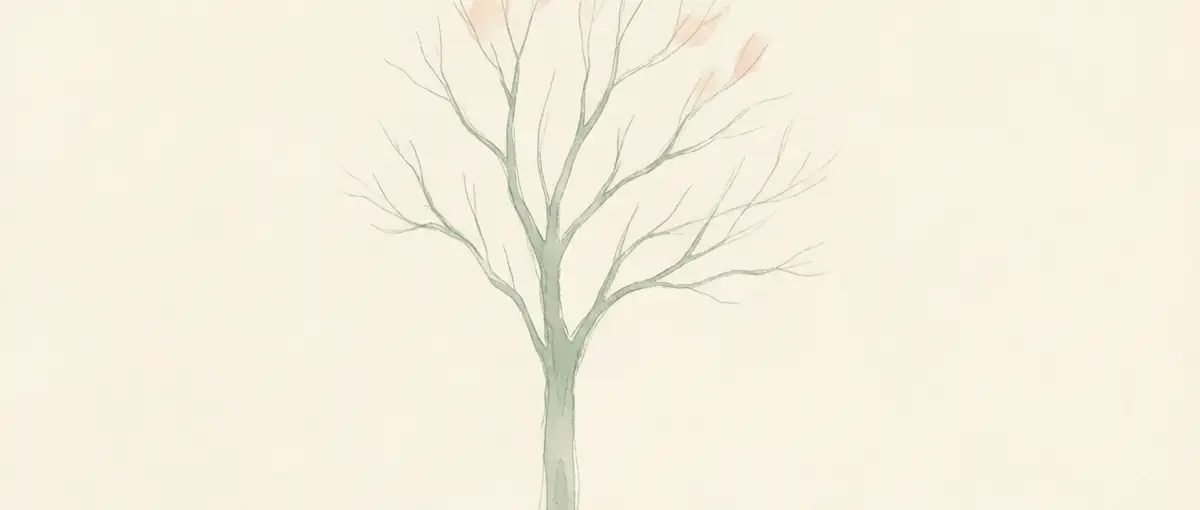
In the Twelve Growth Phases, tracing how the five elements' qi is born, declines, and turns, "Si" — death — follows "Bing," illness. Bing is stalled, sluggish qi; Si is that qi sunk to its lowest and gathered into stillness — like a leafless winter tree or a seed buried in soil, all returning to quiet. It is the most misread phase: Si is not an ending but this round of qi reaching its close, the pause before the next. In life it is no fate, only an experience we all know — a state, a relationship, a self at its stillest, emptiest moment.
What is Si?
We misread "shut down" as "finished," but Si only gathers, never annihilates. A seed in soil looks dead yet waits; a closed matter looks empty yet makes room. So in life a project is shuttered, a relationship ends, a role ends. None of this is gone for good — Si is simply there, that breath sunk low and still. To recognize Si is, when no force comes, to know this is a gathering, not a finale. Too many fixate on "everything vanished" and mistake a rest for collapse, so they cannot let go.
Si in work: drawing the line
Si at work arrives in the closing-up: a long business cut, a role taken, a direction called off. No peak's warmth remains; you may feel hollow — that is Si, the qi gathered, the curtain fallen. Many stay stuck because they won't take their bow: the project gone yet clung to, the direction stopped yet kept alive, burning the last warmth into obsession. Si's wisdom is to bow cleanly and clear the stage; protecting the close beats forcing things together. The reverse also happens: the moment it stops you decide you're worthless and scramble to fill the gap, misreading Si as a dead end. Those who bow are often not weak — they know the curtain was always going to fall.
Si in relationships: parting in peace
In intimacy Si is the stage of having run its course: two people reach a calm goodbye, the bond moving from congestion to zero — not hatred but closure. Many stay stuck by refusing to admit it: finished yet tangled, wearing away the last good between them. Si asks you to acknowledge the bond has closed, return to zero with dignity, protect what just landed. A little less grasping and it settles into quiet earth. The reverse: the moment you part you fear you'll never meet anyone again, misreading Si as a dead end. Those who return to zero are often not unloving — only more afraid of never having truly walked through it.
Si in your own state: the fallow period
Si lives in the person too. There are stretches with no force at all — won't move, won't see people, doesn't know what he wants. A friend says, "You've seemed so empty lately." That is his own Si. It is not bad, yet cannot bear a cold "why so listless," even as the breath's gathering has begun. Many a good state dies when it goes empty and is despised by its owner: stillness read as worthless, stopping rushed to be filled. The patience Si asks is first to allow yourself "only gathered in, not finished." Protect that not-yet-born quiet and it can turn.
What Si fears most: refusing to leave the stage
Si's easiest trouble is holding on when it should have closed — a gone career clung to, a left bond entangled, an empty state performed, twisting the breath that should settle, since gathering comes from letting go. Si needs a clean exit: let the breath settle itself, instead of hauling on and never releasing. Many good things are ruined by refusing to disperse, not by dispersing too fast. So in Si, learn to restrain your grasping and stand aside, letting the breath fall into earth on its own. The real fear is a hand that cannot accept an ending, pulling again and again. Those who hold on by force are often not deeply feeling — only panicked, and failing to tell the two apart twists Si into obsession.
After Si comes the tomb — but the tomb stores, it does not bury
In the cycle Si is followed by "Mu," the tomb, where qi is stored like grain in a granary — not punishment but law. Seeing Si's message calms you: stillness and hiding follow, not failure. Many fear Si as "truly gone," yet the tomb only puts this round away well; after nourishment, womb and birth rise again. Admitting Si gathers lets you dare to stop, knowing it is not vanishing but living another way. So pass through Si without forcing things to stay; the next birth waits elsewhere to break soil.
Do not read Si as "the final act"
Another pit is reading Si as "life stops here," as if a stop were the whole. This crushes the present and misreads the pattern. Si is only the gathering station among twelve, joined before and after: Bing congests it, Mu stores it. To take Si as endpoint misses the long road. Recognize it as a rest, not the destination. Run through, put away well, then turn cleanly — the composure Si teaches.
In closing: that breath sunk to its lowest is also waiting for the next round
Set in daily life, Si is that instant stillest and emptiest, barely able to summon force, yet quietly gathering. Not mysterious, nor a prophecy of your end — only a reminder that from stuck to still, this step has weight. Don't panic that all is gone, nor force-hold because you want to grasp. Catch each gathering moment and your life comes up crop after crop — always a stop, always new green.
What does Si mean in everyday life?
Si can be read as the quietest point of a cycle: a role, relationship, or version of yourself has run out of force and needs space before the next movement. It is not a final verdict or a prediction of literal death.
How can I move through an empty or fallow period?
Lower the demand to perform, name what has ended, and protect basic care while the next direction is unclear. If emptiness, hopelessness, or inability to function persists, seek qualified professional support.
Want to understand why stillness feels like the end of you?
If you keep forcing a new beginning before grief has settled, gentle self-exploration can help you let the quiet store what you need.
A more modern way of saying it
Psychology speaks of mourning and a fallow period: after losing an identity, relationship, or direction, a person enters stagnation and emptiness — the low valley where the mind says farewell and clears space, not a loss of ability. Si's teaching only restates, in the language of the five elements' birth and death, that when qi gathers it is still, and when still it is stored. It reads no fortune, only reminds you: that lowest breath is stillest and briefest — don't panic, don't haul on it by force.
Keep reading: Guan Dai: the step from "alive" to "taking shape" · Lin Guan: grown enough to step up and take hold · Shuai: how the breath loosens, little by little, after it has peaked
Written and reviewed by DustEcho Editorial for self-reflection and cultural inquiry—not counseling, medical advice, or a clinical diagnosis.
Not sure where to begin?