Water: The Softest Thing That Always Finds the Crack
DustEcho Editorial
In the Tao Te Ching, water is lifted to a place no other image can reach — "the highest good is like water." The best kind of virtue is like water: it flows downward, nourishes all things, and contends with nothing. In the I Ching, the Kan hexagram stands for water. Kan means danger, but also wisdom — water's cleverness lies not in sharpness but in knowing how to go around. In the five elements, water governs wisdom, and stands for flow, seepage, and reaching through. So when the ancients looked at water, what they saw was never its softness. They saw that, soft as it was, after all that time it still won.
What is Water?
You have surely seen this scene: two people clash, and one insists on proving who is right, voice rising with every sentence. The other does not take that energy head-on. He sidesteps, yet never loses the matter itself — then, a while later, he gets it done another way. That quality in the second one is water.
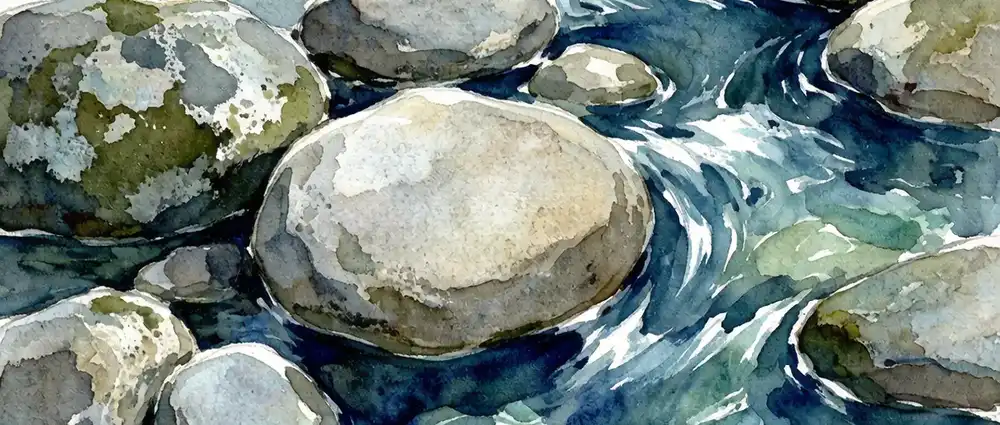
When water meets a stone, it does not stand there and push against it. It goes around. It flows around, or it seeps through slowly, or it waits — because one day the stone's sharp edges will be worn smooth. This is not cowardice. Water runs a clear account: a head-on collision only hurts itself, and the stone loses not a single corner for it; go around, and the path remains, the aim is not lost.
In life there are those who say, "I won't argue with you, but that doesn't mean I agree — I'll just take another road and get it done." That is water's quality made flesh. He does not fight over who wins the argument; he fights over whether the thing actually gets finished. You argue with him, feel you've won, and look back later to find the matter still moved in his direction — that is where water's real power lies. He won the mouth; water won the matter. In the end, who came out ahead? Water never settles that score with you, because by then it has already moved on.
Going to the Lowest Place Is Not Surrender
The most counterintuitive thing about water: it flows downward.
While everyone crowds toward the heights, water goes the other way. This is not a lack of ambition. The Tao Te Ching states it plainly — precisely because water flows to the low places, it can gather into rivers and seas. The low places are where no one else wants to go, and water goes there, taking all those places into itself.
In a person, this becomes the quality of one who does the work others won't do, who patiently untangles the matters others find troublesome. It is not that he lacks the ability to do anything else; he knows that the things no one will stoop to pick up, gathered together, become a foundation no one can take from him. The water-like person often stands the most firmly in the end — because his roots are sunk into the low ground others disdain. By the time others come to their senses, he has already gathered the whole lowland in. The low places have another advantage: no one fights you for them. Up high, rivals surround you on every side; down low, you quietly build your own store, and the strength you save becomes your base.
It Takes the Shape of Whatever It Is Poured Into
Water has one ability no other element can match: it has no shape of its own.
Poured into a cup, it is the cup's shape; flowing into a valley, it is the valley's shape. You call it spineless? No. It simply does not fight over shape. Water's principle is not in its outward form but in its core — no matter what vessel holds it, that it flows downward, gathers to the low, seeps bit by bit, has never changed.
In life this becomes the one who adapts to whatever surroundings he enters, yet never breaks the thread inside. He gets along with you, and gets along with the other fellow — not out of slickness, but because he gives the shape to the occasion and keeps the principle for himself. Others find him easy to be with, when really he just refuses to waste strength on form. You cannot pick a fight with such a one, because he simply does not take that energy — you say east, he does not object, he walks in your direction, and walking with you he leads you to where he wanted to go. You think he is following you, when in fact you have been guided by him.
When Still, the Water Clears
Water has another ability, easy to overlook: the moment it grows still, it clears.
A basin of muddy water — leave it alone, let it sit, and the silt sinks, the water turns clear on its own. The water-like person has this gift: amid chaos he can make himself still, wait for the silt of emotion to settle to the bottom, and only then judge. This is not suppression of feeling, but truly waiting for it to sink.
This is different from "enduring." Enduring is holding back, with the silt still churning in the water. Water's stillness gives the silt time to fall, and then sees clearly what is actually going on. What many people lack is precisely this step: the moment things turn chaotic they turn chaotic with them; the moment emotion rises they make a decision. The water-like person wins because he is willing to wait that one beat — let the water clear, then act. That single pause spares endless rework and regret. The hasty person makes three decisions and gets two and a half wrong; the water-like person makes one decision and gets it right. Not because he is smarter, but because he can afford to wait.
Drop by Drop, It Wears Through the Stone
The most formidable thing about water is not its softness, but that it stays soft for so long and is still there.
The four characters "dripping water wears through stone" — everyone can say them, but few really sit with how frightening they are: a single drop of water, soft beyond soft, and a stone hard beyond hard, yet so long as that drop does not stop, one day the stone will be pierced through. What it relies on is not force, but not stopping.
The water-like person often wins not any single battle but time itself. He advances a little today, a little tomorrow, never much at a time, yet when you look back, the thing everyone thought impossible half a year ago, he has quietly finished. He makes no noise, works no frenzy, signs no oath of defeat-or-death — he simply never stopped. This way of winning is the most miserable for an opponent, because you cannot block someone who exerts no force yet never stops. What the stone fears most is not the flood, but the leak from the eaves that never ceases — a flood you can still dam; the leak you cannot, because it is always there.
Too Changeable, and It Loses Its Base
Water has its weakness too. Adapt too well, and you can dissolve yourself away.
A person who can melt into any setting, after long enough, becomes hard for others to pin down. Everyone finds him easy to be with, yet no one can say what he actually wants. The water-like person's sharpest warning is this: do not let "easygoing" soak the "self" away. Taking the shape of whatever vessel holds it is a skill; but water is always water, not the cup — that line must not be lost. At a certain stage the water-like person faces a question: who am I, really? It is not that I get along with everyone — it is, once every container is set aside, what shape was I originally? Until this is answered clearly, being easygoing becomes having no boundary, and being inclusive becomes being drained.
What does water symbolize in traditional imagery?
Water can symbolize flexibility, persistence, emotional depth, and movement that does not need to collide head-on. Its softness is not passivity; it still needs direction, boundaries, and a place to rest.
How can I keep moving when the direct route is blocked?
Look for a smaller route, let the next step be reversible, and pause when the water is too muddy to see. A detour is different from abandoning your direction. If you are facing serious danger or exhaustion, seek practical support rather than relying on endurance alone.
Want to understand why adapting feels like losing your shape?
If you keep confusing flexibility with self-erasure, gentle self-exploration can help you bend without becoming directionless.
Back to Ourselves
Today we say "the highest good is like water" mostly as a polite phrase. Yet the experience water points to is something anyone can touch: no head-on clash, but never stopping; flowing to the low places, yet gathering ever deeper; no fixed shape, but always knowing which way it flows; able to grow still amid chaos, and act only once the water has cleared.
If you carry this quality of water, remember one thing — going around is allowed, stopping is not. The moment water stops, it becomes a stagnant pool. And if there is such a one near you, who contends with no one yet gets everything done, do not dismiss that soft strength of his. It may be the most patient power you know. Water contends with no one, yet water has never lost — it only wins slowly, wins quietly, wins where you never noticed.
Keep reading: Shan: Always There, Unspeaking and Unyielding · Shi: Silent, Yet Holding Everything · Xingchen: The Highest Place, the Steadiest Order
Written and reviewed by DustEcho Editorial for self-reflection and cultural inquiry—not counseling, medical advice, or a clinical diagnosis.
Not sure where to begin?