Shi: Silent, Yet Holding Everything
DustEcho Editorial
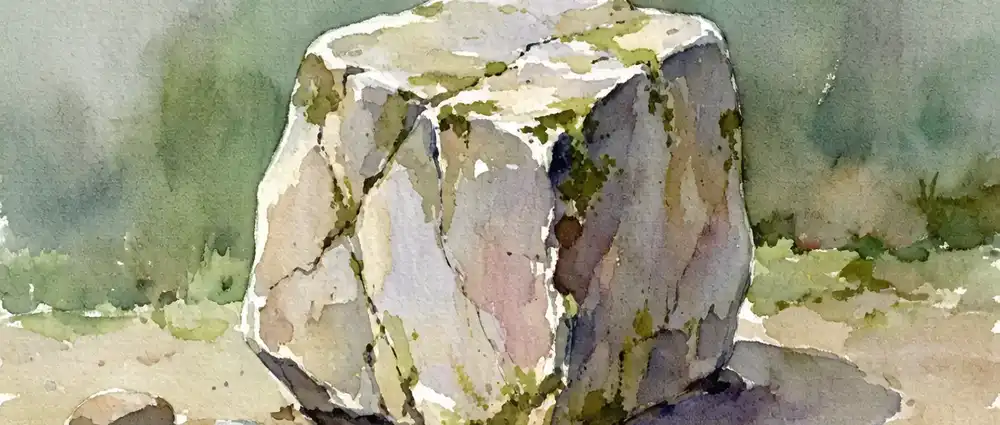
In traditional culture, shi — stone — is "the firmest part of earth." Among the Five Elements, earth governs trust; stone is the part of earth that settles deepest, unmoving, unchanging, unspoken. Jade is born from stone; mountains rise from stone; in a garden where rock and water are arranged, the first thing set in place is the stone. Stone never takes the lead role, yet without it a mountain cannot stand and a garden loses its spirit. So what stone points to is an experience: it says nothing, yet it is always there; it does not answer you, yet when you lean on it, it is solid. It pleases no one and proves nothing; it simply occupies its place, hard and unyielding — and that is precisely its hardest discipline. In an age when everyone scrambles to be heard, to exist quietly is itself a kind of completion.
It is the most silent, yet it holds the most
Stones never make a sound. When the wind comes, they do not cover the wind's mouth; when the rain beats down, they do not cry out in pain. Yet a thousand years of wind-knives and rain-arrows finally carve patterns into the body, not shatter it. Among people there are also those with this "stone nature": they do not complain, they do not justify themselves; when a burden presses down, they take it in silence and slowly wear it smooth. You think they feel nothing, but they simply do not make noise. Stone catches the force, neither bouncing it back nor announcing it; a thousand years later, the patterns you see are the traces of all the storms it quietly caught for others. Among people, those who "catch the fall without claiming the credit" are the rarest, and the ones most deserving to be recognized.
This silence is not woodenness. Inside the stone, every line is a force it once caught. A truly steady person turns wounds into grain, not into grievances. That person around you who is "first to step up when things break and never mentions it after" — that is a stone. He claims no credit, yet without that stone much would collapse. Do not assume he is fine just because he speaks little; the deepest lines in a stone are often carved in moments you never saw.
It is stubborn, yet it can be slowly carved
What people dislike most about stone is its hardness, its refusal to change. But the other face of hardness is this: once a form is carved, it will not easily change again. Jade unworked becomes nothing; stone uncarved is only raw material. People are the same: some stubbornness is simply having never met the right cut. You may find him rigid, but perhaps no one has yet patiently drawn out the form that was always meant to be there.
So do not rush to dismiss a person of "stone temper." His hardness may simply be unread. With someone willing to put in the work, even stone can become a vessel — not by softening him, but by carving his hardness to the right place. Strike it crudely and it only shatters; follow the grain and the form emerges. So with a stone-tempered person, do not hurry, and do not scold — the more you strike, the tighter he clenches; slow down, find the path of his grain, and the form inside the hardness reveals itself.
It can ballast the boat, and steady the room
A boat needs stone in its hold to keep from capsizing; a courtyard needs stone set in place to feel settled. The weight of stone is the source of steadiness. What is too light drifts; what is too full sways; only something still and heavy holds it all down. Human relationships, too, need a "ballast stone": not lively, not witty, yet when he is there everyone feels at ease, knowing the boat will not tip.
Think back to the stable circles you have known — there is always one or two such people. Low in presence, yet the moment they are gone, the whole room starts to drift. They do not make the noise; they make the "will-not-scatter" floor. Do not look down on the quiet ones; sometimes the safety of a whole boat rests on a stone that says nothing. The lively ones make the boat look good; the heavy stone keeps it from sinking — you need both, but when the real waves come, it is the latter you trust.
It does not hurry with time, yet it outlasts all time
Stone is the least hurried of things. When the mountain falls it is still there; when the dynasty changes it is still there; generation after generation of people pass, and it has not moved an inch. With "not moving" it wins over all "moving." People are always afraid of being left behind, of being slow, of falling behind the rush — but stone says: some things arrive longest precisely by not chasing. You hurry for a spell; it does not hurry; in the end all you hurried through has passed, and it is still there.
Learn a little of stone's "not-hurrying": not lying flat, but telling apart what is worth chasing and what is worth waiting for. Move when it is yours to move; where you need not rush, stay put like stone. Much anxiety comes from measuring your own "moving" against others' "moving," forgetting that stone, by "not moving," also passes through everything. You rush to prove you are present, and exhaust yourself into a passerby; stone proves nothing — it simply is there, and all of time passes over it, not one moment missed.
It can be stacked into a mountain, or trodden into a path
The same stone: a gardener stacks it into a false mountain, a craftsman lays it as a stone path, a traveler steps on it to cross the stream. The use of stone lies not in what it thinks of itself, but in who holds it and where it is placed. People are the same: your "substance" is roughly alike; it is how you are placed — in relationships, in tasks, in positions — that decides whether you become a mountain or a path. Do not only ask "who am I"; also ask "where have I been placed."
This gives a person some footing: when you feel "useless," it may only be that you have not yet been placed in the right position. Stone does not mind being stepped on; it simply stays hard where it is. You need not rush to prove yourself; first see by whom and by what you are being used — change the placement, and the same material becomes a different thing. So do not rush to define yourself — when you say "I am useless," it may only be that no one has yet placed you in the right seam; placed right, even stone can carry people across a stream.
It survives fire unchanged, and fire draws out the gold within
The hardest part of stone is precisely what was tempered in fire. Ore is born in the stone's belly; the smith builds his furnace, the tongue of flame licks the stone; the stone does not melt, yet the gold it wraps and the jade it hides are forced out by the fire. The stone itself shows nothing, yet becomes the shell between fire and treasure — without its stubborn guard, the good within would long have scattered. People are like this too: some people's hardness is not coldness; it is that they block the outside fire for those beside them, so that the tender, precious things within can slowly be tempered out. You may dislike his hardness, but perhaps you simply have not seen that he is hard in order to protect what fears the heat more.
In painting, it is the most solid stroke within the empty space
In Chinese painting, clouds may be vague, water may be pale, but stone must be solid — with texture, shading, and the rule that stone shows three faces, it is the one stroke in the whole picture that refuses to be ambiguous. With stone pressing it down, the vague clouds can float, and the pale water can flow. In Chinese painting, stone is the bearer of "solidness." Among people there should also be this kind of "solid stroke": while others leave space, stay vague, refuse to commit, he delivers one honest line. Because of that one solid stroke, the whole scene can stand. Vagueness is not wrong, but a painting of nothing but vagueness drifts; a circle of nothing but vagueness scatters.
What does stone symbolize in traditional imagery?
Stone can symbolize steadiness, endurance, quiet support, and the ability to hold weight without constant display. It also has grain and limits; being dependable does not mean being impossible to change.
How can I become steadier without becoming hard?
Choose one commitment you can keep, let trusted people see when you need help, and allow yourself to be shaped by experience rather than only resisting it. Strength can include flexibility and repair.
Want to understand why silence feels safer than asking to be held?
If you have become the ballast in every room, gentle self-exploration can help you notice when it is your turn to lean.
Coming back to ourselves
The image of stone speaks of a kind of "silent permanence." It does not sound yet it carries the load; it is stubborn yet can be carved; it ballasts and steadies; it does not hurry with time; it can be placed as mountain or as path.
You have surely been stone — in some stretch of life you were the one silent and dependable; and you have also been the one searching for stone, wanting to lean on something steady. Going forward, do not only love what sounds and shines; also recognize those who say nothing: they are not lively, but when you truly collapse, it is a stone that catches you. And if you yourself are a stone, do not feel wronged — to be able to settle is itself a kind of strength. You need not sound, need not shine; simply be there, hard, and some rooms will not collapse. Stone compares its voice with no one, and its speed with no one. It simply is there; wind comes, rain goes, and it is still itself. If you are learning steadiness, do not rush to speak first — to settle carries more weight than to explain.
Keep reading: Shan: Always There, Unspeaking and Unyielding · Water: The Softest Thing That Always Finds the Crack · Xingchen: The Highest Place, the Steadiest Order
Written and reviewed by DustEcho Editorial for self-reflection and cultural inquiry—not counseling, medical advice, or a clinical diagnosis.
Not sure where to begin?