It flows downhill, and carries everything
DustEcho Editorial
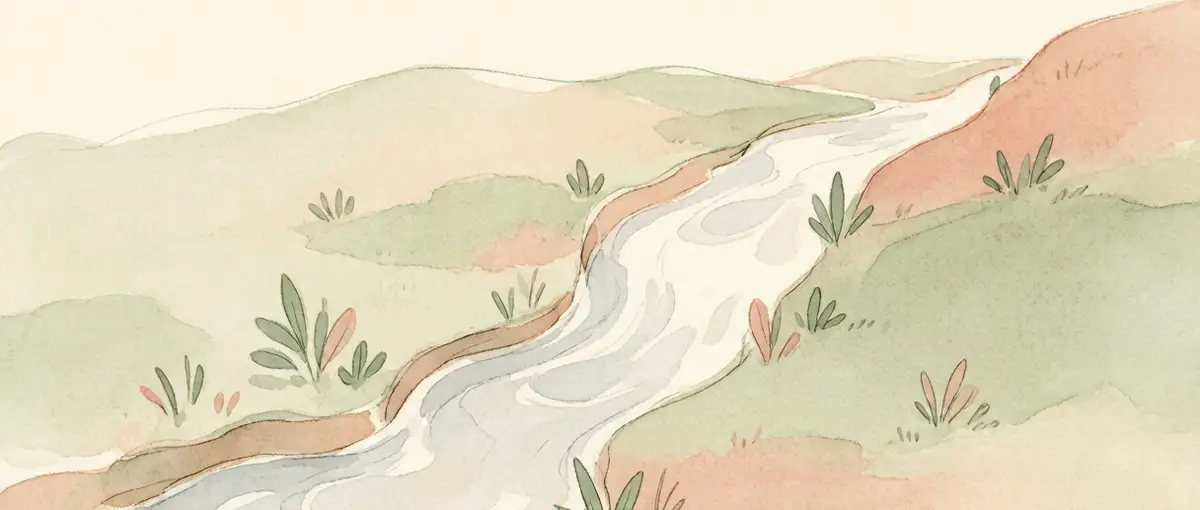
The highest compliment Laozi ever paid a person was not "you are clever" but "the highest good is like water." He said the best way to be is like water. Water is so ordinary we turn on a tap and forget it exists, yet Laozi stared at it and saw the deepest principle of things. Looking back two thousand years later, this praise turns out to be chewier than any book on success.
What a cup of water can teach us
Watch a cup of water for a moment. It has no shape of its own — poured into a square glass it is square, into a round bowl it is round. It does not argue with the container. Stir it with your hand and it lets you; stop, and it levels itself out. It holds no grudge, keeps no score, yet is never truly changed by anyone — it remains water.
We tend to do the opposite. The moment the situation shifts we stiffen; the moment someone stirs us we erupt, and it takes days to settle. Water's first lesson: being soft is not the same as having no mind of your own, and taking a shape is not the same as losing yourself. It adapts to every form while staying, at its core, that same clear thing.
Nourishing all things without contending
The Tao Te Ching says it plainly: "Water nourishes all things without contending, and settles where everyone dislikes to be — therefore it is near to the Way." Water feeds the trees, opens the flowers, carries the fish, and no one remembers it was water that gave. It hides behind, silently, claiming none of the credit.
This is the hardest line for a person to learn. Do a small thing and we want the whole world to know; help someone and we quietly mark it in our minds, waiting for a chance to cash it in. Water keeps no ledger. It helps and moves on, and the next gap that needs filling still gets filled. Not contending is not resentment — it is simply not counting the thing as "mine." This looseness is something others feel, and it makes you lighter too.
Settling where everyone dislikes to be
Water also flows downhill. People crowd toward the high places — the better seat, the brighter spot, the more watching eyes. No one wants the low places, yet water rests there at ease. It does not turn up its nose at what is dirty, does not insist on clean; it runs through the gutter, seeps into the marsh, and never says "this place is beneath me."
"Settling where everyone dislikes to be," in today's words, means being willing to do the things no one fights for — the unseen, unglamorous, but load-bearing tasks. Pouring the tea, covering the gap, cleaning up the mess. These earn no merit, but without them nothing turns. The one who can stay low is the one no one can do without, because there are many who want the heights and few who will bend down to patch the cracks.
Taking any shape, not fighting itself
Water's greatest skill is to "meet the round and become round, meet the square and become square." A rock blocks the way and it splits, flowing around on both sides, refusing to ram it head-on; a cliff appears and it becomes a waterfall, willing to shatter into ten thousand drops just to keep going. It never strains over "I was supposed to flow straight."
People often get stuck on "how things were supposed to be." I was supposed to be promoted, supposed to be understood, this road was supposed to open. The moment reality is otherwise, we jam and we stall. Water teaches us: the goal is ahead, the path may bend. Bending is not losing — it is still moving. Those who clutch the "straight" line are usually the first to stop where they stand.
Softness that outlasts the hard
Laozi also said: "Nothing under heaven is softer or weaker than water, yet for attacking the firm and strong nothing can surpass it." A drop wears through stone — not because water is hard, but because it never stops. It does the longest work in the softest posture, until even stone must yield.
This rewrites what we think of as "weak." We assume strong means hard, and that what cannot be broken is what counts. But what truly wears through stone is the soft thing that refuses to stop. In a fight, the one who softens first is not the loser — they keep the conversation alive. In a relationship, the one who bends is not made smaller — they keep the road open. Softness is another kind of strength.
Water does not choose who it helps
One more thing about water: it nourishes all things without distinguishing close from distant. It waters your flower and the roadside weed; it carries the pretty boat and the broken raft. It does not audit "do you deserve to be nourished by me" — it simply gives.
People attach conditions to their kindness: I help those who deserve me, benefit those on my side. Water does not keep such accounts. Its "undiscriminating giving" is the very goodness of "the highest good" — not "I am good because you are good," but "this is simply how I am." Learn to drop that little calculation of "do you deserve it," and in the giving, you yourself become easier.
Water also stops, and gathers
Do not mistake water for something that only flows. It reaches a low hollow and becomes a lake, a sea, quietly gathering, in no hurry to leave. Moving when it should move, still when it should be still — that is the complete good. One who only rushes tires; one who only rests stagnates; water can do both.
This adds the other face to "not contending": not contending is not forever retreating, it is knowing where to gather. The long, unseen work you do with no one watching — that is gathering water. Gathered enough, when it is your turn to hold something up, you will hold it naturally. Water never frets while gathering, "why am I not moving" — it knows that stillness is also a way of going forward.
Even dirty water must pass through, for it to be whole
Water's goodness does not pick clean from filthy. It flows through clear water and through murky; the black in the gutter, the muck in the marsh — it does not dodge. Precisely because it is willing to pass through these, it brings even the dirty back to life. What stays only in clean places is not real water.
The hardest line for a person to learn is this "not picking." When we help, we secretly choose: the pleasant ones, the kindred ones, but we avoid the troublesome. Water keeps no such accounting. Because it can take in the chaotic, its goodness shows itself wide. Learn to reach a hand toward the less comfortable person, the less clean matter — not as grievance, but as that goodness finally ceasing to pick and choose.
At water's end, still water
Water evaporates into cloud, the cloud falls as rain, the rain gathers into streams, the streams rush to the sea. Its form changes ten thousand times and its name is swapped again and again, yet at its core it remains that same clear thing. One who is good like water should be so too: outwardly ever-changing, the under-color of "benefiting without contending" unchanged.
We too often lose our center the moment the setting changes, forget our beginnings the moment we rise, forget our measure the moment we grow close. Water reminds us: what changes is the form, what is kept is the substance. You may softly adapt to every scene, but the lift that holds others up should not be skipped, and the steadiness of staying low should not be lost. However the form follows, let the substance not scatter — that, perhaps, is what "near to the Way" means.
Learning from water, starting with a cup
Do not make "the highest good is like water" into something mystical. It starts with a cup: today, would you be willing, like water, to do one small thing that claims no credit, picks no recipient, and walks toward the low place? No grandeur needed, no witness required.
Laozi, after all, simply stared at water and saw the Way. We are not far from the Way — what is far is that little willingness to bend. Practice first with a cup: poured into whatever container, take its shape and rest; stirred, pause and level yourself out. Do these small things often enough, and that under-color of "benefiting all things without contending" will slowly grow on you. By then others will feel at ease with you, and you will not have to try.
One small thing to do like water today
You need not go cultivate the Way. Today, do one "water thing": one small act no one sees, that earns no merit, yet lets some situation run a little smoother. Maybe tidy the shared space on your way through. Maybe help someone without announcing it. Maybe soften first in an argument, so the words can keep going.
The highest good is like water — it does not ask you to become a sage. It reminds you: step a little toward the low place, do not fight for that breath of pride, help and do not record the merit. These things are small, but done often, the people around you will feel it — being with you is, like water, comfortable.
Written and reviewed by DustEcho Editorial for self-reflection and cultural inquiry—not counseling, medical advice, or a clinical diagnosis.
Not sure where to begin?