How to Read a BaZi Chart: Is the Day Master Supported?
DustEcho Editorial
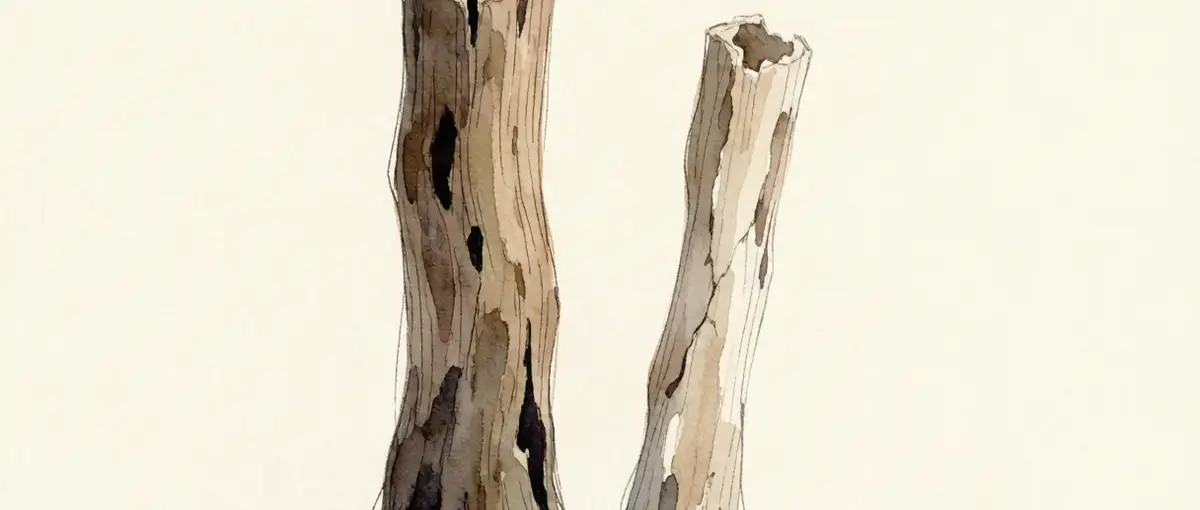
If you are learning how to read a BaZi chart, the "ri zhu," or Day Master, is a gentle place to begin. It is the heavenly stem of the day you were born and, traditionally, the center of the chart — the part taken to represent "you." Every other star, and every generating or draining relation, turns around this "I." In a careful Bazi chart interpretation, the Day Master is not a verdict about your future. It is a way to notice whether your center feels supported, stretched, or hollow.
When the Day Master is called strong, it means this self has backing in the chart, standing firm like a central pillar driven into a foundation. When it is called weak, it means it is isolated, drained from all sides, hollow-seeming, swaying at the first gust. This is not fortune-telling. It is a name for an experience most everyone knows: the "I" at your center, sometimes nailed fast to the ground, sometimes weightless, bowing the moment someone pushes.
The First Step in BaZi Chart Interpretation: Is the Center Holding?
Ri zhu strength has never been about confidence. Confidence is acquired; ri zhu strength describes something more basal, a felt sense of center: is that "I" present, can it put down roots. When the chart is strong, it is not because he believes himself capable. It is that the "I" has allies, something to lean on, and so it sits steady by nature. When the chart is weak, it is not because he is timid. It is that the "I" stands alone, bled by forces on every side, unable to settle. From outside, the strong one reads as having conviction, the weak as lacking resolve. What differs beneath them is the load-bearing of the center, not the courage of the temperament.
A Strong Day Master, Like a Pillar Driven into the Ground
When the day master is strong, he is like the central pillar of a house, driven solid. He has his own mind, listens but is not carried off. In disagreement he returns to himself first, steadies, then moves. This is not stubbornness. The "I" is dense enough to hold against the weather outside. Lived from within, it is a kind of quiet: I am here, I know who I am. Yet strength has its own blind spot. When the pillar grows too thick, no other beam can join it. He stops hearing, turns hard in relations, lets conviction curdle into "no one changes me." He is not being difficult on purpose. The pillar is simply so steady it forgets others might also want to lean in.
A Weak Day Master, Like a Hollow Post Pushed by the Wind
When the day master is weak, the picture inverts. He is a hollow pillar, standing in appearance, swaying at the first wind. It is not that he has no thoughts. The "I" is too thin to hold them; someone feeds him a view and he tilts toward it. At gatherings he drifts with the current. At work he dreads being the one to decide. Even ordering food, he waits for others to speak first. He is not without opinion. The "I" lacks support, can barely stand, and how do you set direction when standing itself is a strain. The hardest part is not the weakness. It is the emptiness afterward, the realization that you walked a long way following others and were never really on the road, only pushed by the wind somewhere you did not choose. What he learns, in time, is not to force himself strong. It is to say first, "I am thin right now," then slowly fill the pillar back in.
It's Not That You Lack Opinions, Just That the Pillar Is Sometimes Hollow
The weak day master gets called spineless, a reed in the wind. He is not boneless. The pillar is hollow inside, and hollow cannot be filled by wishing. What he usually wants is not to defer. It is to have someone brace him, so he can catch his breath and fill the self in. One friend said the question he dreaded most, when thin, was "what do you actually want," because he was still searching for where that want might be. He is not without thought. The "I" has been drained too hard and has not yet come home. His life can feel like a long search for a pillar to lean on, and only once he finds one does he dare to raise his own, slowly, beside it.
Too Strong, and You Weld Yourself in Place
Nor is stronger always better. Taken too far, the central pillar welds itself to the ground. He does everything alone, lets no opinion enter, becomes an island. Relationship is the conversation of two pillars, and when one is too thick, the other cannot approach; those nearest are pushed furthest away. What the strong one most needs to learn is not "more steadiness" but "a little give": leaving room along the pillar for another to lean in. Steadiness does not require keeping everyone outside. True steadiness is being steady enough to let someone near. The moment he yields, just that much, the ones beside him find they can step closer.
Even the Strong Wobble Sometimes
Do not assume a strong day master never wavers. When the props that "I" has always leaned on are pulled away, a trusted one leaves, a familiar role collapses, even a thick pillar cracks. He has not suddenly turned weak. The pillar was always relying on other things to stand; it simply was not visible. What the strong one fears most is that no one has seen him sway, so he cannot let anyone see it now. He is used to being the anchor, but anchors corrode. Strength is not never falling. It is falling and being able to right yourself. To admit, "I too go thin sometimes," is in fact the sturdiest part of the pillar.
In Relationships, Strong and Weak Find Each Other
The strong and the weak often pair, without quite meaning to. One sets the course, the other follows. One gives direction, the other is carried. It is comfortable at first. In time it fatigues: the strong resents the weak for having no view, the weak resents the strong for being too rigid. Neither is wrong; the two pillars are simply mismatched in girth. A good relationship is this: the strong one leaves a gap, the weak one tries, just once, to decide one small thing alone. Strength and weakness are not labels. They are two pillars in the same wind, learning to stand near each other, close enough to lend support, not so close that one bears the other's whole weight. When the wind comes, two pillars standing near hold far better than one alone.
Finding a Foothold Where the "I" Can Stand
Back to ri zhu itself. It is neither lucky nor unlucky. It only describes how much weight the "I" can carry. For the one who leans weak, what matters most is not forcing yourself hard. It is admitting first: this "I," right now, does need a hand. Begin small. This one errand today, decide it yourself, do not wait. This gathering you do not want, say no. Steadiness is not becoming another. Give the thin "I" one concrete support and it will thicken on its own. You need not stand like a central pillar forever. You only need, when you sway, to press your foot into the small piece of ground beneath you. It need not be large. If it holds your weight, it is enough.
A Word from the Modern Side
In the language of psychology, ri zhu strength comes close to ego strength, its presence or absence. When self-boundaries are clear and inner support is sufficient, the center holds under pressure; the self is not easily pulled off its mark. When the sense of self is thin, it is easy to lose your place in relationships and decisions, swinging between compliance and dependence. It correlates closely with having been, early on, seen and allowed to be. When the small "I" is ignored or done-for, the pillar is left without its own foundation. Naming the pattern is not resignation. It is so that, when you notice you have been carried off again, there is less self-blame, more clarity: ah, my center has gone thin, let me brace it first. To see it as the swaying of a state, not a failing of who you are, loosens much of the inner friction.
How do I start reading a BaZi chart?
Start with the Day Master, then ask a simple question: does the center of this chart appear supported or overburdened? From there, look at the surrounding elements as relationships — what nourishes the center, what drains it, and what asks too much of it. This keeps BaZi reading grounded in observation rather than turning one symbol into a fixed identity.
Want a guided reading of your own BaZi chart?
An article can give you the vocabulary; a personal reading can help you connect the symbols to your actual questions, relationships, and season of life. If you want a calm, guided interpretation without a fixed-fate verdict, start with a personal BaZi reading.
Keep reading: Huo-Yan: When the Light Comes On Too Fast, It Also Burns · Jin-Han: When the Edge Is Wrapped in Frost · Mu Wang: That Upward Drive You Can't Hold Down
Written and reviewed by DustEcho Editorial for self-reflection and cultural inquiry—not counseling, medical advice, or a clinical diagnosis.
Not sure where to begin?