The Horse: You Run, and the Road Appears Underfoot
DustEcho Editorial
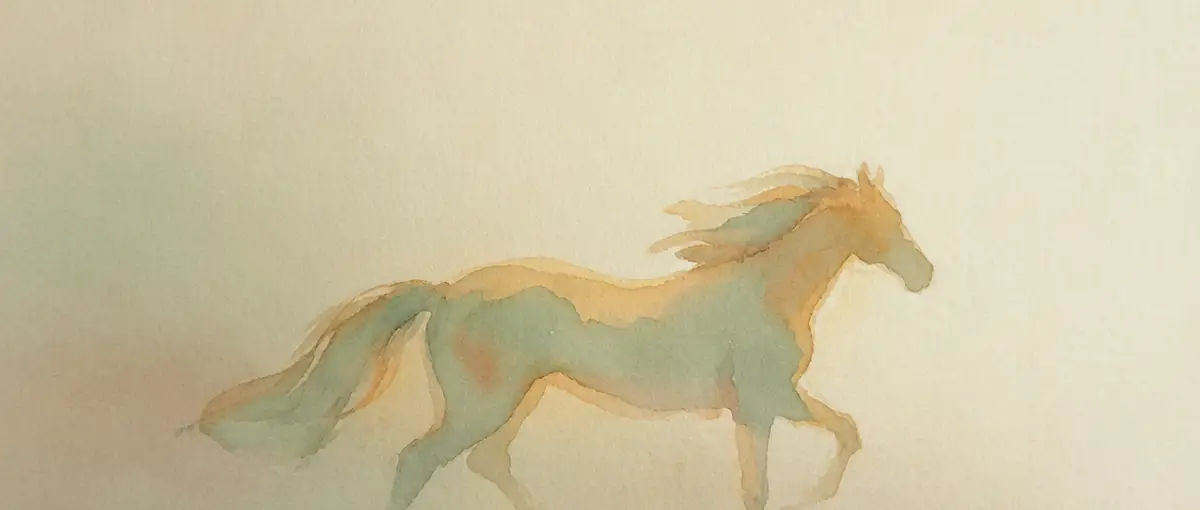
The horse, in traditional culture, was never just livestock. It was among the six domesticated animals in the Zhou era, charged the ranks in war, carried letters along the post roads; by the time Han Yu wrote "On Horses," the horse had become a metaphor for a kind of person — "fine horses are common, but a discerning eye is rare." It is both real locomotion and a symbol of "talent seen." Among the twelve zodiac signs it holds the noon position, the hour of fullest yang, matching that restlessness that will not stop. The horse, in the end, writes of "movement" — a life force unwilling to be stuck in place.
What It Fears Least Is Tiredness; What It Fears Is the Tether
The horse's worst state is not a long charge, but being tied to the manger, day after day facing the same wall. People are like this too. Many can endure hardship; what they cannot bear is the stuffiness of "clearly able to move, yet fixed to one spot." That stuffiness slowly turns into numbness: at first it still kicks, later it cannot be bothered to kick. The horse reminds us that what drains a person may not be intensity, but stillness. Someone who always says "I'll move once conditions are right" often waits until they have rusted in place.
Run, and the Direction Reveals Itself
Standing still and thinking about direction, the more you think the messier it gets. The horse is not like that; it steps first, and the road appears bit by bit underfoot. Many things are not "done after you've thought it clear," but "become clear as you do them." A job search, writing, where a relationship is headed — reasoning about it ten times indoors is worth less than going out and bumping into it once. This is exactly the horse's symbolic meaning: action itself generates information; standing still only generates anxiety. You need not know the endpoint at the start. You must first let the body move; the wind will tell you which way you drift.
The Fine Horse and the Discerning Eye Are Two Different Things
The sharpest line in "On Horses" is "only to be disgraced in the hands of a servant, and die alongside the manger." A good horse, placed in the wrong hands, gets the same treatment as a poor one. This says talent needs the right eyes to see it — but it also hints at another layer: whether the horse runs, and how, is not wholly decided by the discerning eye. Those who wait to be "discovered" often wait only to miss their chance. The horse's modern footnote is this — you may hope for appreciation, but you cannot stake the premise of action on "someone will recognize me." Running is the horse's own business; being seen is a matter of luck.
Free Spirit Is Not the Same as Reckless Charging
The horse is often labeled "free and untamed," as if barging about is its nature. In truth a good horse has a rein, a rider, and measure under its hooves. Real freedom is "knowing where you head and when to rein in," not directionless frenzy. People envy the horse's ease, usually seeing only its frolic, missing the self-control it was trained into day by day. A person who can give fully and also stop before the cliff approaches the higher part of the horse image: freedom is tamed wildness, not rules-less chaos.
It Can Also Carry Weight, Not Only Gallop
The war horse bears armor and men; the post horse bears documents and hope. It is not only for looking dashing, but for bearing loads — steadying the hooves, carrying on the back, transporting in silence. This side of the horse is often overlooked: it can charge, and it can pull day after day. A person, too, often has these two sides — like a horse when wanting to fly, and like a horse when needing to be steady. To understand the horse only as "longing for far places" misses the half that steadily hauls freight.
Stopping Is to Run Again
The horse is no perpetual engine; it too rests, lowers its head to drink by the river, stands still at night to chew the cud. A horse that never stops will break down. Yet people often take "never stopping" as a virtue, as if resting means losing. The horse's story holds no such obsession: it runs truly, and rests truly. It does not hesitate when it should charge, and feels no guilt when it should stop. This sense of rhythm lets it run farther. Many burn themselves out not from running too much, but from not knowing how to stop — the horse understands better than us that resting is also a kind of stride.
It, Too, Grows Old
A good horse has its aged day: the mane greys, the step slows, no longer covering a thousand miles a day. Yet the old horse's worth is not in speed, but in the roads it has walked, all grown into its body — which ridge to cross how, which slope to ease how, it knows better than anyone. So do people: at a certain age the drive may no longer peak, but judgment and sense of proportion are things youth did not have. If the horse image is used only to praise "galloping," it grows thin; it can equally write the settled ease of "once ripened, no need to prove anything." An old horse knows the way — not the road, but its own rhythm.
It, Too, Is Skittish
The horse looks bold, yet it is alert and skittish; a strange smell or sound can make it rear. Its boldness has a bottom line — not that it fears nothing, but that it fears and still charges. People often misread "bravery" as "fearless," and so stiffen themselves not to show fear. The horse demonstrates another way: I admit I am afraid, but fear does not stop me from running. A person who can step forward while trembling is closer to the essence of the horse's life force than one who claims to fear nothing yet freezes in place. Courage is not the absence of panic; it is moving forward even while panicked.
No Anxiety in the Sound of Hooves
The horse's pace has its fast and slow, yet never has one heard it lose its step because "everyone else is running." People, though, are always thrown off by the footsteps around them — a colleague works late, so they stay up too; a friend switches tracks, so they panic. The horse's worth lies not only in being able to run, but in "running to its own beat." Taking the outside's urging as background noise rather than a starting gun is the most practical lesson one can learn from the horse. It does not accept "everyone else has moved" as a reason, only where the road under its own feet should lead.
What does the horse symbolize in traditional imagery?
The horse can symbolize movement, vitality, freedom, support, and the willingness to discover the road by taking a step. It is not a guarantee of success or a reason to run without direction.
How can I move forward without rushing blindly?
Choose a direction for the next stretch, check what support or rest the journey requires, and allow the route to become clearer through action. Stopping to recover is part of continuing, not the opposite of motion.
Want to understand why standing still feels more frightening than uncertainty?
If you keep waiting for a complete map, gentle self-exploration can help you take one grounded step and let the road answer back.
So Writing the Horse Is Writing a Life Force in Motion
We do not write "whoever rides a horse must succeed," nor "those born in the horse year are destined for travel." What we write is: that urge in you to move deserves respect. It may not bring results at once; you may run halfway before finding the fork — but standing still will never bring you closer to the answer than running. The old horse image stands in the dust, watching everyone still hesitating whether to take a step — the road is not in thought, but underfoot; you run, and it appears.
Keep reading: The Dragon: Grow Your Scales Where No One Sees · Plum: It's the Coldest Time, Yet It Blooms First · The Crane: Standing Alone Because You Won't Settle
Written and reviewed by DustEcho Editorial for self-reflection and cultural inquiry—not counseling, medical advice, or a clinical diagnosis.
Not sure where to begin?