The Phoenix: You Burn Out, Then Light Up Again
DustEcho Editorial
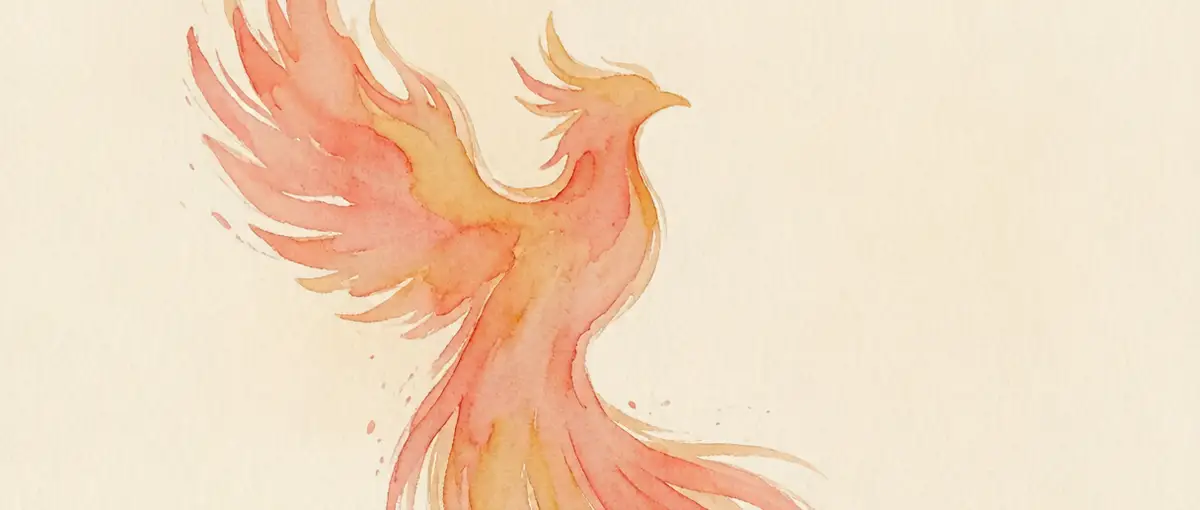
The phoenix, in traditional culture, is an auspicious bird — not a predator, and not an ordinary one. Zhuangzi wrote that it "rests only on the paulownia, eats only bamboo seeds, drinks only from the sweet spring," describing a fastidiousness bordering on stubborn cleanliness. Later, folk tradition linked it to "rising from the ashes" — a layer of meaning added mostly afterward. But that it could be added at all is because the phoenix already carried that drive of "out with the old, in with the new." It is not a god enshrined in a temple, but an imagination of how to turn the page.
It Was Never Just a Painted Myth
Most auspicious symbols eventually become flat patterns — pasted on New Year prints, embroidered on robes, their meaning slowly worn smooth. The phoenix never quite became that. It has always kept one very concrete gesture: walking into the fire. Other birds flee the flames; it walks toward them. That reversal is what sets it apart from the "safe and sound" kind of blessing. What it stands for was never "may things stay fine forever," but "after everything breaks, you can begin again." When someone has lived through a great collapse and gets back up, what rises in their mind is rarely a rational plan — it is this primal image: burn, then grow.
First, You Have to Burn Clean
The easiest part of the phoenix story to skip is the burning itself. Not a light singe — the whole bird burned to nothing. People, too, often need that kind of thoroughness. A relationship that drags on without dying, a job you cling to though it's stale, an identity you won't let go — the half-alive state drains you most. What truly transforms a person is often the moment when "nothing is left." Yet we always want to keep something: keep our dignity, keep an escape route, keep a little room to go back. The phoenix's ruthlessness is that it burns even the escape route. Of course it hurts. But only after the hurt is there empty ground, where something new can land.
Rebirth Is Not Going Back
People often read "rebirth" as "going back to how things were," as if after one burning and one revival you are the same person. You are not. A paulownia burned once will not grow the same leaves. Someone who has lived through a great ruin and gets back up will find their temperament, their choices, their sense of proportion with people and things rewritten. This new version is not necessarily "better," but it is certainly "truer" — because the branches grown to please others cannot survive the fire. The comfort the phoenix offers is not "you will be fine," but "you will not be who you were, and that need not be a bad thing."
That Refusal to Settle
Zhuangzi's line that the phoenix "rests only on the paulownia" was later read as aloofness, but it is more like a clear-eyed sorting. It knows what kind of place is worthy of it, and knows that settling would feel wrong. People, too, reach a stage where this pickiness grows: no longer attending every dinner, joining every group, maintaining every relationship. Others see it as growing solitary; you know it is finally telling "noise" from "what fits." The phoenix's pickiness is not arrogance — it knows it cannot afford to keep landing in the wrong place, because every wrong landing means another fire to clear the ground.
It Rarely Travels in Flocks
The dragon can summon wind and rain and appear in ceremonies in a crowd; the phoenix is different — it almost always appears alone. An auspicious bird alone hints that this "power to turn the page" is essentially private. No one can burn for you, and no one can grow for you. You can talk to someone, have someone keep you company, but the instant you send the old self into the fire can only be your own step. This also explains why many big turnings happen very quietly — no ceremony, no audience, just waking one day to find some things can never return, and that you are somehow standing.
It Is Not the Dragon
People often pair dragon and phoenix, assuming they are of a kind. They are far apart. The dragon governs "showing" — riding clouds, being seen, being worshipped. The phoenix governs "changing" — burning the old, growing the new. One reaches outward, one reorganizes within. People, too, swing between these two poles: sometimes wanting to be seen (like the dragon), sometimes only wanting to put themselves in order (like the phoenix). Reading the phoenix as "another kind of dragon" loses its point: it did not come to add glory to your name, but to help you turn the page. Know this, and you won't waste the strength of "showing" when what you need is "changing."
Before the Light, the Dark
The most romanticized part of the phoenix is "dazzling after rebirth." But the process in the fire is dark, black, without a visible direction. What people fear most in a collapse is exactly this: suddenly there is no light, and no knowing how long the dark will last. Yet dark is not an end; it is the necessary passage of reordering. A seed buried in soil is also in the dark — it is not "dying," it is "changing how it lives." Reading the phoenix story backward, you find its real courage is not in the moment of flight, but in the step into the fire, knowing full well it will go dark.
It Promises No Ending
Rising from the ashes is often told as "and they lived happily ever after," but the phoenix story has no "ever after." It burns once, lives once, and then will grow old again, grow stale again, need to burn again. Rebirth is not a once-and-for-all reward; it is a cyclical ability. People always want "solve it once, rest forever," but relationships, careers, the self — all grow stale again. The phoenix's ruthlessness is accepting this: I do not ask that one burning grant eternal light; I only ask that after each burning, I am still willing to shine again. This drive of "promising no ending, yet promising to come again" is its most modern part — it is not a destination, but a reset button.
What does the phoenix symbolize beyond good fortune?
The phoenix can be read as a symbol of renewal: an old identity ends, something is grieved, and a different way of living becomes possible. It is not a promise that hardship will automatically produce success; the meaning lies in the choice to begin again with clearer terms.
How can I turn the page after a difficult period?
Name what has ended, keep one lesson, and choose one small action that belongs to the next chapter. Renewal does not require pretending the ashes were beautiful. If you are dealing with ongoing trauma, severe depression, or thoughts of self-harm, seek qualified support rather than relying on symbolism alone.
Want to understand what kind of ending you are standing inside?
If an old version of life no longer fits, gentle self-exploration can help you approach change without turning it into a prediction.
So Writing the Phoenix Is Writing the Power to Turn the Page
We do not write "you are a phoenix, so you are fated to prosper," nor "meet fire and great fortune must follow." What we write is: when a stretch of life has burned about down, do you sit in the ashes unmoving, or light yourself up again? This ability lives in everyone; it is only usually covered by the teaching to "stay steady, don't change." The old image of the phoenix is there to remind you — some endings are not failure; they are fire, they are clearing, they are the ground-breaking rite of a new version of yourself. It does not promise how high you will fly, but it tells you: to still shine after burning to nothing is, in itself, already remarkable.
Keep reading: The Horse: You Run, and the Road Appears Underfoot · Plum: It's the Coldest Time, Yet It Blooms First · The Crane: Standing Alone Because You Won't Settle
Written and reviewed by DustEcho Editorial for self-reflection and cultural inquiry—not counseling, medical advice, or a clinical diagnosis.
Not sure where to begin?