The Turtle: Slow Is Not Stupid, It Keeps Its Own Clock
DustEcho Editorial
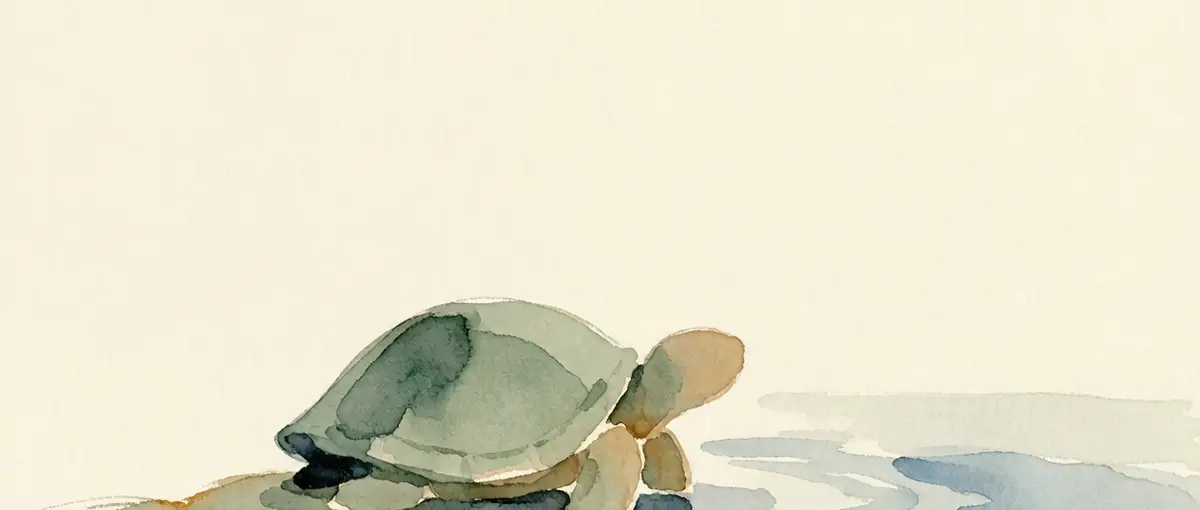
The turtle's place in traditional culture is higher than many assume. It is one of the "Four Auspicious" — dragon, phoenix, qilin, turtle. The first three are imaginary creatures, yet the turtle, a real living thing, was pulled into the same list, showing how much the ancients revered it. The "Book of Rites" says "qilin, phoenix, turtle, dragon — these are the Four Auspicious." The turtle was among them. The shell on its back was once used for divination; its patterns were read as the order of heaven and earth. Folk tradition is blunter, tying it to "living long." The turtle image writes not of dullness, but of a way of being that does not rush.
It Joined the Four Auspicious Not for Speed
Among the four, the dragon flies, the phoenix rises from fire, the qilin is auspicious — each has a "formidable" role. Only the turtle stands by "slow" and "long." That it was listed among the four shows precisely that the ancients saw "staying steady" as a kind of spirituality too. Yet people often read slow as stupid, and long as dull. A person who works at an unhurried pace easily draws others' impatience: "why aren't you done yet?" In truth the turtle's slowness is not slow reaction, but that it has its own internal metronome — the outside clock runs fast, its inner clock runs its own. It does not chase, so it rarely panics, and rarely trips from panic.
The Shell Is for Guarding, Not for Hiding
The turtle withdraws its head at the slightest fright, often taken for "timidity." From another angle, that shell is the home it built itself, its choice to protect its vital points. People need this kind of "shell" too: not softening for everyone and retreating from everything, but knowing clearly what one's core is, not letting outside shocks poke in at will. The turtle's withdrawal is not surrender, but measure. When it should stretch its head to feed, when it should step out to walk, it is not the least bit vague. To see the turtle only as "spineless" misses its clarity of "guard where it must, move where it must."
It Does Not Compete for Time
Measured by human scales, the turtle's life is absurdly slow. But it does not care about human scales. It wakes in spring, sleeps in winter, lives by the solar terms, does not rush the schedule. People, though, are always rushing: rushing to be one step early, rushing the trend, rushing to have "caught up" in others' eyes. The result of rushing is often — the front not seen clearly, the back not kept up with, the whole way taut. The turtle's contrast is this: some things are not the faster the better, but good only when their season comes. A person who, like the turtle, is not thrown off by "everyone else is running," already possesses a kind of composure.
Longevity Is Not Endurance, It Is Steadiness
Folk say the turtle lives long; science agrees it does. But behind "long" is low consumption and little fuss. It does not sprint desperately, nor jitters back and forth; it spends energy where the blade is sharp, so it lasts. People wanting to "go far" often mistake that for needing to be fiercer; in truth it is more likely needing to be steadier. Those who burn themselves fiercely often go out halfway; the turtle way of living is a low fire kept warm, never out. The "long-termism" we speak of, the turtle demonstrated long ago with its whole shell: not chasing a moment's brightness, but pursuing a brightness that keeps going.
Hiding One's Edge Is Not the Same as Having No Strength
The turtle looks wholly non-aggressive, never provoking anyone, yet it has jaws and claws, and when truly cornered can bite. Its "not contending" is not "cannot," but "no need." Among people there are also such: usually showing neither mountain nor water, everyone thinks them easygoing, yet when a bottom line is touched they are harder than anyone. The turtle teaches hiding one's edge — keeping strength in, not displaying it everywhere, using it only when needed. Those who flash muscle everywhere often waste the most; the turtle keeps muscle under its shell, and so retains it.
It Is Not the Same as a Stone
In the nature series we wrote of stone — settled, lasting, silent. The turtle is also settled and lasting, but the turtle is alive. Stone is pressed unmoving by time; the turtle chooses not to hurry. Writing "slow" the same way, stone has no choice, the turtle does — it can withdraw when danger comes, stretch when safe, crawl when it wants to move. This difference matters: the "steadiness" people envy, if it is only passively freezing, that is stone; if it is active, chosen slowness, that is turtle. The turtle teaches "I am slow because I choose to be," not "I am slow because I cannot move."
It Moves Too
Do not be fooled by "slow" into thinking the turtle does not move. It only tunes its movement to a gear it can bear: stretching its head, stepping, foraging, mating — none is missing, only unhurried. Many misread "not flaunting" as "no vitality," and so tell themselves "this is just how I am," which is really learning the turtle wrong. The turtle's quiet is a surface; underneath it is always crawling. A person need not make a great show to seem energetic, but also must not use "I have a steady nature" as an excuse to stop growing. The turtle reminds: slow is a speed, not a rest.
Its Slowness Is Sometimes Calculated
The turtle's slowness is often taken for dullness, yet much of that "slow" is the result of judgment. It withdraws its head because it judges that stretching out now is not worth it; it stays still because it judges that moving brings no good. This slowness is saved-up cleverness, not missing cleverness. If a person is always brainwashed that "fast equals smart," they will move blindly when they should be slow, spending a good hand on useless motion. The turtle reminds: slow is sometimes not falling behind, but having seen clearly — those who see clearly do not rush to move. It is not slow to react, but counts the cost before stepping.
It Does Not Envy the Quickness on the Bank
The turtle lies by the pond, watching people come and go on the bank, hurrying footsteps, and feels no urge to climb up and join. Not because it is lazy, but because it knows its road is not on that path. People often mistake "others' pace" for "the standard pace," and so desperately chase a quickness that is not their own. In the turtle's calm is a kind of composure: I do not envy your quickness, because I know the far I want is not at the end you charge toward. Keep your own clock, and the noise on the bank is only sound, not a command.
What does the turtle symbolize beyond slowness?
The turtle can symbolize steadiness, protection, patience, and a pace that belongs to itself. Slowness is not automatically wisdom, but moving at a sustainable speed can be a real form of strength.
How can I stop rushing when everyone else seems ahead?
Choose one pace you can repeat, protect a recovery period, and compare your next step with your own capacity rather than another person’s visible result. If exhaustion or anxiety remains severe, seek qualified support instead of treating endurance as the only answer.
Want to understand why slowing down feels like falling behind?
If your inner clock is always chasing someone else’s, gentle self-exploration can help you find a steadier rhythm.
So Writing the Turtle Is Writing a Way of Living Without Panic
We do not write "keeping a turtle adds years," nor "the patterns on its shell decide fortune." What we write is: in an age when everyone fears slowness and fears falling behind, slowing down and steadying oneself is itself a kind of ability. The old turtle image lies by the pond, watching the anxious, scurrying people on the bank — it does not block you, nor hurry you; it only tells you with its whole shell: you need not sync your clock with everyone's. Whether the clock inside you runs true, only you know. Steady yourself, go a little slow, and you will still arrive.
Keep reading: The Horse: You Run, and the Road Appears Underfoot · Plum: It's the Coldest Time, Yet It Blooms First · The Crane: Standing Alone Because You Won't Settle
Written and reviewed by DustEcho Editorial for self-reflection and cultural inquiry—not counseling, medical advice, or a clinical diagnosis.
Not sure where to begin?