The Dragon: Grow Your Scales Where No One Sees
DustEcho Editorial
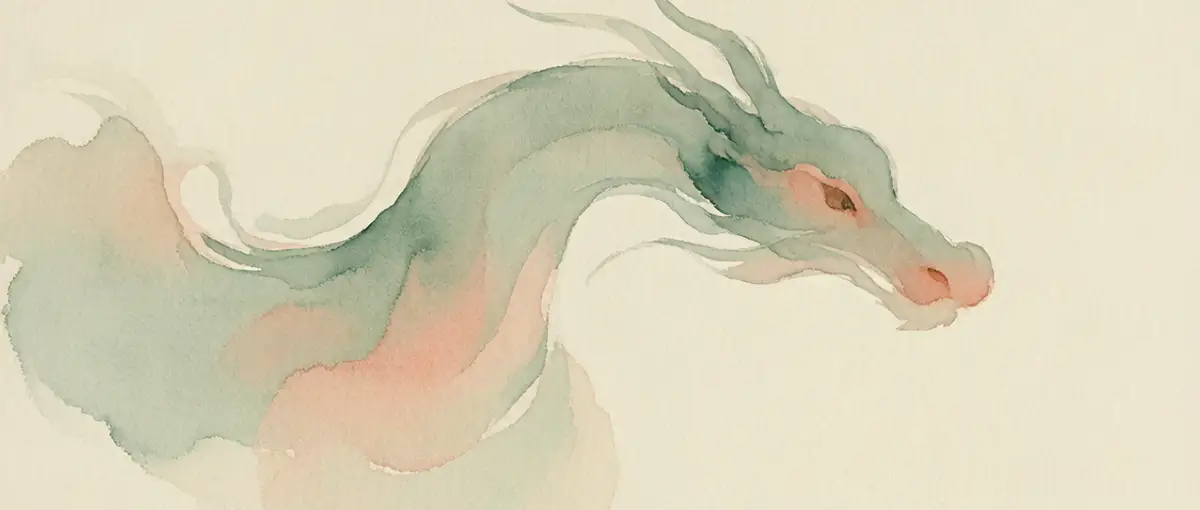
The dragon in Chinese culture is not some abstract "feeling" but a symbol-image used again and again across thousands of years. The jade dragon unearthed from the Hongshan culture is over five thousand years old; the kuilong of Shang and Zhou, the Azure Dragon of Han, the dragon boats of the Duanwu festival, the dragon robes of emperors—they all keep saying the same kind of thing: change, rain, power, and a rhythm of "hide when you should hide, show when you should show." It is not a personality label for any one person, but a whole set of cultural imagery about how a person lives with timing. This needs to be said up front, because the moment you write about the dragon it is easy to slide into fortune-teller talk like "you are a dragon," and that is not what we are doing.
The Hidden Dragon Does Not Act: Not Absent, Just Not Yet Time
The Book of Changes has a line people reach for constantly: "the hidden dragon does not act." Many read it as "don't stand out," but the original meaning is closer to this: when a dragon is still lying at the bottom of the water, it is not because it is weak, but because the time has not come. You have had a phase like that—you clearly feel there is something growing inside you, your ability is building, yet the outside simply does not recognize it, opportunities are slow to arrive, and all you can do is keep practicing on your own in silence. People around you think you are spacing out; only you know you are growing your scales one by one. This state of having to push yourself even when no one is watching is held by the ancients in a single word, qian, "hidden." It does not rush you, does not put you down—it only tells you: before it is time to show, rushing is useless.
The Hard Part of Hiding Is Not Seeing the End
But the difficulty of hiding is not "not moving," it is "not knowing how long you will keep hiding." What modern people fear most is not hardship itself, but hardship with no end in sight. The things you write get no readers, the project you are building gets no feedback, the material you study has no use yet—all of it makes a person doubt: am I simply no good, am I only flattering myself? The good thing about the dragon image is that it offers a less anxious frame. Where you are right now may just be the "deep" rather than the "sky." The deep is not failure; it is merely not yet time to fly. Separating "I am not recognized" from "I am not good enough" is the first bit of calm the hidden dragon can give a person today.
The Moment of Being Seen Is Harder to Take Than You Imagine
Then comes being seen. Interestingly, many people treat "the flying dragon in the sky" as the finish line, a wish-fulfillment kind of ending. But when that moment actually arrives, it is often harder to take than imagined. Someone who has been lying at the bottom is suddenly pushed to center stage, and the first reaction is usually not joy but panic. When the light hits and every eye turns toward you, you wonder whether you were ready, whether you will show fear, whether you deserve to be there. The dragon image hides this tension within it: it can fly, but flying means bearing the wind. The threshold for being "seen" keeps dropping for modern people—one video, one article, one remark can shove you from the corner to the middle, and that dizziness of "I got seen before I was ready" is, in the body, the very same feeling as a dragon leaping from the pool's bottom to the surface.
Knowing When to Hide and When to Show Is the Real Skill
The dragon carries another often-overlooked meaning: it can be great or small, it can rise or withdraw. It does not only charge forward, nor does it only hide. Show when you should show, draw back when you should draw back—this give-and-take itself is the skill. Our generation gets torn between two voices. One says "you only have value if you are seen," the other says "don't be restless, build your foundation." The dragon holds both inside one body. It is not either/or; it can lie hidden in the deep and leap to the sky; the key is the water and the wind of the moment. A person who knows to draw back in good times and to show before opportunity—that sense of flex is worth far more than plain effort.
Riding the Clouds, Spreading the Rain: When You Have Gathered Enough, It Falls Naturally
Another role of the dragon in tradition is "riding the clouds and spreading the rain." In a long drought people look to the dragon not to reveal itself, but to turn the water it has gathered in the pool into rain that nourishes the ground. This is much like a person after long accumulation: those things finally stop being "only yours" and begin to act outward—the books you read, the nights you stayed up, the things you worked out, one day becoming a word that helps someone, or a decision that actually lands. Rain is not squeezed out; the pool fills and naturally rises into clouds, then falls. Modern people always want to "cash out now," to "be useful immediately." The dragon bringing rain is exactly the reverse: first honestly store the water in the pool, and when the time comes to fall, one good rain is enough.
A Flock of Dragons Without a Head Is Also Auspicious
The Book of Changes also says, "use the nines: see a flock of dragons without a head—auspicious." It means a group of dragons each in its own place, not scrambling to be first, and that is good. Today we over-emphasize "you must lead," as if not leading means falling behind. Yet the dragon image inherently carries a composure of "not always needing to be out front"—some dragons in the deep, some in the fields, some in the sky, each with its place, none needing to press down on another. A person who can rest at ease in their own position, not scrambling for that "head," holds a rare kind of freedom. A flock without a head is not chaos; it is each in its right place. This ease and "the hidden dragon does not act" are two sides of one coin.
The Real Hard Part Is Knowing Where You Should Be
The real difficulty was never "try hard to hide" or "bravely fly," but knowing where you should be right now. Too many turn "hiding" into escape—using "I am building my foundation" to cover up the fact that they dare not act; too many turn "flying" into recklessness—using "I need to be seen" to cover up roots that were never firmly planted. The sharpest thing about the dragon image is that it forces you to judge honestly: are you really growing scales now, or only putting things off; are you truly at the time to show, or merely unable to bear the loneliness? No one can make this judgment for you, just as no one can decide for a dragon which day it leaves the water.
So writing about the dragon is not writing "you are a dragon, so you are destined to be great." It is writing about a rhythm everyone has: some phases you simply have to grow things on your own where no one sees, some phases you simply have to walk into the light carrying discomfort. The only difference is whether you drudge through it vaguely, or clearly know that you are hiding, waiting, preparing for that leap. The ancients condensed this tangled state of body and mind into a dragon that can hide and can show. The calm we have today perhaps lies in occasionally being able to tell ourselves: I am still hiding now, no rush.
What does the dragon symbolize beyond power?
The dragon can symbolize timing, hidden preparation, visibility, and the ability to move between retreat and expression. It is not a promise of greatness; it is a way to ask whether this season calls for gathering strength or stepping into view.
How can I know when to hide and when to show myself?
Ask what the quiet period is producing, what information is missing, and what small public step would test readiness. Resting to prepare is different from hiding to avoid every risk.
Want to understand why being seen feels harder than preparing?
If you keep waiting for a perfect moment to emerge, gentle self-exploration can help you choose a visible step without turning it into a prophecy.
Keep reading: The Horse: You Run, and the Road Appears Underfoot · Plum: It's the Coldest Time, Yet It Blooms First · The Crane: Standing Alone Because You Won't Settle
Written and reviewed by DustEcho Editorial for self-reflection and cultural inquiry—not counseling, medical advice, or a clinical diagnosis.
Not sure where to begin?