Lotus: It Rises From the Mud, Untouched by It
DustEcho Editorial
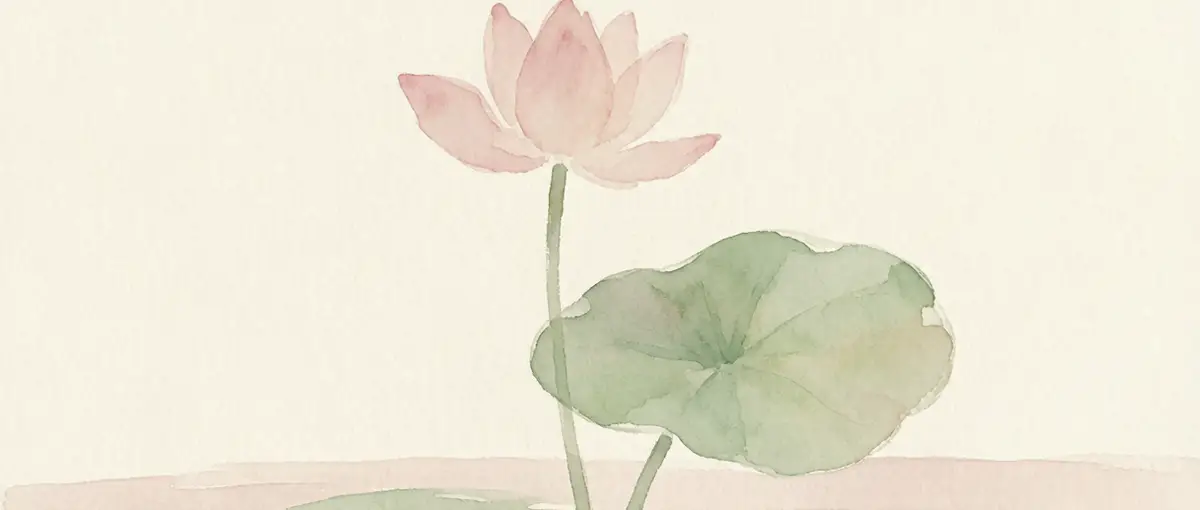
In Chinese ponds, the lotus is a special presence. It grows from the mud, yet has nothing to do with the mud. Zhou Dunyi wrote "On Loving the Lotus"—"rising from silt yet unstained, washed in clear ripples yet not seductive"—and for a thousand years that line has been recited as the most direct Chinese image of "purity." But the lotus's cleanliness isn't because it never touched mud; it's precisely because it touched mud, soaked in water, climbed up from the very bottom, and then carried a whole body of clarity. This piece isn't about "keeping lotus at home brings wealth and fortune," nor "lotus placement decides good or bad luck." We're only looking at where this plant stands in the culture, and the bit of spirit it maps onto a person today.
The Mud Isn't Its Fault
A lot of people look at the lotus and only see the flower and leaves above the water, forgetting what it stands on beneath. The lotus's roots sink into pond mud—the dirtiest, darkest, most stifling place in the whole pond. But the lotus didn't grow into the shape of mud just because it grew in mud. This gets repeated in tradition: a person's origin, starting point, environment—these don't define what they finally grow into. Mud is mud, lotus is lotus; they touch, but the lotus isn't swallowed. This isn't to say environment doesn't matter; it's to say environment isn't a verdict. Where you come from doesn't equal where you're headed. The lotus's most remarkable feat isn't the word "clean"—it's the whole act of "coming out of the mud, still clean."
Hollow Inside, Straight Outside
"In On Loving the Lotus," the lotus has four traits: hollow inside and straight outside, neither spreading nor branching, fragrance reaching far and growing purer, standing tall and cleanly planted. These four phrases later became the standard portrait of a gentleman in Chinese thought. First, "hollow inside and straight outside"—the lotus stem is hollow, open all the way through, and straight on the outside, unbending. Hollow isn't empty; it's "unblocked"—not blocking your own breath, nor blocking another's path. Straight isn't rigid; it's "not bent"—not swaying just because the current flows a certain way. A person can have this quality too: clear within, hiding nothing; composed without, never bowing to accommodate. This isn't forcing strength; it's a very steady structure—emptied, you're light; straight, you're steady. The lotus is both light and steady.
Neither Spreading Nor Branching
"Neither spreading nor branching" means the lotus doesn't grow excess. Vining plants love to cling, to wind, to reach in all directions; the lotus doesn't. One stem rises straight up—leaves where leaves belong, flowers where flowers belong—no side shoots, no clinging to other things. In a person this is a rare ability: not clinging, not overreaching, not reaching out where you shouldn't. A lot of people's energy gets eaten by "spreading"—wanting this and that, clinging to this vine and tugging that thread, until the main trunk never grows, while the side branches tangle all over. The lotus tells you: those who grow tall are often those who cut side branches without mercy. Neither spreading nor branching isn't doing less—it's not doing what you shouldn't.
Fragrance Reaching Far, Growing Purer
The lotus's scent isn't the in-your-face kind; it drifts from afar, purer the farther it goes. You stand by the pond, the wind comes, you catch a wisp—not heavy, but clean. This differs from the plum's "hidden fragrance"—the plum's is a bitter clarity, the lotus's is a light clarity. In tradition this is read as "the friendship of gentlemen is as light as water": a truly good presence needn't be felt only up close. A person's influence works the same: it isn't about how loud you shout or how close you get before others feel you. Some people's presence is like lotus scent—at a distance you savor that clarity all the more. Too close and you can't smell it, because it's so faint; but faint doesn't mean absent.
Standing Tall, Cleanly Planted
"Standing tall, cleanly planted" is the lotus's posture—standing straight on the water's surface, clean, settled, neither crooked nor leaning. These four characters have been painted countless times in traditional art: one stem alone, flower on top, leaf beside, water below; the whole plant is "standing," not lying down, not leaning, not propped. In a person this is a sense of posture—you stand, you don't lean. One who stands doesn't depend on external support, doesn't wobble this way and that, can hold their own. This isn't to say you need no one; it's to say your center of gravity is in yourself. When others come they're company; when they leave you don't collapse. The lotus's tall clean stance is the quiet confidence of "I can stand on my own."
Even the Buddha Chose It
The lotus isn't only a Confucian gentleman's image; Buddhism chose it too. The seat of buddhas and bodhisattvas is the lotus throne; the Pure Land school speaks of "lotus birth"; sutras are full of lotuses everywhere. Why the lotus and not another flower? Because the lotus is the best metaphor for purity born from filth—Buddhism teaches "affliction is itself enlightenment," not that you should flee affliction, but that you should open awakening right within it. The lotus comes from mud; the mud is affliction. The lotus flower opens on the water's surface; the flower is enlightenment. The two aren't opposed; they're the two ends of the same plant. A person too—your confusion, your hardship, the mud under your feet, aren't things to escape. They're precisely the nourishment for your upward growth. Flee the mud and the lotus couldn't live either.
Lotus Seeds Can Last a Long Time
The lotus flower fades, the leaves wither, but the seed can last a long time. Archaeologists have found lotus seeds from a thousand years ago in ancient tombs, planted them, and they still sprouted and bloomed. This is rare in the plant world—a tiny seed carrying a thousand years of vitality, waiting for the right moment to speak again. This maps onto people too: some things are of the season, gone once they fade; some things can be kept, and come back to life long after. The thoughts you write down today, the choices you make, the experience you save up—some are petals, some are seeds. Petals are for beauty; seeds are for continuation. Whether a person has something left after "fading" depends on whether they've been saving petals or seeds.
The Stem Breaks, the Threads Still Connect
The lotus's root is the rhizome; when the rhizome breaks, the threads inside stay connected. This is the origin of the idiom "the stem breaks but the threads connect"—originally a physical phenomenon, later used to describe emotional entanglement: on the surface it's broken, but underneath it's still linked. We're not writing fate here, but the image itself has meaning: some relationships, some experiences, aren't truly severed just because you say "broken." The threads underneath remain; you can't pull them out, and you don't need to. Admitting they're connected is more honest than pretending they're cleanly cut. The lotus tells you: being clean doesn't mean having no ties; it means that even with ties, you can still hold the flower upright and proper.
So Writing About Lotus Is Writing a Kind of "Not Being Defined" Ability
We're not writing "keep lotus for wealth," nor "lotus placement decides good or bad luck." What we write is: when your starting point is poor, your environment is poor, and everything around you is mud, do you have that ability to "grow out of the mud, still clean"? The lotus's cleanliness isn't the cleanliness of never having touched mud; it's the cleanliness of having touched mud, soaked in water, climbed from the very bottom, and still being clean. This cleanliness is far harder, and far more valuable, than the cleanliness of "never touched mud." This old image of the lotus stands in the center of the pond, watching everyone trapped by origin, environment, and past—the mud under your feet isn't your verdict; it's the nourishment for your upward growth. You come from the mud, but you don't leave with it. That alone is already remarkable.
Written and reviewed by DustEcho Editorial for self-reflection and cultural inquiry—not counseling, medical advice, or a clinical diagnosis.
Not sure where to begin?