The Deer: What You Chase Is Light — Don't Use Heavy Hands
DustEcho Editorial
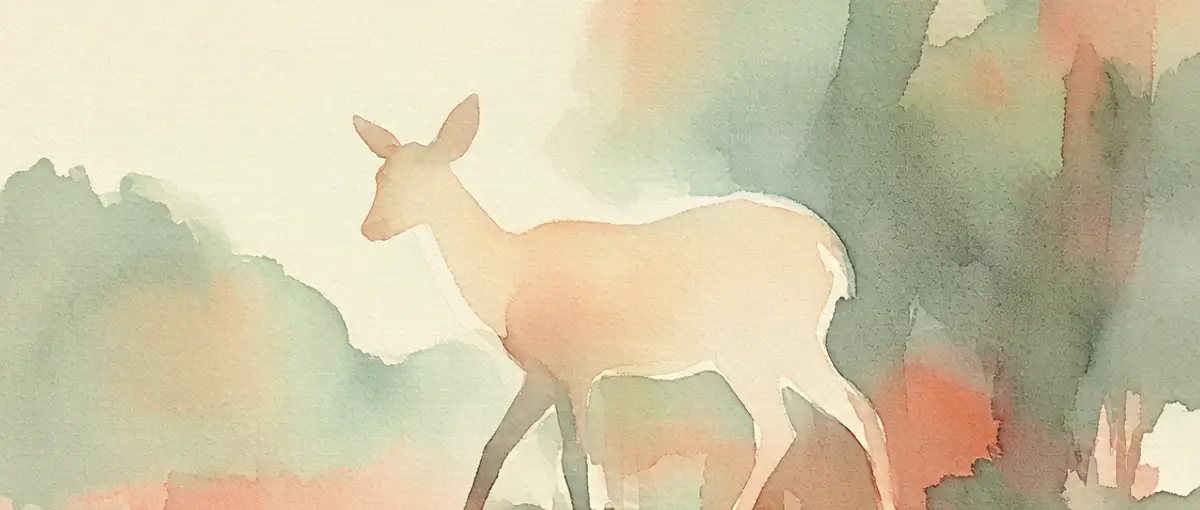
The deer in traditional culture is a very special animal, special in that it carries almost none of the "power" baggage. The dragon governs change, the tiger governs might, the crane governs clarity, and the deer governs "spirit"—liveliness, lightness, and a touch of easily-startled sensitivity. The ancients painted the deer carrying lingzhi in its mouth as an auspicious sign; spoke of "chasing the deer across the central plains" to mean the realm; placed it in mountain-forest poems as that unfettered, wild delight. The deer was never a personality template for some type of person, but an image about "longing": the thing you truly want in your heart is, much of the time, actually very light, like a deer, not like a stone. State this identity clearly, and you will not slip into sticky comfort-talk like "you are just a little deer."
What is The Deer?
The image of "the deer carrying lingzhi" is often brushed past as a lucky phrase, yet it hides a very modern reminder: what you want can be light. Lingzhi is an immortal herb in tradition, but the deer holding it has a relaxed posture, not wrested by desperate struggle. Compared to today, we are too used to weighing "goals" heavily—buy a house, get promoted, be liked by many, prove you did not live in vain. These matter, of course, but have you noticed that the things which truly light you up inside are often far lighter: an undisturbed weekend, a word that happens to understand you, a relationship you do not have to perform for. What the deer points to is that light longing covered by heavy things; it is always there, you just rarely look it in the eye.
Chasing the Deer: The Contest You Thought You Had to Win
The other side is "chasing the deer." The moment this phrase appears, the scene turns hard: the realm, power, a fight to the death. Yet interestingly, what is being chased is the very same deer. That is, between "light" and "heavy," the difference is not in the deer but in how you chase. Much modern anxiety comes from rewriting an originally light longing into a contest you cannot lose—you like something, and slowly it becomes "must produce results"; you want to get close to someone, and slowly it becomes "must not be left behind." The deer here is like a mirror: what you chase was originally a little deer; you yourself chained it and put a timer on it. The hardship of chasing the deer is often not given by the deer, but by the rules you added afterward.
The Deer's Alertness: Sensitivity Is Not Weakness
The deer has another undervalued trait: alertness. Its ears stay up; at the slightest stir it lifts its legs. We often treat sensitivity as weakness—"too fragile," "overthinking"—yet the deer's alertness is precisely a survival wisdom: it knows when to stop, to look, to turn. Today many people are told to be "thicker-skinned," "less sensitive," as if strong perception is a flaw. But the experience the deer corresponds to is this: your sensitivity is not a problem; it is an ancient radar inside you that helps you avoid what truly does not suit you. The issue is not sensitivity itself, but whether you have learned, like the deer, to keep walking after alerting, instead of freezing in place from fright.
The Deer Belongs to the Mountains, Not to the Grid
In traditional landscape, the deer is always part of the mountain, not part of the garden. It should trot in mist-not-yet-cleared woods, not be watched in a gilded cage. Today many people feel tired not because there is too much to do, but because they have been placed in a grid that is not theirs: doing work they do not hate but do not love, living an arranged rhythm, even rest built into some system. The deer's instinct of "I should be in the mountains" quietly wakes at such times—not that you want to flee life, but you vaguely remember you were meant to walk more freely, more wildly. Admitting this instinct, without rushing to actually run away, just letting it live, is already far lighter than pretending to adapt.
The Deer's Antlers: Even Soft Things Have Their Own Hard Bone
Do not think the deer is only light. The stag's antlers on its head are solidly hard, and they shed and regrow every year, each time sturdier. This exactly fills the side that "lightness" easily misses: that you long lightly does not mean there is nothing inside you. What the deer corresponds to is a state where soft and hard dwell together—a loose posture, substance within; light thoughts, yet hard antlers quietly growing in the bone. Today many people are either too hard and look tired, or too soft with no shape; the deer offers a third way: outside, a little deer; on the head, its own weight.
The Flowers the Deer Keeps Company With: Longing and Aesthetics Often Go Together
In old paintings the deer often does not walk alone; beside it there is always some flower, some zhi, some mist, as if "wanting" and "beauty" are placed in the same scene. We are used to making longing bitter—"fight," "seize," "endure"—as if without bitterness you do not deserve it. But the longing the deer points to originally carries an aesthetic: the thing you chase, if even thinking of it does not make you a little lighter, is the way of chasing itself not a little crooked? Letting longing keep company with a bit of beauty is not precious sensitivity; it is reminding you that what you want should make you looser, not tighter.
What does the deer symbolize in traditional imagery?
The deer can symbolize lightness, longing, sensitivity, vigilance, and the ability to move without charging blindly. It is not a command to be fragile; it is a reminder to match the force of your pursuit to what you are actually chasing.
How can I pursue a goal without exhausting myself?
Name the goal, the next step, and the amount of force it truly needs. If you are using a mountain of effort to chase a small signal of approval, pause and ask what would still matter without the chase.
Want to understand why wanting something has become so heavy?
If pursuit has swallowed your ability to notice what is already enough, gentle self-exploration can help you recover a lighter way to move.
The Deer Does Not Run Fast, but Never Charges Blindly
Often overlooked is that the deer does not live by speed but by sense of direction and proportion—it knows which woods are safe, from which angle it can escape, and never rushes in a panic. Today many people chase things fiercely yet get messier the more they chase, because they only mind running, not the road. The "spirit" the deer corresponds to is not all softness; it also carries a clarity: knowing when to stop, to turn, to wait. Separate "agile" from "reckless," and the deer you chase will not lead you into a ditch. Walking slowly but walking right is what the deer does best.
So writing about the deer is not writing "be gentle like a little deer." It is writing about an awareness of the posture of "chasing": is the force in your grip far exceeding the weight of the thing you chase itself? Many people live tired not because the goal is wrong, but because the chase is too heavy—using the strength to carry a mountain to chase a deer; the deer is not caught, and the person collapses first. The ancients, in their paintings, let the deer lightly carry lingzhi across the rocks; that effortless longing may be what we should recover. Take the truly light things in a light way; give the heavy, necessary force only to what must be heavy. What you chase is so light—don't use so much force. The deer stands there, reminding you of this.
Keep reading: The Tiger: When It's Time to Glare, A Smile Won't Do · Lotus: It Rises From the Mud, Untouched by It · The Dragon: Grow Your Scales Where No One Sees
Written and reviewed by DustEcho Editorial for self-reflection and cultural inquiry—not counseling, medical advice, or a clinical diagnosis.
Not sure where to begin?