The Crane: Standing Alone Because You Won't Settle
DustEcho Editorial
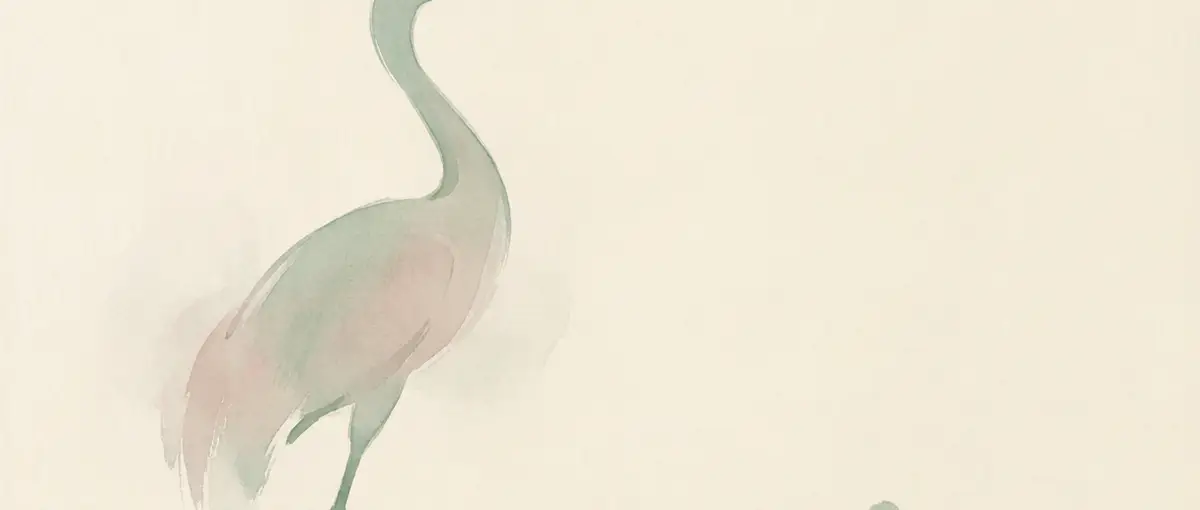
The crane in traditional culture is a bird written about again and again, but what gets written is never its feathers. Pine-and-crane for longevity, a crane standing among chickens, a crane drifting with the leisure clouds, plum as wife and crane as child—the ancients placed on the crane every posture of "aloofness, long life, unstained by mud." Unlike the dragon, which speaks of timing and power, the crane speaks more of a "stance": I can stand very high and very clean, even if there are not many companions nearby. It is not a personality summary of some type of person, but an image the Chinese literati used to settle their "unwillingness to settle." Get this identity straight first, and you will not later slip into labeling talk like "you are a proud, lonely crane."
What is The Crane?
"Crane standing among chickens" is mostly used today to praise someone as excellent, as if standing out in a group is purely something to be happy about. But if you have truly been in that position, you know that the moment you are called "special," what wells up first is usually not pride but loneliness. Among a group moving in lockstep, you are half a beat slow, you think differently, you do not want to join the excitement, so you get singled out—others admire, you feel suspended. The experience the crane corresponds to is that slight chill of "I am not one of them": not that you are bad, but that you will not grind your edges smooth to fit the same shape. This loneliness is not precious sensitivity; it is the price of refusing to merge. The ancients said it all with a single figure standing among the chickens.
Leisure Cloud, Wild Crane: Not Without Ambition, Just Not Wanting to Be So Busy
Another crane is the "leisure cloud, wild crane." It is often misunderstood as "without ambition," but it is closer to "not wanting to be so busy." The wild crane does not return to the cage not because it cannot fly, but because it would rather walk slowly by the clouds than enter that system of timed feeding and scheduled roosting. Today many people scramble into every kind of "circle"—dinner circles, tracks, cliques, rankings—terrified of falling behind, yet occasionally a thought flashes by: could I also be like that wild crane, not rushing, just staying off to the side? The crane here corresponds to a desire pressed very low by an efficiency-driven society: allowing yourself not to participate, allowing yourself to be slow, allowing your small patch of sky not to be exchanged for anything.
Pine and Crane for Longevity: Slowness Is an Undervalued Way to Live
"Pine and crane for longevity" ties the crane to long life. On the surface it is for auspiciousness, but underneath hides an overlooked way of living: slowness. The pine grows unhurried, the crane lives at ease; put them together and they describe a state of life that does not race against time. Our generation is chased by "do it early," "instant results," "don't fall behind," as if being a little slow means losing. But the crane reverses this: it does not chase, yet lives long and clean. This is not advising you to lie flat; it is reminding you that the "good" of some things lies precisely in not rushing. Stringing yourself into a full-drawn bow may not bring you closer to the life you want than a loosely standing old crane.
Refusing to Merge Also Means Facing Its Other Side
But "refusing to merge" also means facing its other side. If the crane's loneliness is romanticized too far, it turns into self-enclosure: deliberately not approaching anyone to seem aloof; pushing away even the connection you truly wanted, just to avoid the crowd. The reminder the crane image gives a person today is not "you should be alone," but "you may be alone, but tell the difference: do you stand apart because you are clear about what you want, or do you hide because you are afraid of being seen as you really are?" The former is a posture, the latter a shell. A crane stands by the water because that place suits it, not because it hates the people on the shore.
The Crane's Cry: It Calls Rarely, but Each Call Is Clear
The crane's cry is called li. The ancients said "the crane cries to the ninth heaven," its sound carrying far not because it is loud but because it is clear. Today many people fear silence, so they send messages, take positions, prove their presence without stop, as if not making a sound means not existing. The other experience the crane corresponds to is this: you can say little, but what you do say should be what you truly mean. One clear cry outweighs a whole day of noise. This composure of "quality over quantity" is rare precisely in an age when anyone can speak.
The Legend of the Crane Transformation: The One Who Wants to Change Back Was Always Human
There is an old legend. Ding Lingwei, after becoming an immortal, transformed into a crane and flew back to his hometown, landing on the huabiao pillar at the city gate, looking down at people no longer the ones he knew. What moves in this scene is not "becoming immortal" but "wanting to come back for a look"—having gone far, the softest thought in the heart turns out to be the wish to change back into that crane lightly resting on the pillar top. Today we rush forward and outward, yet occasionally at night a similar longing surfaces: not to go back and live, but to confirm we still recognize the shape of that first crane. That original self, the crane has kept it for us.
Clear Is Not Cold, Selective Is Not Absolute
It is easy to misread the crane's aloofness as coldness—not joining the fun equals heartless. But the crane in culture is never so reclusive as to hate the world; it simply selects. There are cranes by the pine, cranes by the plum; it has its own companions, it just does not enter any crowd at random. Today many people either force themselves to merge for fear of being left out, or cut all contact the moment they step back. The middle ground the crane offers is this: you can have very close people while keeping distance from the outside circles. Clear does not equal cold; selective does not equal absolute. Separate these two layers and the crane stands, and is worth learning from.
A Crane Stands by the Water Because That Place Suits It
The "refusing to merge" above easily makes people feel the crane actively distances itself from crowds. But from another angle, it simply found a place that suits it—by the water, under the pine, by the clouds. It did not hide from the world; it is just that in the world there happens to be a spot where it stands comfortably. Today we have too much "forced conformity" or "forced solitude," and too little of this "I chose where I stand." The calm the crane gives is not about alone or not, but that the position is one you acknowledged yourself. Knowing where you stand and why is far more important than the label "alone or with a group."
So writing about the crane is not writing "you are proud, therefore superior." It is writing about a state many people carry in their hearts yet hardly dare admit: sometimes you stand seeming alone not because your character is strange, but because you have not yet found the crowd worth moving toward, or you do not yet want to shave off a piece of yourself to fit some circle's shape. The ancients, with a thin, clean, lone-standing bird, left behind this dignity of "rather less, not indiscriminate." Our difficulty today perhaps lies in occasionally daring to admit to ourselves: this moment, I do not want to merge; standing like this is fine too.
What does the crane symbolize beyond longevity?
The crane can symbolize clarity, selective belonging, solitude, and a pace that does not need to imitate the crowd. It is not a claim that being alone makes someone superior; it is an invitation to choose company without abandoning yourself.
How can I be selective without becoming isolated?
Keep one or two relationships where you can be ordinary, and notice whether solitude restores you or only hides fear. You can decline a group without declaring every group unworthy.
Want to understand why fitting in feels like losing part of yourself?
If belonging always seems to require self-erasure, gentle self-exploration can help you find a circle where you do not have to become a copy.
Keep reading: Lotus: It Rises From the Mud, Untouched by It · The Dragon: Grow Your Scales Where No One Sees · The Deer: What You Chase Is Light — Don't Use Heavy Hands
Written and reviewed by DustEcho Editorial for self-reflection and cultural inquiry—not counseling, medical advice, or a clinical diagnosis.
Not sure where to begin?