The Tiger: When It's Time to Glare, A Smile Won't Do
DustEcho Editorial
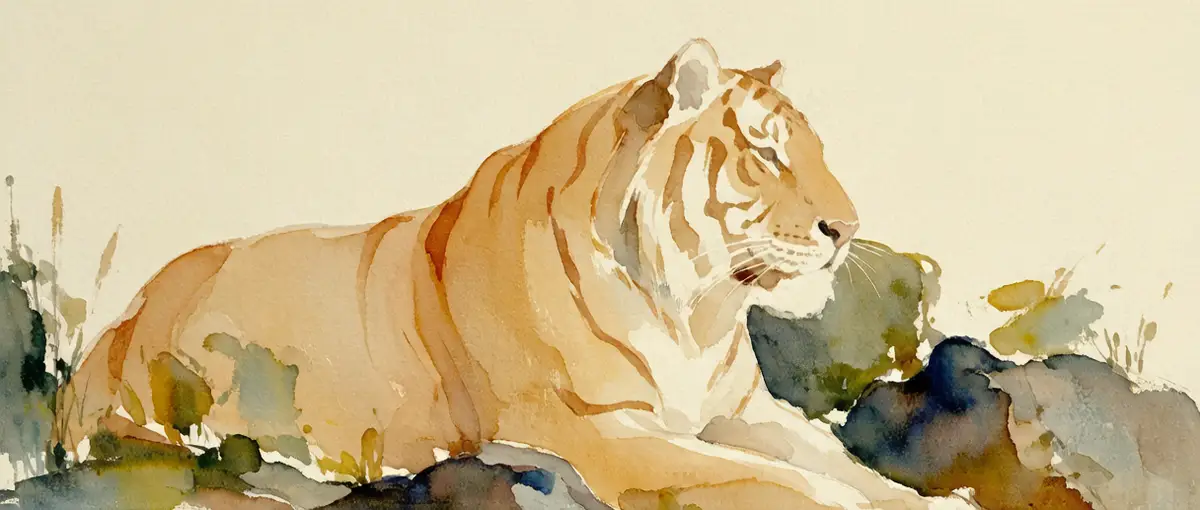
The tiger in traditional culture is an animal that holds the ground, and holds it directly. Paste a tiger on the door to ward off evil; children wear tiger-head shoes and tiger hats to be protected from intrusion; the military tally is made tiger-shaped to hold the "say one thing and it stands" authority in hand; in the mountains it is called "mountain lord," recognizing its unviolable might. The dragon governs change, the crane governs clarity, the deer governs spirit; the tiger governs "boundary"—a force that can be hard when it should be hard. It is not a temper label for some type of person, but an image about "self-protection": that bit of "no, this far and no further" in your body, the ancients made concrete as a beast with a king-character on its forehead. Get this identity straight, and you will not write the misreading "you are just a hot-tempered tiger."
The Tiger That Guards the House: You Need a Boundary of Your Own
"The tiger that guards the house" sounds a bit superstitious to modern ears, yet underneath is a very real need: you need a boundary of your own. Too many people live like a yard with no gate—anyone can come in and trample, anyone can pour their emotions onto you, anyone can send a late-night "you there?" and occupy your whole night. The experience the tiger corresponds to is that moment of finally having had enough and wanting to draw a line at some border: this far, allowed; further, no. That line is not coldness; it is the premise that lets you stay steady. A tiger guards its mountain not out of hostility, but because it needs its own territory, or it will be squeezed to the cliff's edge. You too need such a "mine" place—need not be big, but no one should be able to enter at will.
Turning Pale at the Mention of a Tiger: The Fear of Firmness Is Taught
"Turning pale at the mention of a tiger" is the reverse, speaking of fear. Interestingly, many people's fear of "firmness" was taught from childhood. As a child, a tantrum got "don't be fierce"; grown up, expressing dissatisfaction got "is it really that serious," so slowly "glaring" and "bad" were equated. The result: when you should stand up for yourself, you habitually smile, yield, gloss over, as if not doing so means you are not good. What the tiger corresponds to here is that suppressed, originally healthy aggression—it is not calling you to hurt anyone, but calling you, when crossed, to give a clear, non-pleasing response. If a person says "no" even with a smile and an apology, that boundary equals not drawn.
The Tiger Tally: Use Your Edge at the Key Moment
The tiger tally image actually gives "edge" a very restrained instruction manual: use your edge at the key moment, not everywhere. The tally moves thousands of troops because it acts only at the most critical juncture; a tiger does not pounce at everything either, most of the time it just lies down. Today many people are either too soft—endure everything—or swing to the other extreme—explode at everything. The tiger's image is instead balanced: it has authority, but not overused; it has teeth, but shows them only at the most critical moment. A mature person's "tiger authority" is not roaring at every turn, but at the moment of glaring, the eyes hold no hesitation, no pleasing. That certain, unexplained "stop" is more useful than a hundred roundabout refusals.
Tiger-Head Shoes: The Fiercest Image Protects the Softest Person
Interestingly, the ancients made the tiger into patterns on children's shoes and hats, using the fiercest beast to protect the tenderest cub. Underneath is a very warm logic: the boundary is not to hurt anyone, but to circle in what should be protected inside. Today many people think "setting a boundary" is an attack, so either they dare not set one, or they set it like a hedgehog. The other shape tiger-head shoes give is this: outwardly you can be clear, toothed, not-to-be-messed-with, but what you protect is the softness inside that does not want to be touched—toward family, toward your own time, toward the still-growing parts. Fierce and protective were always two sides of one thing.
The Paper Tiger: A Boundary You Bluff Up Collapses at a Gust of Wind
There is an old saying, "paper tiger," for those whose outward scare is empty inside. The healthy boundary the tiger corresponds to is exactly what most fears becoming a paper tiger: you do not actually have that line, just put on a show, and at a push you show fear and feel even more hollow. True tiger authority does not rely on volume, but on your truly recognizing that line and truly acting when crossed. A bluffed boundary is more tiring than none—you have to keep performing. The tiger stands on the mountain without a sound, yet no one dares casually climb, because its mere presence makes it clear. Fill the inside solid first, and the outside naturally holds.
The Three Laughs at Tiger Creek: A Boundary Is Not a Dead Wall
There is an old allusion, "the three laughs at Tiger Creek," about a rule that should have been "no crossing the creek" which one time was broken by laughter. Borrowing this, I want to say a boundary is not a dead wall: the tiger has its territory, but at the territory's edge there is also a creek, and moments to cross it laughing. Today many people either set boundaries so hard no one gets in, or soften and collapse entirely. If you take only the tiger's "fierce," it is narrow; what it truly teaches is this: draw the line clear, but on the other side of the line, know clearly whom to let across. Guarding and opening are both the same tiger's skill.
The Tiger's Quiet Carries More Weight Than Its Roar
Many think "tiger authority" equals a constantly open mouth. The reverse: the tiger in the mountains spends most of its time lying down, not roaring, not pouncing, yet no one dares casually cross its line. A person with real boundaries is also like this: not flying into rage at every turn, but at the moment of speaking up, the voice is quiet yet unmistakably clear. It is those who stay braced and snap at everyone who usually have the weakest lines. The tiger teaches a "quiet authority"—once you have established your presence itself, much crossing bends away before it even gets close. That majesty without anger is worth more than shouting yourself hoarse.
So writing about the tiger is not writing "you must be fiercer to be great." It is writing about a capability many people lack: when it is time to protect, not misplacing your tenderness. Tenderness and teeth were never in conflict—you are soft to those who deserve it because you chose to, not because you had no choice; you are firm to those who cross the line because that line you drew and recognized. The tiger stands there; the king-character on its forehead is not written for itself to see, but for all who would cross the line: this ground is mine to govern, please stop. Our difficulty today perhaps lies in recovering that clean glare when it is time—when it is time to glare, a smile is useless, and you have always known it.
What does the tiger symbolize beyond power?
The tiger can symbolize protection, dignity, boundaries, and the courage to be firm when softness is no longer enough. It is not an instruction to intimidate others; a useful boundary is clear, proportionate, and tied to what you will do next.
How can I set a firm boundary without becoming aggressive?
Name the behavior, the limit, and the consequence you control: “Please do not speak to me that way. If it continues, I will end the conversation.” Calm clarity is often stronger than a threat.
Want to understand why firmness feels cruel even when you are protecting yourself?
If you smile through every intrusion until resentment roars, gentle self-exploration can help you find the tiger before the explosion.
Keep reading: Lotus: It Rises From the Mud, Untouched by It · The Dragon: Grow Your Scales Where No One Sees · The Deer: What You Chase Is Light — Don't Use Heavy Hands
Written and reviewed by DustEcho Editorial for self-reflection and cultural inquiry—not counseling, medical advice, or a clinical diagnosis.
Not sure where to begin?