Jue: At the End of the Line, How That Last Breath Severs
DustEcho Editorial
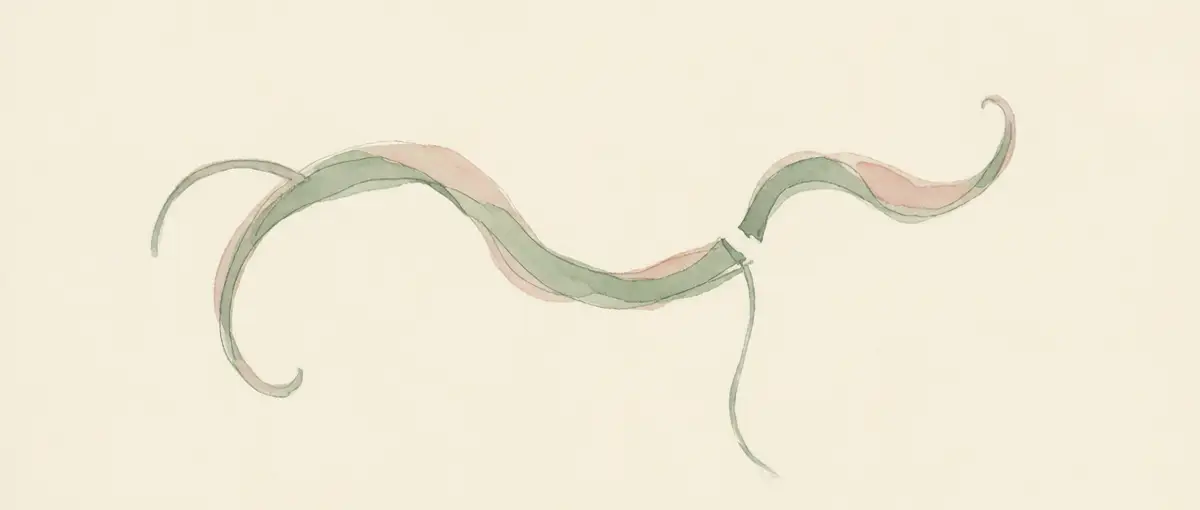
In the "Twelve Life Phases" (十二长生) system, which charts how the qi of the five elements is born, peaks, and decays, "Jue" 绝 is the station right after "Mu" 墓, the storing phase. Mu is the storehouse where the qi rests safely. Jue is when that qi reaches its limit and the single connecting thread is cut — like a vine snipped clean, or a river whose source is dammed. Not stored, but wholly disconnected. Jue is not destruction; it is the complete severing of an old tie. Brought into life, it names an experience everyone passes through: the moment a state, a relationship, or a version of yourself reaches the breaking point and can no longer connect.
What is Jue?
We often misread "it's cut" as "it's over," but the truth about Jue is this: it cuts, but it does not explode. The vine is snipped — not because the vine is broken, but because that one tie is gone. The river is dammed — not because the river is ruined, but because the old source no longer flows. Life is the same: a partnership formally dissolves; a relationship is cleanly divided, with no further entanglement; an old thought in yourself is fully let go, and you can no longer summon the energy to think it. None of these is destroyed. Jue has arrived — the breath has broken, and it is clear. Recognizing Jue means, when "it won't connect anymore," not to panic; to know this is only a disconnection, not a collapse. Too many fixate on "how could it be completely cut" and turn an ordinary breaking point into a tragedy, only to reconnect it themselves.
Jue in work: the road runs out
In career, Jue often arrives as "the full stop." A path walked for a long time loses its resources, its direction declared dead; a business fought over for ages is finally shut down for good. These moments leave no room for a comeback — the breath is broken, and it is clear. Many get stuck inside Jue through false continuation: the contract ended long ago yet they secretly keep serving the client; the business closed but they check its numbers every day — so the broken breath never truly finishes breaking. The wisdom of Jue is to cut clean at the stop and empty the space entirely, rather than hang on by a thread. The reverse happens too: the moment it breaks, some feel "utterly finished" and scramble to grab another root — and that Jue is misread as a dead end. Those who dare to cut clean are often not weak; they know roots were always going to age.
Jue in relationships: the bond is spent
In close relationships, Jue is usually the stage of "clean separation." Two people move from apart, to clearing even that last tie — no more back-and-forth, no more probing each other. The relationship moves from being held to being disconnected — not from hatred, but because it is spent. Many get stuck in Jue by wanting false continuation: clearly the bond is spent yet they keep the contact and watch daily; clearly it should be cleared yet they manufacture one more intersection — and so wear away the last dignity between them. What Jue asks is to admit the bond is spent, clear it cleanly, protect the relationship just broken. A little less hanging on, and it breaks clean by itself. The reverse happens too: the moment it breaks, some fear "I'll never meet anyone again" and grab blindly — and that Jue is misread as a dead end. Those who dare to cut clean are often not unloving; they fear more never having let it end well.
Jue in your own state: the thought breaks
Jue lives in a person, too. One day someone suddenly loses all drive for a fixation held a long time — a career change pondered for years, an obsession nursed for ages — and just like that, gently sets it down, never churning it again. A friend says, "You actually stopped bringing it up." That moment is their own Jue. It is not bad; it cannot bear a cold splash of "how could you give up so fast," yet the severing of that breath has already happened. Many good states die because the moment they break, the person reconnects them: just set down, then picked back up to over-analyze; just broken, then reasons dragged back. The patience Jue asks for is first to allow yourself "it is only broken, not lost." Protect that not-yet-clear emptiness, and it will truly break open.
What Jue fears most is "false continuation"
The easiest problem with Jue is hanging on when it should have broken: the career declared dead but kept alive, the bond spent but still hung on, the thought released but picked back up. This hanging on re-connects the breath that should have broken clean — because breaking is produced by letting go, not by hanging. What Jue needs is "cut clean": give it room, let that breath sever itself completely, rather than reaching out to continue it. Many good things are ruined by refusing to break, not by breaking too hard. So inside the experience of Jue, the lesson is not to keep continuing, but to hold back from reconnecting: let that breath break clean by itself, and you just stay beside it without pulling. The greatest fear is not the break itself, but a hand that "cannot break" repeatedly splicing the thread back. Those who cling to the past are often not deeply feeling — they are anxious. Failing to tell these two apart, they churn a just-arrived Jue into a "lotus root broken but threads still connected."
After Jue comes Tai — but Tai is not Jue's regret
In the cycle of the Twelve Life Phases, what follows Jue is "Tai" 胎 — a point of new qi quietly taking shape after the break is complete, like a seed pushing out its first embryo in the soil. This is not punishment; it is rhythm: only by completely breaking the old do you empty the space for the new. Recognizing the message Jue brings calms: you know what follows will sprout and be born — that is not failure, it is one round arriving at the position it was meant to empty. Many fear passing through Jue and treat it as "all over," when Tai is only the start of another round of growth. Admitting Jue will break clean makes people dare to break — because they know breaking is not vanishing, it is making room. So to live through a stretch of Jue, there is no need to hang on, nor to scare yourself — the next Tai, nurtured elsewhere, waits for you to sprout.
Don't read Jue as "all over"
Another easy pit is misreading Jue as "life ends here" — as if breaking means total loss. This both crushes the present and misreads the rhythm. Jue is only the breaking station among twelve; it is connected to other stations before and after: before it, Mu gently gathers it in; after it, Tai quietly nurtures it. To take Jue as total end is to miss the whole length of growth. Recognizing Jue is to treat it as a breaking point on the journey, not the destination itself. Break, empty, then turn nimbly — that is the composure Jue teaches.
In closing: the breath broke, and the space emptied too
The word Jue, brought into life, is that instant of "can't connect, cleared, completely severed." It is not mysterious, nor does it predict you must lose everything. It only reminds you: from tie to break, this single step carries its own weight. Don't panic because it "broke completely"; don't hang on because you "still want to connect." Catch every breaking moment, and your life will, crop after crop, always have its breaking points and always have its new sprouts.
What does Jue mean in everyday life?
Jue can be read as a clean ending: an old attachment, role, or direction has reached its limit and no longer needs to be kept alive by force. It is not a prediction of loss; it is a metaphor for making room after something is genuinely over.
How can I let go of something that has ended?
Name what is finished, stop reopening the same negotiation, and keep only the lesson or boundary that still serves you. If the ending involves grief or trauma that feels unmanageable, qualified support can help you move through it safely.
Want to understand why continuing can feel easier than closing the door?
If “maybe” keeps you trapped in an old loop, gentle self-exploration can help you tell the difference between hope and false continuation.
A more modern way to say it
Psychology speaks of "psychological detachment" and "closure": when a fixation, a relationship, or a direction ends completely, a person completes their psychological withdrawal by severing the tie — a necessary step to be released from the old loop and free up space, not a loss of ability. The teaching of Jue is only to tell the story of "when the qi is severed it breaks, and when it breaks it empties" once more, in the language of the five elements' birth and decay. It does not read your fortune; it only reminds you: that breath, once broken, is cleanest and shortest — don't panic, and don't go reconnect it.
Keep reading: Yang: Only After Soaking Up Earth and Water Does the New Sprout Slowly Take Shape · Fanyin: Just as you breathe easy, things flip to the other side · Fuyin: Some hurdles come back as if they were looking for you
Written and reviewed by DustEcho Editorial for self-reflection and cultural inquiry—not counseling, medical advice, or a clinical diagnosis.
Not sure where to begin?