Why do I stay up later the more exhausted I am
DustEcho Editorial
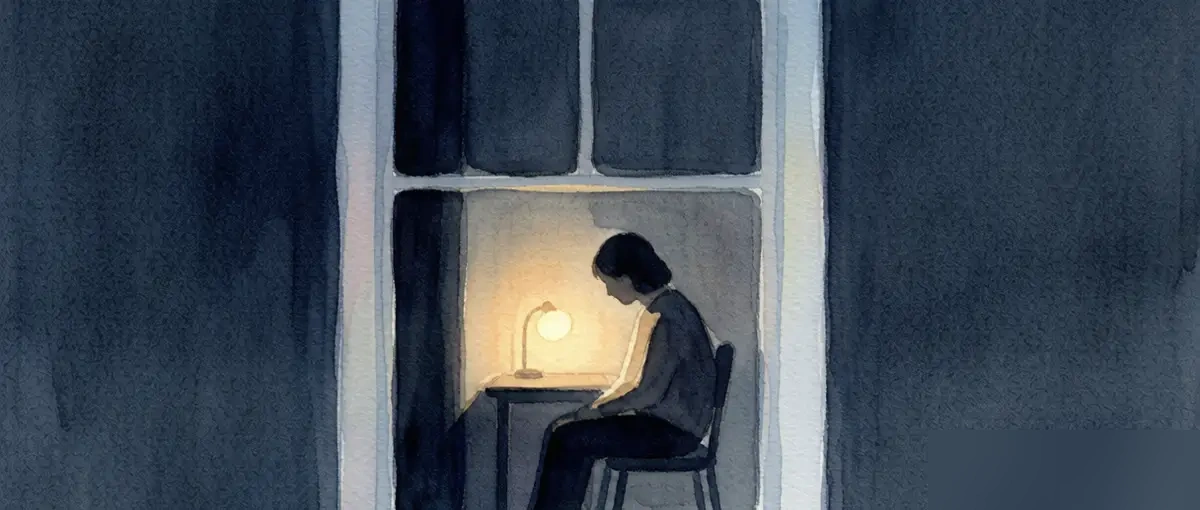
Your eyes are already heavy, yet your fingers keep scrolling. Not because there's something you must see — but because a small voice says: stay a little longer, the day isn't over yet.
Every minute of the daytime feels claimed by someone else in advance. Meetings, replies, fires to put out, tending to this and that — even a blank stare has to be squeezed into the gaps. By the time you collapse into bed, your body is weighted with exhaustion, but your mind suddenly wakes. It has been waiting all day for the one stretch when no one comes knocking.
Daytime is time you've lent out
You've probably noticed it: from Monday to Friday, the slices of the day that are actually yours are scarce. Even a sip of water waits for a work gap. This "being full" isn't an occasional accident; it's the default, day after day. So the bit of wakefulness at night becomes the only moment you can call "not belonging to anyone."
It's not that you're playful. You've gone too long without time that was purely your own, and your body remembers the deficit — at night it scrambles to make it up.
That quiet is the only room no one knocks on
In the daytime, the phone rings, the group chats buzz, anyone can reach you. Only late at night does the world hand back its quiet. You can do nothing at all, just lie there and listen to your own breathing. That "no one needs me" looseness is something daytime simply cannot offer.
So you hate to turn off the light. Turning it off means the day is officially over, means you return to tomorrow — chopped up and claimed by others. The late night is the one locked room in your day.
Not awake — just unwilling to end
Worth separating: you're not dealing with insomnia, you're "unwilling to end."
The insomniac lies there unable to sleep, thoughts spinning. You're different — you could sleep, but you actively push drowsiness back. The tiredness is real, but the thought "let the day run a little longer" is realer. Even ten more minutes of scrolling feels like quietly reclaiming a sliver that belongs to you.
That's why the more exhausted you are, the later you stay up. When you're drained, the sense of being occupied all day is sharper, so the nighttime compensation feels more precious — and harder to give up.
The loop: the emptier, the more you hold on
There's a hidden layer: the bigger the daytime deficit, the more the night "compensation" has to be enough, or it feels like the day was wasted again.
So an inversion sets in — the more tired the body, the less the mind will let go. You use staying up to confirm "I finally lived a bit for myself," even if the cost is tomorrow's fatigue. The loop spins lightly but is hard to stop, because what it feeds isn't laziness — it's a need that's gone unmet for a long time.
Why do I stay up late when I’m exhausted?
Late-night scrolling or staying awake can be a way to reclaim time that felt controlled by work, family, or other people all day. It is not a character flaw, but it can keep the exhaustion loop going. If sleep problems persist or impair daytime functioning, a qualified healthcare professional can help.
How can I reclaim personal time without sacrificing sleep?
Create a small “mine” period earlier in the evening—short, protected, and free of productivity goals. A consistent wind-down is easier when your day contains some ownership before the lights go out.
Want to understand why bedtime feels like giving your day away?
If sleep feels like the last thing other people get to take from you, gentle self-exploration can help you reclaim time without needing to stay awake to prove it is yours.
First, give that time back to yourself
Don't force early sleep right away. What you've lacked was never discipline; it was a stretch of time that was unapologetically yours.
Try carving something out in the daytime: no replies on the commute, screen off for ten minutes at lunch. Even a little tells your body "I'm a part that's set aside too," and the night's "grab a bit more" urge loosens.
As for late night — if it really is your only gap to breathe, don't rush to erase it. Acknowledge that it needs to exist, then nudge it earlier bit by bit. If tonight you still can't bear to sleep, at least know: what you're clinging to was never the screen, but the self that finally doesn't have to answer to anyone.
Keep reading: Why do I feel guilty the moment I rest? · Why do I feel more tired after I rest · Why Do I Feel More Anxious When It Gets Quiet
Written and reviewed by DustEcho Editorial for self-reflection and cultural inquiry—not counseling, medical advice, or a clinical diagnosis.
Not sure where to begin?