Xiushen: Coming Back to Yourself, One Small Repair at a Time
DustEcho Editorial
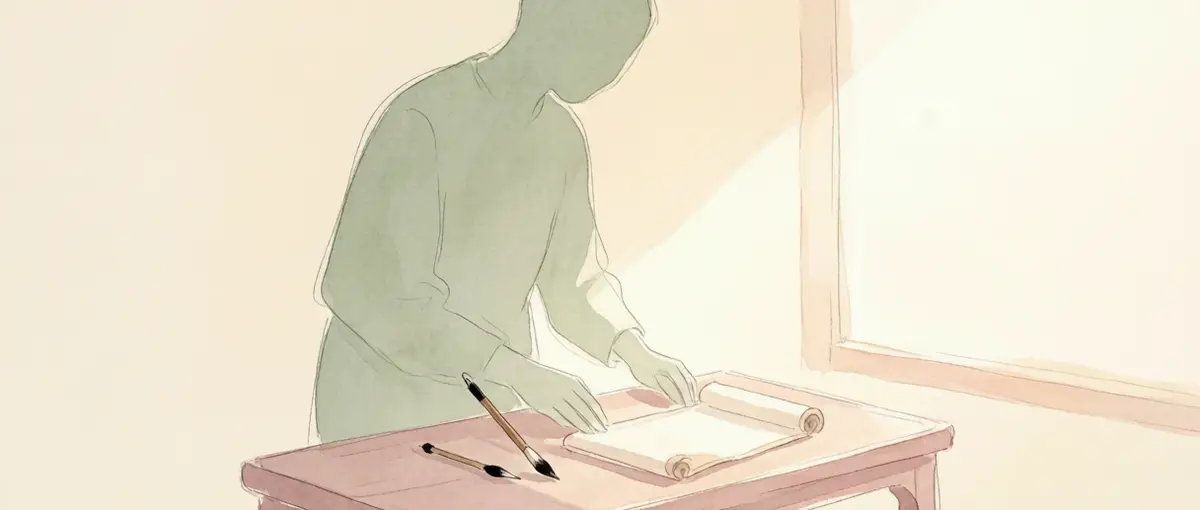
What does xiushen mean in everyday life?
Xiushen, often translated as self-cultivation, means turning attention back toward your words, habits, emotions, and responsibilities so you can live with more steadiness. It is not harsh self-discipline or self-punishment; it is a small, ongoing practice of caring for how you show up.
How can I practice xiushen without attacking myself?
Choose one repair that matters today: apologize, rest, keep a small promise, or pause before reacting. Explore the idea gently if “working on yourself” has started to sound like another voice putting you on trial.
Where it comes from
Self-cultivation sits in the middle of the eight steps laid out in the Confucian classic the Great Learning. Before it come investigating things, extending knowledge, making your intentions sincere, and setting your mind right. After it come ordering your family, governing the state, and bringing peace to the world. The Confucian view is simple but demanding: if you want to put the outside world in order, you have to put yourself in order first.
It is not a rigid rule so much as a willingness to turn around and tidy yourself up — the rough edges in your words and conduct, the habits lodged in your emotions, the apology you still owe someone. That is why cultivation is the part of the whole practice that sits closest to ordinary life.
We usually turn it into self-judgment
The moment someone mentions cultivation, many of us picture austerities: waking before dawn, fasting, denying ourselves, staring at a wall. As if you haven't suffered enough, you haven't really done it. But that misses the point. What a modern person most needs to cultivate is rarely some spectacular feat of willpower that would impress anyone. It is the small honesty we let erode in daily life.
The promise to yourself you keep postponing. The hurtful thing you said to someone close and never bothered to take back. The way you push through exhaustion instead of resting, telling yourself it's fine when it isn't. The first lesson of cultivation is to take these seemingly trivial debts seriously again. Cultivation, here, is not a trial where you are the defendant. It is care, the kind you would extend to someone you love.
Turning inward, not grasping outward
We have grown used to treating "getting better" as "getting more": more income, more recognition, a fuller calendar, a louder life. The feed rewards this. So does the culture of optimization, where every quiet hour feels like a wasted one. Cultivation runs the other way. It turns inward.
It draws the attention scattered across trending posts, group chats, and to-do lists back onto yourself. It draws the dependency on other people's judgments back into your own. This turning is not retreat and it is not avoidance. It is finally agreeing to take responsibility for what your life becomes, instead of handing that responsibility to luck and to other people's eyes. Only someone willing to turn inward can honestly be said to be moving forward, because everyone else is just being carried by the current.
It lives in the most ordinary day
Cultivation does not require incense and sitting in silence, though it can include those things. It might be the moment you decide tonight to put the phone down and sleep earlier, even though a part of you wants to keep scrolling. The moment you read the reply you wanted to fire off in a group chat, pause three seconds, and delete the sentence. The moment after a fight with your partner when you say out loud, I'm sorry, I lost my temper, instead of letting the silence harden.
These moves are so small they are nearly invisible. No one claps. Yet each one pulls you back from being pushed along by habit and seats you again in the driver's seat of your own life. The truth of cultivation is that it is not far away. It is whether today you are willing to take a little more responsibility for yourself than yesterday.
You cultivate habits, not a persona
Some people cultivate to build a persona — posting reading, workouts, and meditation to their feed, living like a polished poster of self-discipline. The danger is that the habit becomes a performance, and a performance needs an audience. But the moment no one likes it, those habits collapse, because the real reason for doing them was never internal.
Real cultivation is the opposite: it needs no audience at all. You run in the morning not to be seen. You read not to look deep. You apologize not to perform sincerity. Only when the purpose returns to "I want to live a steadier life" does cultivation actually sink into the body and become the bone that holds you up — invisible to others, but supporting you when nothing else will. The persona evaporates the instant the spotlight leaves. The habit stays, because it was always for you.
Don't let cultivation become self-attack
There is a bend here worth watching. If cultivation loses its measure, it can slide into self-attack — scanning your flaws every day, dissatisfied with everything, living as if you were writing a confession against yourself. The inner voice stops being a guide and becomes a prosecutor. Nothing you do is ever enough.
The Confucian idea of cultivation is colored by the ideal of the gentleman, and that ideal is composure, not self-flagellation. You tidy yourself because you take yourself seriously, not because you hate who you are. Cultivate from reproach and what grows is only tightness, a body held in permanent apology. Cultivate from care and what grows is ease with strength — the sense that you are on your own side.
When one person tends, those around get carried along
Cultivation looks like your own business, but it leaks outward whether you intend it to or not. When your emotions steady, your family absorbs fewer outbursts from nowhere. When you keep your word, colleagues trust you with more. When you stop exploding at every turn, relationships suffer fewer private injuries that never get named.
This is exactly why the Confucian order places cultivation before ordering the family and the state: when this one square is stable, the squares after it can stand. You cannot hand someone a calm you do not possess. So cultivation is never selfish, however solitary it feels in the moment. It is the most concrete gift a person can hand the people around them, given not in words but in the simple fact of being easier to be near.
It asks for no instant result
Cultivation is slow work, not a dose of medicine that cures at once. You sleep early one night and you are not reborn by morning. You apologize once and the relationship does not snap back immediately. You hold your temper and the old pattern does not vanish on contact. The return on cultivation is measured in years, not in notifications.
Only looking back a year later do you notice that the self who used to blow up at anything has gone noticeably quiet. Because it gives no instant feedback, it forces you to drop the greed for immediate effect and learn to persist for something longer. That patience itself is part of what gets cultivated. The practice trains you to care about a harvest you may not live to see, and that is its own quiet kind of freedom.
In the end, what you grow is steadiness
A person who cultivates steadily may not be visible to others. No halo, no medal, no before-and-after reel. But your own experience stays honest: the mind is less chaotic, relationships less shaky, and when something happens you no longer default to fleeing or exploding. The noise inside gets quieter not because life got easier but because you got wider.
What cultivation gives is not the pride of "I got better" but something quieter — steadiness. You know roughly what kind of person you are, and roughly which way to step next. That steadiness is something a whole lifetime of looking outward can never trade for, because the outward world keeps moving and the anchored self does not.
Cultivation is not the same as discipline
Discipline usually drives you; cultivation tends to you. Discipline says you must. Cultivation says you are worth it. The difference is in the motive: one comes from fear — if I don't cultivate, I'm finished, I'll fall behind, I'll be exposed — and the other from cherishing — I want to live a steadier life, and I matter enough to be looked after.
Fear-based discipline collapses easily, because fear exhausts the one who carries it. Cultivation grown from cherishing lasts, because it draws on a renewable source. So the entry to cultivation is not being harder on yourself, not adding one more whip to the rack. It is taking yourself more seriously, which is a very different thing from taking yourself less kindly.
It never demands you become perfect
Cultivation is often misread as becoming a flawless person, someone with no rough edges and no regrets. It is not. Even the gentleman in the Confucian ideal is not without faults; he is simply willing to keep tidying himself up, again and again. The goal was never sainthood.
You will still get impatient, lazy, regretful. You will still say the wrong thing sometimes. But you care, and you want to be a little better next time, and that wanting is the whole practice. The end of cultivation is not perfection but walking the road of getting better honestly, even if slowly. Someone willing to slow down and tidy themselves goes further than someone who sprints and keeps collapsing, because the sprinter is running from himself and the cultivator is walking with himself.
Cultivation is the ground you give your relationships
When you steady yourself, the people closest to you feel it first with their bodies, before any of it is spoken. You no longer ignite at a touch, so your partner absorbs fewer stray fires and sleeps better for it. You keep your word, so friends dare to entrust you with more of what matters. You no longer flee at the first sign of trouble, so your child learns from you to hold emotions too, instead of learning to hide them.
Cultivation looks like tending only yourself, but it spills outward as a calming presence that other people can stand near without bracing. Someone willing to tidy themselves lets the people around them quietly exhale. The gift is not a lecture about how to live. It is the simple relief of your company.
Cultivation begins by accepting who you are right now
Cultivation easily becomes a rejection of the present: I'm not good enough as I am, so I must cultivate, so I must become someone else. But if the ground is rejection, cultivation soon curdles into contempt, and contempt is just self-hatred wearing a virtuous mask. You end up polishing a self you secretly despise, which is its own kind of suffering.
A better starting point is acceptance: I acknowledge how I am now, with the impatience and the laziness and the regrets, yet I'm willing to walk forward with myself a little. What you cultivate is not a mess to be thrown away but a self worth treating well. Cultivate from acceptance and every step is light, because you are not fleeing — you are tending. And a light step carries you further than a frantic one.
A small step you can take starting today
You don't need to wait for an auspicious day, a new year, a Monday, or a version of yourself that has it together. Tonight, put the phone a little farther from the bed. Tomorrow, send one true sentence to the person you've long wanted to apologize to, the one you keep rehearsing and deleting. Or simply do that small thing you've put off for three days, the one that shrinks a little every time you think about it.
Cultivation was never an exam to pass, with a grade and a rank. It is only that, amid the noise of life, you sometimes bend down and smooth the loose threads of your own. When the threads are smoothed, the days stop knotting up so much. You don't become a different person. You become the person who, bit by bit, takes himself back.
Keep reading: Bianyi: What You Thought Was Nailed Down Has Been Moving All Along · Buyi: When Everything Turns on You, Something Ought to Stay · Compassion: The Warmth You Hand a Struggling Friend, and Withhold From the Person in the Mirror
Written and reviewed by DustEcho Editorial for self-reflection and cultural inquiry—not counseling, medical advice, or a clinical diagnosis.
Not sure where to begin?