Qijia: The Slow Practice of Turning 'Me' Into 'We'
DustEcho Editorial
Where it comes from
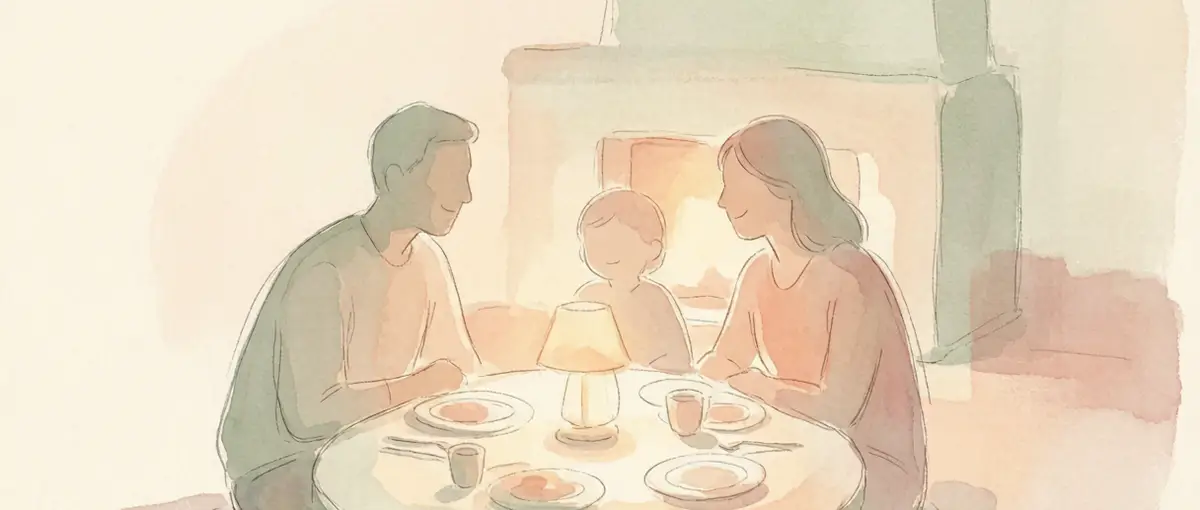
Qi-jia sits immediately after self-cultivation (xiu-shen) as the fourth of the eight steps laid out in the Great Learning (Da-xue). The early Confucians arranged a life into a sequence: put your own house in order first, and only then do you have the grounding to settle your household; once the household is settled, you can begin to attend to the world beyond. The eight steps run from investigating things inward, through the self and the family, and outward toward the state and the world — and qi-jia is the hinge where private virtue finally turns toward a shared life. In ancient times, "home" meant the whole clan; today it looks more like the few relationships closest to your skin — a partner, children, parents, or the people you live with. Qi-jia is simply the insistence that this most private stretch of human relationship also deserves to be tended with real care.
We tend to imagine qi-jia as controlling the people at home
The moment someone mentions qi-jia, it is easy to slide into control: the child should follow my plan, the partner should drop the habits that annoy me, the parents should take my advice. But that is not qi-jia — that is treating home as your own territory. The real premise of qi-jia is the opposite: first you govern your own impulse to remake everyone else. When you yourself are steady, the atmosphere at home shifts on its own. The harder you try to arrange other people, the more they want to slip away. The hardest first lesson of qi-jia is to admit that everyone in your home is a separate person, with their own mind and their own right to be unlike you.
Qi-jia is the continuation of self-cultivation, not a separate project
Plenty of people are gentle and polite out in the world, then walk through the front door and turn back into themselves — they can hold their temper with colleagues but flare at a partner; they listen in meetings but never at home. That is not qi-jia; that is saving your worst mood for the people you love most. Qi-jia reminds us that the composure you practice outside the door has to come inside with you. The patience you extend to strangers, your family deserves at least as much of. Split self-cultivation apart from qi-jia and home becomes the dumping ground for your emotions, the one place you allow yourself to be unguarded in all the wrong ways.
What it tends is the gap between us
Even the best relationship has seams. You want steadiness; he wants freedom. You like to talk things through; she likes to stew in silence. Qi-jia does not try to erase these differences — it lets the air pass through the cracks without letting the rain in. It might be the agreement you make to never let a fight last past midnight. It might be finally learning, when your parents nag, not to talk back but to change the subject. It might be accepting that your child is simply not the person you imagined. Most of qi-jia's daily work is not grand events but these seams being mended, gently, again and again, until the small kindnesses outnumber the small injuries.
Making peace with the family you came from is also qi-jia
For many people today, the qi-jia work is not in the small family they built but in the family they came from. You try to understand the limits of your parents' generation, and stop reopening childhood wounds just to hurt yourself with them. You learn to listen for two more sentences on the phone instead of slamming the door on every argument. This reconciliation is not surrender; it is setting down what they owed you, so your hands are free to tend the home you have now. The outward reach of qi-jia very often begins right here, in the quiet decision to stop litigating the past.
Qi-jia does not mean erasing yourself
A common misunderstanding: to qi-jia you must give in completely and smooth yourself away. That is wrong. A person who vanishes entirely inside a relationship cannot hold up any home. Qi-jia asks for "we" to step one pace further than "me" — not for "me" to disappear. You have your boundaries; the other person has theirs. The overlapping ground between those two boundaries is where a home truly grows. Keep your boundaries and the home has a skeleton; yield half a step for the other and the home has warmth. Both are required, and neither is the whole of it.
A well-ordered home is a kind of backing
When qi-jia is done well, it gives you a backing that lets you walk outward without panic. You know someone has your back. You know you will not be cross-examined on your return. You know even your worst mood will be caught. Many people scramble to prove themselves outside precisely because home is shaky, hoping outside applause will fill an inside hollow. The reverse is also true: people whose homes are steady are less driven to prove anything. Qi-jia settles the rear so you can set out a little lighter, trusting that the ground behind you will hold.
What it gives is not perfection but a place to exhale
Done well, qi-jia does not turn home into a showroom with no conflict. What it gives is something plainer: you know that no matter how chaotic the outside gets, you can push the door open and someone will hear you out. You know there are shames you do not have to perform strength through in front of family. The final landing place of qi-jia is making home a place you return to in order to breathe — not a place you return to more exhausted. That steadiness is something no outside achievement can replace, because no achievement ever waits up for you at night.
What qi-jia fears most is silence
Many homes do not break up in fights; they go cold. No one argues, and no one speaks. Each scrolls their own phone; no one bothers to discuss anything big or small. This silence hurts more than fighting, because behind it sits an unspoken "what's the point, you never listen anyway." What qi-jia must protect is exactly that small willingness to still talk, to still confer. Even a fight is better than never opening your mouth. A home that can still put things into words is a home that can still be saved, because language is the thread that holds a "we" together.
It changes shape with the life stage
Qi-jia is not one fixed assignment. When the children are small it is feeding and caring for them; in adolescence it is restraining yourself from controlling; when parents grow old it is you being cared for in return. The same person must learn a completely different qi-jia at each stage. Do not run one old method for a lifetime; when the family changes, your way has to change with it. Qi-jia is a lesson you keep having to relearn; the more you refuse to learn, the less the home will hold together, and the more everyone quietly drifts.
Qi-jia is also a form of self-care
We always cast qi-jia as giving, as if it is all me making allowances. In truth qi-jia also takes care of you. A harmonious home is somewhere you can go back to after a draining day — not another battlefield. The care you spend sorting the relationship out benefits you too. You stop bracing the moment you walk in; you stop burning yourself up over small things. Qi-jia is not one-sided sacrifice; it is the two of you holding each other up, so that the daily weight feels lighter than it would alone.
The most overlooked person in qi-jia is yourself
Qi-jia says a lot about being considerate to others, but do not leave yourself out. Many people, for the sake of qi-jia, swallow all their own tiredness and grievance; in time the home is orderly but the person is empty. Qi-jia is not about your disappearing; it is about leaving a distance between you and the other that is comfortable for both. Take care of yourself first, and only then do you have anything left to give the home. A person burnt to a crisp cannot hold up real qi-jia, no matter how placid the surface looks.
Qi-jia is a slow craft
Do not expect one deep talk to put the home in order. Relationship is an everyday matter — a little better today, maybe knocked back tomorrow. Qi-jia is like a slow craft, built on countless tiny adjustments: one less cutting remark tonight, one more greeting tomorrow morning, one more meal eaten together this weekend. It does not hinge on some grand gesture to turn things around; it hinges on your willingness to keep showing up and sorting the days out little by little. It cannot be rushed, and it cannot be paused — the thread is kept alive only by being picked up again tomorrow.
What does Qijia mean in everyday life?
Qijia can be read as the slow practice of turning “me” into “we” without erasing the self. It is the work of making close relationships more livable, reciprocal, and able to hold ordinary conflict.
How can I make home feel safer without doing all the emotional work?
Choose one concrete repair—listen without fixing, name a household expectation, or ask for a fair division of care. A home becomes steadier through shared responsibility, not one person silently managing everyone.
Want to understand why home feels like another battlefield?
If you can care for everyone except yourself, gentle self-exploration can help you make room for your own needs inside the “we.”
Start with one small thing today
You do not have to wait for a new apartment, for the child to grow wise, for the parents to become open-minded. Tonight, put down the phone and really hear your partner finish that work complaint you have actually heard before. This weekend, call your parents without it being a chore. Answer your child's "why" one more time. Qi-jia was never some grand project; it is simply the extra bit of care you are still willing to spend in front of the people you know best. That care, accumulated day by day, is how a home slowly comes into order — how "me" is quietly, stubbornly expanded into "we."
Keep reading: Bianyi: What You Thought Was Nailed Down Has Been Moving All Along · Buyi: When Everything Turns on You, Something Ought to Stay · Compassion: The Warmth You Hand a Struggling Friend, and Withhold From the Person in the Mirror
Written and reviewed by DustEcho Editorial for self-reflection and cultural inquiry—not counseling, medical advice, or a clinical diagnosis.
Not sure where to begin?